
The Banksy.com Domain Dispute: Navigating Cybersquatting and Brand Identity in the Digital Age
In the vibrant, often chaotic world of street art, few names command as much intrigue and global recognition as Banksy. The anonymous British graffiti artist, political activist, and film director has carved out a unique space in contemporary culture, his works fetching astronomical prices and sparking conversations worldwide. Yet, even an artist as elusive as Banksy is not immune to the complexities of brand protection in the digital realm. The battle for control over the seemingly innocuous domain name, Banksy.com, offers a compelling case study in cybersquatting, trademark law, and the challenges of maintaining a digital identity for an anonymous public figure.
The saga began with the filing of a Uniform Domain-Name Dispute-Resolution Policy (UDRP) complaint against the current owner of Banksy.com. While initial reports surrounding the complaint’s origin were shrouded in a degree of typical Banksy-esque mystery – with some speculation suggesting the filing might have initially been from an imposter or faced authenticity questions – the official record confirms the case was ultimately filed by Banksy Inc (C/O Pest Control Office Limited). This entity is widely recognized as the artist’s official agent and the sole authenticator of his artwork, lending significant weight to the legitimacy of the complaint. Pest Control Office is also actively pursuing a U.S. trademark for the name “Banksy,” a critical step in solidifying the legal grounds for their claim over the domain.
Understanding the Uniform Domain-Name Dispute-Resolution Policy (UDRP)
At the heart of this dispute is the UDRP, a mechanism established by the Internet Corporation for Assigned Names and Numbers (ICANN) to resolve conflicts arising from the abusive registration of domain names. Unlike traditional litigation, the UDRP offers a streamlined, relatively inexpensive, and efficient process for trademark owners to reclaim domain names that have been registered in bad faith. For a complainant to succeed under the UDRP, they must prove three key elements:
1. The Domain Name is Identical or Confusingly Similar to a Trademark
The first hurdle for Banksy Inc is to demonstrate that “Banksy.com” is either identical or confusingly similar to a trademark in which they have rights. Given the global recognition of the artist’s moniker and the ongoing efforts by Pest Control Office to secure a U.S. trademark, this element is often the most straightforward in such cases. The very essence of the domain name directly incorporates the artist’s renowned pseudonym, creating an immediate and undeniable link to his brand. The intent behind this requirement is to prevent consumers from being misled or confused about the origin, sponsorship, or endorsement of a website.
2. The Registrant Has No Rights or Legitimate Interests in the Domain Name
The second, and often more contentious, element requires proving that the current registrant of Banksy.com has no legitimate rights or interests in the domain name. If you navigate to Banksy.com right now, you won’t find a digital gallery of street art or an official portal for the artist. Instead, visitors are greeted by a website dedicated to the entirely unrelated topic of “banks” – financial institutions. This stark thematic disconnect is crucial evidence. Legitimate interests typically include using the domain for a bona fide offering of goods or services, being commonly known by the domain name, or making a legitimate non-commercial or fair use of the domain without intent for commercial gain or to mislead consumers. A site about financial institutions under a name globally synonymous with a street artist strongly suggests a lack of legitimate interest in the name “Banksy” itself.
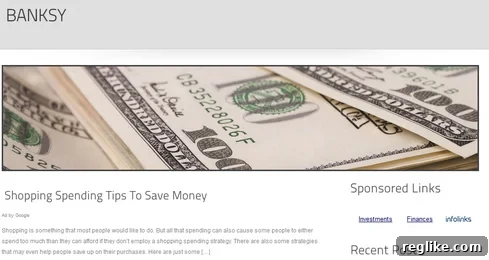
The domain’s history further complicates matters. Banksy.com was initially registered in 2002, expired, and was subsequently re-registered in 2006. It is currently registered to an entity identified as “Banksy Blog” in Quebec. The mere presence of “Blog” in the registrant’s name could be argued as an attempt to establish some form of legitimate interest, perhaps as a fan site. However, if the site’s content bears no relation to the artist Banksy, this argument quickly crumbles under scrutiny. The timing of the re-registration in 2006, a period when Banksy’s fame was undeniably on the ascent, might also be considered by the UDRP panel as suggestive of opportunistic registration.
3. The Domain Name Was Registered and is Being Used in Bad Faith
The final and often most challenging element is proving that the domain name was registered and is being used in bad faith. Bad faith can manifest in various ways, such as registering a domain primarily to sell it to the trademark owner for a profit (known as “domain parking” or “typosquatting”), to prevent a trademark owner from reflecting their mark in a corresponding domain name, or to disrupt a competitor’s business. In this case, the disparity between the domain name (Banksy) and the website’s content (financial banks) could be interpreted as a deliberate attempt to capitalize on the artist’s brand recognition, either to attract traffic through confusion or to hold the domain hostage for potential sale to the artist. The UDRP panel would scrutinize whether the registrant was aware of the artist Banksy at the time of registration and whether their use of the domain was intended to mislead or profit from the artist’s goodwill.
The Uniqueness of Banksy’s Brand and the Role of Pest Control Office
Banksy’s anonymity adds a fascinating layer of complexity to this UDRP case. Unlike most public figures or corporations, his identity is a closely guarded secret, making the establishment and defense of his brand identity a unique challenge. However, this has not deterred the growth of his global brand. The official authentication service, Pest Control Office, serves as the critical nexus for validating his works and managing his public persona. Their active pursuit of a U.S. trademark for “Banksy” is not just a formality; it significantly strengthens the legal standing for claiming ownership over digital assets like domain names. A registered trademark provides a clear, legally recognized claim to the brand, making it much easier to prove the “trademark rights” element of a UDRP complaint.
The immense value associated with Banksy’s physical art further underscores the significance of controlling his digital presence. His works regularly sell for hundreds of thousands, if not millions, of dollars at auction. In the digital age, a domain name like Banksy.com is not merely an address; it’s a vital piece of intellectual property, an official portal for information, and a critical component of brand integrity. Allowing an unrelated entity to control such a pivotal domain could lead to fan confusion, dilution of the brand, and potentially enable unauthorized commercial exploitation.
Cybersquatting: A Persistent Threat in the Digital Landscape
The Banksy.com dispute is a microcosm of a much broader issue: cybersquatting. This predatory practice involves registering, trafficking in, or using a domain name with bad-faith intent to profit from the goodwill of someone else’s trademark. It remains a persistent challenge for businesses, celebrities, and artists alike. For an artist of Banksy’s stature, with a globally recognized, distinctive name, the protection of his online identity is paramount. Without control over key domain names, the risk of misinformation, fraudulent merchandise, or simply diverting fan attention to irrelevant content becomes substantial.
While the UDRP process is designed to be efficient, the nuances of each case can lead to lengthy deliberations by WIPO (World Intellectual Property Organization) panels. The outcome for Banksy.com will not only impact the artist’s control over his online presence but also provide valuable precedents for future domain disputes involving unique public figures and anonymous brands. It raises critical questions about how established trademarks, even those associated with individuals who intentionally operate outside traditional structures, can be effectively safeguarded in the ever-evolving digital frontier.
The Anticipated Outcome and Broader Implications
The resolution of the Banksy.com UDRP case will be keenly watched by intellectual property lawyers, brand managers, and fans alike. If Banksy Inc, through Pest Control Office, successfully demonstrates all three elements of the UDRP, the domain name will likely be transferred to them. Such an outcome would reinforce the principle that trademark owners have a fundamental right to control online representations of their brands and that opportunistic domain registration will not be tolerated under international dispute policies.
This case serves as a powerful reminder of the imperative for all brand owners, regardless of their public persona or modus operandi, to proactively protect their digital assets. For artists like Banksy, whose very mystique is part of their brand, securing official online channels is not just about convenience; it’s about preserving artistic integrity, combating potential fraud, and ensuring that their authentic message reaches their global audience. The battle for Banksy.com is more than just a domain dispute; it’s a testament to the ongoing struggle for identity and control in a world where digital presence is increasingly synonymous with real-world recognition and value.