
The Domain Name Aftermarket: A Potential Vulnerability During Economic Downturns
In periods of significant economic uncertainty, every sector of the global market undergoes rigorous scrutiny. The digital economy, often perceived as an engine of growth and resilience, is not entirely immune to these pressures. A recent virtual investor day hosted by GoDaddy, a dominant force in domain registration, web hosting, and online services, provided critical insights into how the ongoing economic climate, heavily influenced by the COVID-19 pandemic, is impacting various facets of its business. A key takeaway from their presentation underscored a potential vulnerability within the domain name aftermarket, suggesting it could become a distinct weak spot during a prolonged economic contraction.
The core discussion centered on the unprecedented challenges presented by the COVID-19 crisis, analyzing its immediate and projected long-term effects on the digital infrastructure that powers millions of businesses worldwide. While the digital realm has largely proven its indispensability, particularly as global lockdowns accelerated the shift to online operations, certain segments, like the domain aftermarket, face unique headwinds that warrant deeper exploration.
GoDaddy’s Financial Resilience: Navigating Initial COVID-19 Impacts
GoDaddy’s Chief Financial Officer, Ray Winborne, offered a detailed financial overview, highlighting the company’s performance during the initial phases of the pandemic. For the first quarter, the impact of the global health crisis on GoDaddy’s operations and revenue was remarkably minimal. The company anticipated its revenue to land comfortably within a $5 million range of its $795 million guidance, a testament to the fundamental stability of its business model. This resilience is largely attributed to GoDaddy’s strong emphasis on recurring revenue streams, primarily derived from domain renewals, web hosting subscriptions, and other essential online services.
Existing customers, recognizing the critical importance of maintaining their online presence in an increasingly digital world, largely continued to renew their services. This consistent demand for foundational digital infrastructure provided a robust financial buffer against the initial economic shockwaves. However, the outlook for the second quarter presented a more nuanced and challenging picture. GoDaddy projected a more significant financial impact, estimated to be approximately $25-$30 million. This anticipated dip reflects the deepening and more widespread economic repercussions of prolonged lockdowns, reduced consumer spending, and general market uncertainty that began to fully manifest later in the first quarter and extend into the second.
Despite these projected headwinds, the company expressed confidence in its core business, particularly its renewal segment, which is expected to remain largely stable without significant changes. The primary area of concern regarding revenue generation was identified as a “mild softness” in new sales. This suggests that while established online entities are largely holding firm, the pace of new business formation or the expansion of digital footprints by existing ventures might slow as individuals and businesses adopt a more cautious and conservative approach to new investments and expenditures.
The Domain Name Aftermarket: A Deeper Dive into Vulnerability
The most pronounced area of concern articulated by GoDaddy’s leadership was the domain name aftermarket. This segment of the industry involves the buying and selling of previously registered domain names, often at premium valuations that far exceed standard registration fees. These transactions are typically driven by a variety of factors, including strategic branding for businesses, investment speculation by domain professionals, or the acquisition of highly sought-after, memorable, or keyword-rich web addresses.
The inherent characteristic of “higher price points” within the aftermarket makes it particularly susceptible to economic contractions. In a recessionary environment, businesses universally prioritize cash conservation, cost-cutting measures, and the deferral of non-essential expenditures. Investments in premium domain names, often viewed as discretionary rather than critical operational costs, are frequently among the first items to be postponed or reconsidered. Startups, facing tighter budgets and increased uncertainty, might opt for readily available and less expensive domain names rather than committing substantial capital to acquire a prime aftermarket name.
Similarly, established corporations might delay significant rebranding initiatives or expansion plans that necessitate the acquisition of a specific, high-value domain. Domain investors, a crucial part of the aftermarket ecosystem, also tend to become more cautious during downturns. Facing broader market uncertainties and potentially limited capital, they may reduce their buying activity, impacting overall market liquidity. There’s also the possibility that some domain owners, facing personal or business financial strain, might be compelled to divest their premium domain assets, potentially increasing supply and exerting downward pressure on prices across various categories, including generic, brandable, and industry-specific names. This dynamic creates a challenging environment for brokers, auction platforms, and private sales alike, leading to lower sales volumes and potentially depressed values.
Operational Challenges: The Impact of Remote Work on Productivity
Beyond the direct financial implications, GoDaddy also highlighted significant operational challenges arising from the global shift to widespread remote work. While many technology-centric companies were already accustomed to flexible work arrangements, the rapid and mandatory transition of an entire workforce to a work-from-home model introduced immediate and ongoing productivity drags. The initial phase involved ensuring that all employees had adequate home office setups, reliable internet connectivity, and the necessary tools and software for seamless collaboration and communication.
However, the challenges extend beyond mere logistical setup. Maintaining team cohesion, fostering organic innovation, ensuring effective knowledge transfer, and managing performance in a fully distributed environment present complex, persistent hurdles. While companies like GoDaddy have demonstrated remarkable adaptability, the initial shock and the continuous refinement of remote work strategies can impact overall efficiency, delay project timelines, and affect the fluidity of day-to-day operations. This “drag” on employee productivity, while not a direct line-item revenue loss, can accumulate into significant indirect costs over time, potentially manifesting as delayed product launches, reduced customer service response times, or increased operational overheads required to support a decentralized workforce. GoDaddy, like many global enterprises, has had to swiftly implement and evolve strategies to support its vast employee base, maintain its high standards of customer service, and continue its trajectory of technological advancement amidst these new operational realities.
Entrepreneurship in Adversity: A Resilient Spirit
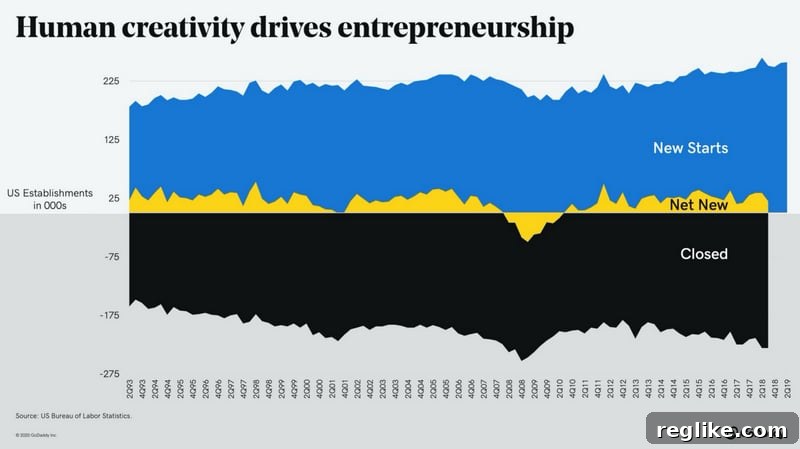
Despite the array of challenges, GoDaddy’s investor presentation also brought forth a compelling and optimistic counter-narrative: the enduring spirit of entrepreneurship. A key visual from their presentation, featuring U.S. government data, clearly demonstrated that individuals and small teams continue to launch new businesses even during severe economic downturns, including the profound period of the Great Recession. This finding is profoundly significant for GoDaddy, as it underpins the fundamental, unwavering demand for its core services: new domain registrations, website builders, and hosting plans.
Economic recessions, while destructive in many respects, paradoxically often act as powerful catalysts for innovation and new venture creation. Individuals who may have been laid off from traditional employment might turn to entrepreneurship out of necessity, leveraging new skills or pursuing long-held business ideas. Moreover, crises like the pandemic often create entirely new market needs and accelerate existing trends, such as the monumental shift to online interaction and commerce. This environment fosters a fertile ground for digital-first businesses, from burgeoning e-commerce stores to online service providers and content creators, all of whom critically depend on a robust online presence.
For these new ventures, a domain name and web hosting are not discretionary luxuries but rather essential foundational elements. This consistent and often accelerated creation of new businesses provides a vital baseline demand for GoDaddy’s services, helping to offset some of the softness experienced in other, more discretionary segments of the market. It underscores the intrinsic human drive to build, adapt, and innovate, even in the face of profound adversity.
The Unpredictable Recovery: Navigating Uncharted Economic Waters
A crucial point emphasized during GoDaddy’s investor day was the unprecedented and unique nature of the COVID-19 crisis. Unlike previous recessions, which often stemmed from financial bubbles or specific market failures, the current downturn is primarily a consequence of a global public health crisis and the extraordinary, widespread measures taken to contain it. This fundamental difference makes predicting the precise shape, duration, and window of economic recovery exceptionally complex and challenging.
Economists and business strategists worldwide grapple with various potential recovery scenarios: a sharp “V-shaped” recovery characterized by a quick rebound; a more gradual “U-shaped” rebound, indicating a prolonged period of subdued activity before recovery; or even a “W-shaped” scenario, where multiple waves of infection lead to recurring peaks and troughs in economic activity. The concept of a “K-shaped” recovery, where certain sectors and demographics thrive while others significantly struggle, also looms large as a distinct possibility. This profound level of economic uncertainty directly impacts virtually every aspect of business planning, including consumer confidence, corporate investment decisions, and expansion strategies. For the digital economy and the domain name market, this unpredictability necessitates extreme agility and strategic foresight. GoDaddy, like other forward-thinking global companies, must build robust contingency plans and adaptable strategies, preparing for a multitude of potential eventualities rather than relying on a single, definitive recovery forecast.
Conclusion: Vigilance and Adaptability in the Digital Frontier
GoDaddy’s investor day offered a candid and transparent analysis of the evolving economic landscape as viewed through the critical lens of digital infrastructure. While the company’s core business, heavily reliant on essential domain renewals and hosting services, continues to demonstrate commendable resilience, the domain name aftermarket emerges as a segment highly susceptible to economic pressures due to its inherent higher price points and discretionary nature. Simultaneously, the operational adjustments required for widespread remote work demand ongoing attention to maintaining productivity and fostering innovation.
Nevertheless, the enduring human drive to create, innovate, and adapt, even during the most challenging times, provides a powerful counterbalancing force. This ensures a continuous stream of new businesses requiring a robust online presence, thereby sustaining a vital baseline demand for GoDaddy’s foundational services. The profound unpredictability of the COVID-19 recovery necessitates unwavering vigilance, unparalleled adaptability, and astute strategic foresight from all participants in the digital economy. Understanding these intricate dynamics is absolutely crucial for domain investors, small business owners striving for online success, and large corporations navigating the complexities of the current global economic climate as they collectively shape the future of the digital frontier.
For a deeper dive into the company’s insights and detailed projections, the full investor presentation can be accessed here (pdf).