
Verisign Navigates Shifting Waters: Modest Growth Predicted Amidst Global Headwinds
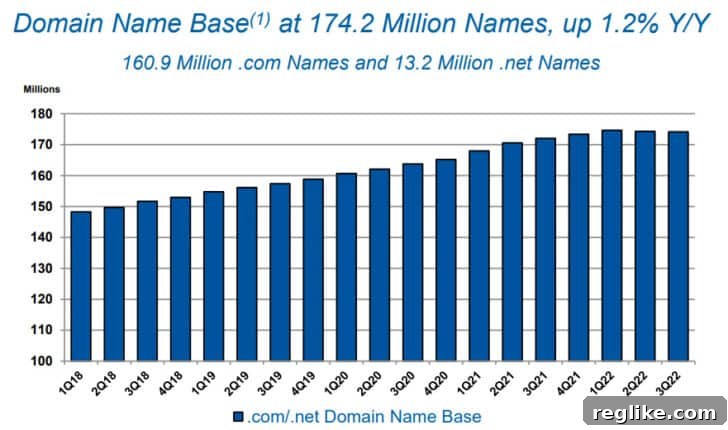
Verisign (NASDAQ: VRSN), the foundational pillar behind the internet’s most critical domain extensions, released its third-quarter earnings report following the market close today. The announcement provided investors and industry observers with a comprehensive look into the company’s financial health and the evolving landscape of global domain name registrations. While Verisign continues to demonstrate robust financial performance, the report highlighted a notable deceleration in its core .com and .net domain growth, prompting a downward revision in its full-year growth forecast to a modest 1% or less.
This revised outlook signals a shift from earlier, more optimistic projections, underscoring the dynamic interplay of post-pandemic market corrections and broader macroeconomic pressures. As the exclusive registry operator for the .com and .net top-level domains (TLDs), Verisign plays an indispensable role in the internet’s infrastructure, processing billions of domain name system (DNS) queries daily. Its performance often serves as a key indicator for the overall health and expansion of the digital economy. The insights from this latest earnings call are crucial for understanding not only Verisign’s trajectory but also the wider trends shaping online presence and digital identity globally.
Verisign’s Enduring Financial Strength in Q3
Despite the challenges observed in domain base growth, Verisign showcased remarkable financial resilience during the third quarter. The company reported a total revenue of $357 million, marking a solid 6.8% increase compared to the same period last year. This consistent revenue growth, even in the face of slowing domain registrations, underscores the inherent value and stability of its core services. Verisign’s business model, heavily reliant on renewal rates for established domain names and periodic price adjustments for its widely used TLDs, provides a significant degree of financial predictability and strength.
A standout figure from the earnings report was Verisign’s impressive operating margin, which stood at a robust 66.3%. This high margin is a testament to the company’s efficient operations, scalable infrastructure, and the relatively low incremental cost of managing additional domain registrations once the foundational systems are in place. Such a strong operating margin allows Verisign to generate substantial free cash flow, which is crucial for ongoing investments in infrastructure, security, and returning capital to shareholders. Furthermore, the company generated $262 million in operating cash flows, reinforcing its capacity for sustainable growth and financial flexibility. These financial metrics paint a picture of a company that, while facing top-line growth adjustments in its domain base, remains exceptionally profitable and cash-generative.
The Evolving Landscape of .Com and .Net Domain Registrations
The health of the .com and .net namespaces is a primary concern for Verisign and the wider internet industry. At the close of the third quarter, the combined .com and .net domain base stood at 174.2 million names. While this figure represents a modest 1.2% increase year-over-year, indicating continued albeit slower expansion over a longer horizon, a closer look reveals a more nuanced trend. The domain base experienced a sequential decline of approximately 160,000 domains when compared to the end of Q2 2022. This marks the second consecutive quarter-over-quarter decline, signaling a potential shift in the short-term growth dynamics of these prominent TLDs.
The .com domain, in particular, remains the undisputed king of the internet, representing the first choice for businesses, individuals, and organizations seeking an online presence. Its widespread recognition, trust, and global appeal make it an invaluable digital asset. The .net domain, while secondary, also holds significant importance, often used for networking technologies or as an alternative when a desired .com name is unavailable. The slight contraction in their combined base from the previous quarter, though numerically small, carries symbolic weight. It suggests that the surge in new registrations seen during the peak of the pandemic, driven by a global rush towards digitalization, is now normalizing, or perhaps even reversing slightly due to other market forces. Understanding these shifts is vital for investors assessing Verisign’s long-term growth prospects and for businesses planning their digital strategies.
Verisign’s Shifting Growth Projections for the Full Year
Perhaps the most impactful revelation from the earnings call was Verisign’s revised full-year domain base growth forecast. The company now expects the .com and .net domain base to grow by a mere 0.25% to 1.0% for the entire year. This projection represents a significant adjustment from previous estimates, reflecting a more cautious outlook in response to the observed market conditions.
To put this into perspective, earlier in the year, at the outset of 2022, Verisign had initially forecasted a much more robust growth rate of 2.5% to 4.5%. This optimistic view was likely predicated on the continuation of strong demand trends seen during the pandemic. However, as the year progressed, the company first lowered its forecast to 0.5% to 1.5%. The latest revision to 0.25% to 1.0% clearly illustrates a pattern of sequential downward adjustments, indicative of a deteriorating or at least a less favorable operating environment than initially anticipated. These repeated revisions are crucial for stakeholders, as they directly impact revenue projections and signal the degree to which external factors are influencing what was once a highly predictable growth engine. The cautious stance taken by Verisign management underscores the need for a deeper examination of the specific headwinds impacting new domain registrations and renewals.
Key Factors Influencing the Decline in Domain Growth
Verisign elaborated on several critical factors contributing to the observed deceleration in domain base growth. These elements combine to create a challenging environment that impacts both new registrations and the renewal rates of existing domains. Understanding these drivers is essential for a holistic view of the domain industry’s current state.
- A Hangover from the Covid Boom: Normalization of Registration Numbers
The COVID-19 pandemic catalyzed an unprecedented surge in digital transformation. Businesses of all sizes, and individuals, rushed to establish or enhance their online presence, leading to a significant spike in new domain name registrations. This period saw many companies rapidly accelerating their digital strategies to adapt to lockdowns and remote work. As global economies reopen and pre-pandemic routines gradually return, this extraordinary boom has naturally subsided. The current trend reflects a normalization, with registration numbers returning closer to historical, pre-pandemic levels. This doesn’t necessarily indicate a collapse in demand but rather a return to a more sustainable, albeit slower, growth trajectory after an anomaly. The market is now processing the influx of registrations from 2020-2021, and the pace of new domain additions is recalibrating. - Global Macroeconomic Headwinds: Economic Uncertainty Impacts Digital Spend
The global economy is currently grappling with a multitude of challenges, including persistent inflation, rising interest rates, and fears of a looming recession in major markets. These macroeconomic headwinds have a tangible impact on consumer and business spending. When economic uncertainty prevails, companies often cut back on discretionary expenditures, and individuals may postpone new ventures or consolidate existing digital assets. This translates directly into fewer new domain registrations and potentially lower renewal rates as businesses seek to optimize costs. Startups, which are significant drivers of new domain registrations, may find it harder to secure funding, further dampening demand. The cost of doing business online is increasing, leading to more cautious digital investment decisions across the board. - Fewer Registrations in China and Lower Renewal Rates from Past Surges
China has historically been a significant market for domain registrations, capable of influencing global domain statistics due to its sheer scale. However, Verisign has noted a decline in new registrations from China. This trend could be attributed to a combination of factors, including China’s own economic slowdown, evolving regulatory landscapes, or shifts in local internet usage patterns. Furthermore, a substantial number of domains registered in China during previous periods of high activity are now renewing at lower rates. This could be due to speculative registrations that are not being maintained, or businesses exiting the market, or a general cooling of digital expansion enthusiasm in the region. The dynamics of the Chinese market, therefore, play a disproportionate role in the overall .com and .net domain growth figures. - The Impact of .Com Price Increases: Acknowledged but Unquantified Factor
While Verisign has not explicitly identified its own .com price increases as a primary cause for the slowdown, industry observers widely consider it a contributing factor. Verisign implemented a 7% price hike for .com domains earlier this year, a standard practice allowed under its agreements. Although the price elasticity of demand for .com domains is historically low – meaning people are generally willing to pay more for such a crucial digital asset – even a slight increase can deter some new registrations or encourage non-essential domains to lapse. For price-sensitive users or those with many domains, the cumulative effect of these increases can be significant. It’s an interesting dichotomy: while the price hike might lead to a marginal decline in the total number of domains under management, it simultaneously contributes positively to Verisign’s revenue growth, demonstrating the company’s strategic leverage over its indispensable product.
Broader Industry Implications and Future Outlook
Verisign’s Q3 report and its revised growth forecast resonate throughout the broader domain name industry. As the stewards of .com and .net, Verisign’s performance is often seen as a bellwether for the entire market. While new generic top-level domains (gTLDs) have emerged, .com remains the default and most trusted online identity, making its trends particularly significant. The insights shared by Verisign highlight a maturation phase for the internet’s core domains, where explosive growth is being replaced by more moderate, and sometimes fluctuating, expansion.
For investors, Verisign remains a strong, profitable company with robust cash flow, underpinned by the essential nature of its services. However, the slowing domain base growth may prompt a recalibration of growth expectations and a greater focus on operational efficiency and potential new revenue streams. For the wider digital economy, these trends suggest a period of consolidation and strategic focus rather than unbridled expansion. Businesses might become more discerning in their domain registrations, prioritizing core online assets and potentially exploring alternatives if price sensitivity continues to rise. The shift also underscores the imperative for digital businesses to build enduring value, as the initial rush for online presence gives way to more sustained engagement and strategic digital planning.
Conclusion: Navigating a New Era of Domain Growth
Verisign’s third-quarter earnings report paints a dual picture: one of sustained financial strength and profitability, and another of a challenging environment for domain base expansion. With revenue up and operating margins robust, Verisign continues to be a financial powerhouse. However, the successive downward revisions of its full-year growth forecast, now anticipated to be between 0.25% and 1.0%, clearly indicate a recalibration of expectations in the face of evolving market dynamics.
The convergence of post-pandemic normalization, global economic uncertainties, specific market shifts in regions like China, and the subtle impact of price adjustments are collectively shaping a new era for domain growth. This period calls for careful observation and strategic adaptation from all players within the internet ecosystem. While the rapid expansion witnessed during the peak of the pandemic may be behind us, the fundamental importance of a reliable and secure internet infrastructure, for which Verisign is paramount, remains unwavering. The company’s ability to maintain strong financial performance while navigating these changing currents will be key to its continued success and its foundational role in the global digital landscape.