
Navigating the Digital Frontier: The Promise and Peril of .co.com Domains
In the vast and ever-expanding digital universe, a memorable and relevant domain name is the cornerstone of any successful online presence. For decades, the .com extension has reigned supreme, synonymous with credibility, global reach, and immediate recognition. However, the very success of .com has led to an inevitable challenge: scarcity. The vast majority of desirable .com domain names are already registered, leaving individuals, startups, and established businesses scrambling for alternatives. This scarcity has fueled a continuous search for new and innovative domain solutions, prompting the launch of various new generic Top-Level Domains (gTLDs) and novel approaches to naming digital assets.
It is against this backdrop that the .co.com third-level domain name made its general availability debut, positioning itself as a compelling solution to the omnipresent .com dilemma. The company behind this new extension boldly introduced it with the tagline, “Get the .com You’ve Always Wanted.” This powerful pitch resonates deeply with countless aspiring website owners who have faced the frustration of discovering their ideal .com is already taken. The conceptual appeal is clear: if your first choice is unavailable, .co.com offers a path to secure a highly similar, arguably next-best option. It aims to provide a sense of familiarity and proximity to the coveted .com, offering a “second chance” at digital identity.
The Critical Flaw in a Promotional Campaign: DomainIt’s Misstep
While the core concept of .co.com as an alternative is sound, its successful implementation heavily relies on targeted and intelligent marketing. Unfortunately, a recent promotional campaign from a prominent registrar, DomainIt, highlighted a significant disconnect between the product’s intent and its execution. This misstep underscores the delicate balance required when introducing new domain options and the crucial importance of understanding your audience.
The specific promotion in question, aimed at me personally, arrived with an enthusiastic headline: “Second chance to get the .com you always wanted!”
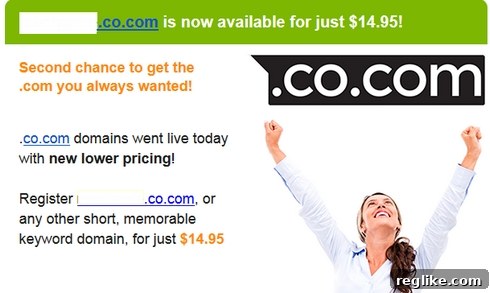
This enticing offer, however, completely missed its mark. The primary flaw was that the promotion was based on a .com domain name I already own. The irony was palpable: why would I need a “second chance” at a .com I’ve always wanted when I already possess that exact .com? This glaring oversight immediately undermined the credibility and relevance of the entire campaign. The core value proposition of .co.com is to offer an alternative *when* the desired .com is unavailable, not to existing .com owners who have already secured their preferred digital asset.
This promotion, therefore, entirely misses the point of getting the .com I’ve always wanted. Instead of targeting individuals who genuinely face the challenge of .com scarcity, it wasted resources on a customer who had already overcome that hurdle. A more effective and logical approach would be to pitch this opportunity to owners of alternative domain extensions such as .net, .info, or .biz. These users are actively demonstrating a need for an online presence but have, by circumstance, opted for a domain other than their first-choice .com. They represent the precise demographic for whom .co.com offers genuine value.
The Importance of Targeted Marketing and Data Integrity in the Domain Industry
The DomainIt promotion serves as a stark reminder of the paramount importance of robust customer data and intelligent targeting in marketing. For a registrar, which deals with millions of domain registrations, understanding the customer’s existing portfolio is fundamental. While the specific .com domain in question isn’t currently registered at DomainIt, it’s unlikely that the registrar resorted to indiscriminate WHOIS scraping for this campaign. The more probable scenario is that DomainIt utilized outdated customer records. My recollection suggests that I had acquired this particular domain in a drop and it was briefly registered with DomainIt approximately seven years ago. This indicates a failure to maintain current customer data or to segment marketing lists effectively, leading to irrelevant communications and a diminished customer experience.
Such a blunder can have several negative repercussions. Beyond the immediate waste of marketing spend, it can frustrate recipients, leading them to perceive the registrar as out of touch or even intrusive. In an industry where trust and reliability are crucial, sending irrelevant promotions can erode customer loyalty and brand perception. It highlights a broader challenge for domain service providers: accurately identifying genuine needs and delivering tailored solutions, rather than employing a one-size-fits-all approach.
[Update: It’s worth noting that this particular promotional campaign takes on an added layer of context. Someone reminded me that DomainIt is owned by Paul Goldstone, who is also one of the founders of .co.com. This connection raises interesting questions about the strategic intent behind such a promotion. While it highlights a direct pathway for Goldstone’s ventures to promote each other, it also amplifies the need for such promotions to be exceptionally well-targeted to avoid perceived conflicts or misjudgments in marketing strategy. The inherent relationship between the registrar and the new gTLD creates both opportunities and obligations for clear, customer-centric communication.]
Understanding .co.com: Who Stands to Benefit?
Despite the promotional missteps, the underlying concept of .co.com addresses a genuine market need. For whom, then, is this third-level domain truly intended? It primarily targets individuals and entities who have faced the disheartening reality of their desired .com being unavailable. This includes:
- Startups and Entrepreneurs: Launching a new venture often means a unique brand name. Finding `yourbrand.com` can be nearly impossible, forcing startups to compromise with longer, less memorable names. `yourbrand.co.com` could offer a concise alternative.
- Small Businesses: Local businesses looking to expand their online presence might find their ideal `.com` taken by a similar business in another region. `yourbusiness.co.com` offers a solution without resorting to geographically specific or generic alternatives.
- Personal Branding: Individuals aiming to establish a personal website or blog often desire `firstname-lastname.com`. If unavailable, `firstname-lastname.co.com` provides a professional-sounding option.
- Specific Niche Projects: For a particular campaign or micro-site, where `projectname.com` might be too expensive or taken, `.co.com` could serve as an effective, temporary, or permanent solution.
The appeal stems from its visual and phonetic similarity to .com, hoping to leverage the decades of trust and familiarity associated with the premier TLD. By embedding “.co” within the .com, it attempts to signal a close relationship while still offering availability.
Pros and Cons: Weighing Your Options with .co.com
Choosing a domain name is a significant decision that impacts branding, marketing, and long-term online strategy. Potential adopters of .co.com should carefully consider its advantages and disadvantages:
Advantages of .co.com:
- Availability: This is the primary selling point. It offers a higher chance of securing your desired name when the equivalent .com is unavailable.
- Familiarity: The inclusion of “.com” helps users recognize it as a website address, reducing potential confusion compared to entirely new or obscure gTLDs.
- Brevity: In many cases, it allows for a shorter, more memorable name than appending words to an existing .com (e.g., `bestapp.co.com` vs. `getthebestappnow.com`).
- Cost-Effectiveness: Premium .com domains can be incredibly expensive. A .co.com might offer a more budget-friendly alternative for a similar name.
Disadvantages of .co.com:
- Third-Level Domain Perception: Despite the .com in its structure, it remains a third-level domain. This can, in some contexts, be perceived as slightly less authoritative or “secondary” compared to a direct .com.
- Memorability Challenges: While familiar, the extra “.co” might still lead to user confusion or typos (e.g., users might default to typing `.com` or `.co`).
- Brand Confusion: If `yourbrand.com` already exists and belongs to another entity, operating `yourbrand.co.com` could lead to brand confusion or even legal challenges depending on trademark laws.
- SEO Nuances: While Google officially states that TLDs don’t directly impact SEO rankings, user trust and direct navigation habits, which heavily favor .com, can indirectly influence traffic and engagement.
The Broader Domain Name Landscape and SEO Implications
The debate around domain extensions and their impact on Search Engine Optimization (SEO) is perpetual. For years, there was a common misconception that having a .com domain automatically conferred an SEO advantage. While Google and other search engines have consistently clarified that the Top-Level Domain (TLD) itself does not directly influence search rankings, the reality is more nuanced. User perception, brand authority, and ease of recall play significant roles, and these are areas where .com still largely dominates.
When Google assesses a website, it prioritizes content quality, relevance, user experience, site speed, and a strong backlink profile. The specific TLD (.com, .net, .org, .co.com, .app, etc.) is considered a neutral factor. However, this neutrality doesn’t mean all TLDs are equal in the eyes of users or, consequently, in their indirect impact on SEO. Users often instinctively trust and remember .com domains more readily. This leads to more direct traffic, higher click-through rates from search results (as users might prefer a .com link over an unfamiliar TLD), and better brand recall – all factors that can positively, albeit indirectly, influence SEO performance over time.
For a .co.com domain, the SEO strategy would be largely identical to any other website: focus on high-quality content, optimize for relevant keywords, build authoritative backlinks, and ensure a seamless user experience. The challenge would be to overcome any initial user skepticism or confusion that might arise from the less conventional domain structure. This might require additional branding efforts to educate the audience and establish the domain’s legitimacy.
Beyond .com: Exploring Alternative Domain Extensions
Given the persistent scarcity of premium .com domains, it’s imperative for businesses and individuals to explore a diverse range of alternatives beyond just .co.com. The domain landscape has evolved dramatically over the last decade, offering a plethora of options:
- New Generic TLDs (gTLDs): Thousands of new gTLDs have been launched, catering to specific industries, interests, or locations. Examples include .app for mobile applications, .tech for technology companies, .store for e-commerce, .blog for personal journals, .online for general use, .io for startups, and many more. These can offer highly relevant and memorable domain names that accurately reflect a brand’s purpose.
- Country Code TLDs (ccTLDs): While primarily intended for specific countries (e.g., .de for Germany, .uk for the United Kingdom), some ccTLDs have gained popularity as generic alternatives due to their perceived coolness or relevance. Notable examples include .io (Indian Ocean, but popular with tech companies), .tv (Tuvalu, popular with media companies), and .me (Montenegro, popular for personal branding).
- Creative Approaches with Existing .coms: Sometimes, a slight modification to a desired .com can yield results. This might involve adding a descriptive word (e.g., `getyourbrand.com`), using a short prefix or suffix, or even opting for a hyphenated version if readability isn’t compromised.
- Purchasing a Premium .com: For well-funded businesses, acquiring a premium .com domain from the aftermarket, though expensive, can be a worthwhile investment due to its unparalleled brand recognition and trust.
The key is to select a domain extension that aligns with your brand identity, target audience, and long-term strategic goals. While .co.com presents a unique “familiar alternative,” it is just one option among a rich tapestry of choices.
Crafting Your Digital Identity: Best Practices for Domain Selection
Regardless of whether you choose a .com, .co.com, or another gTLD, adhering to best practices in domain name selection is paramount for building a strong online presence:
- Brand Alignment: Your domain name should perfectly reflect your brand identity, mission, and values. It should be consistent with your company name, product, or personal brand.
- Memorability and Pronounceability: A good domain name is easy to remember, spell, and say aloud. Avoid complex spellings, obscure jargon, or unnecessary numbers and hyphens that can lead to confusion.
- Brevity: Shorter domain names are generally easier to type, remember, and less prone to typos. Aim for conciseness without sacrificing clarity.
- Future-Proofing: Choose a domain name that allows for future growth and expansion of your business or content without becoming obsolete or restrictive.
- Social Media Handle Availability: Ideally, your domain name should correspond with available social media handles to ensure brand consistency across all digital platforms.
- Trademark Considerations: Before registering, perform a quick trademark search to avoid potential legal issues with existing brands.
- Audience Relevance: Consider your target audience. If you primarily serve a local market, a ccTLD might be beneficial. If you aim for a global audience, a globally recognized TLD is often preferred.
Conclusion: A Shifting Paradigm in Digital Branding
The launch of .co.com represents another fascinating chapter in the ongoing evolution of the domain name system. It acknowledges the persistent challenge of .com scarcity while attempting to offer a solution that leverages the familiarity of the dominant extension. While its conceptual appeal is strong, the success of .co.com, like any new domain, will ultimately hinge on effective market adoption, clear value proposition, and, crucially, intelligent and highly targeted marketing strategies. The DomainIt promotion, while flawed, inadvertently highlighted the precise demographic for whom .co.com could be a game-changer: those who truly desire a .com but cannot secure it. As the digital landscape continues to diversify, the journey to find the perfect online identity becomes increasingly complex, yet also rich with new possibilities. For businesses and individuals, the ultimate goal remains the same: a memorable, relevant, and accessible domain name that truly represents their digital aspiration.