
Unlocking Domain Availability: How Whois Reveals Name Collision Status
Navigating the complex world of new Top-Level Domains (TLDs) can often be a perplexing experience for prospective domain registrants. The excitement of finding a perfect, short, and memorable domain name can quickly turn into frustration when a search tool returns the dreaded “not available” message. This common hurdle leaves many wondering about the reasons behind a domain’s unavailability, and often, the immediate instinct is to suspect that registries are intentionally withholding valuable names. However, the reality is far more intricate, frequently pointing to a crucial yet often misunderstood phenomenon: name collisions. Understanding these technical nuances is key to a smoother domain registration journey, and innovative approaches like Uniregistry’s transparent Whois reporting are revolutionizing how users interact with domain availability data.

The Frustration of Unavailable Domains in New TLDs
For anyone involved in the domain industry, or even a casual user attempting to secure a web address, the experience of a domain pre-registration or search returning “not available” is undeniably frustrating. When you’ve meticulously crafted the ideal domain name, only to be met with a dead end, it’s natural to question why. Many domain hopefuls initially point fingers at domain registries, assuming they might be holding back prime domain real estate for their own benefit or for future premium sales. While premium domains do exist and are reserved for higher prices, this is usually not the primary reason for a domain appearing blocked or unavailable, especially at the initial launch phases of new TLDs.
More often than not, the true culprit behind such unavailability, particularly for new TLDs, is a concept known as “name collision.” These domains are not permanently taken or being hoarded; rather, they are temporarily blocked due to specific technical and security considerations mandated by global internet governance bodies like ICANN. The good news is that these domains are typically not lost forever and may become available at a later date, albeit not immediately at the launch of a TLD. The challenge, historically, has been discerning *which* specific reason applies to a blocked domain – is it a premium name, reserved, or caught in a name collision?
Demystifying Name Collisions: A Critical Internet Stability Measure
So, what exactly constitutes a “name collision”? In essence, a name collision occurs when a query for a given domain name within the new TLD namespace could lead to an unintended or conflicting response. This often happens because many private or enterprise networks internally use domain names that are similar or identical to potential new TLDs. For instance, an internal company network might have used a non-existent TLD like “.corp” or “.home” for its local resources long before these were proposed as actual TLDs. When ICANN introduced hundreds of new TLDs to the root of the internet, there was a significant risk that internal network queries could “collide” with legitimate public DNS queries.
To prevent potential security vulnerabilities, data leakage, and system instability that could arise from such conflicts, ICANN mandated that registries identify and temporarily block any Second-Level Domains (SLDs) that are deemed at high risk of causing name collisions. This protective measure ensures a smoother and more secure transition into the expanded domain name space. While crucial for internet stability, it adds a layer of complexity for registrants and registrars who need to understand why specific names are unavailable.
The Traditional, Tedious Quest for Name Collision Status
Discovering the precise reason behind a domain’s blocked status has traditionally been a cumbersome task. When a domain lookup in Whois returns a generic message like “reserved by the registry,” it offers little in the way of actionable information. This ambiguity leaves users in the dark, unable to distinguish between a domain held back as a premium name (which might be released for a higher price) and one that is temporarily blocked due to a name collision (which might eventually become available for standard registration).
For most new TLDs, the only reliable way to ascertain if a domain was on the name collision list involved a convoluted, multi-step process. This typically required users to:
- Navigate to ICANN’s website to find the specific registry agreement for the TLD in question.
- Once on the registry agreement page, locate and click on a link usually labeled “List of SLDs to Block” or similar.
- Download and meticulously search through a potentially massive text file containing tens of thousands, if not hundreds of thousands, of blocked domain names.
This method was not only time-consuming and inefficient but also intimidating for the average user, requiring a degree of technical savvy and persistence. It highlighted a significant transparency gap in the domain registration ecosystem, fostering frustration and misunderstanding among potential registrants.
Uniregistry’s Game-Changing Approach to Whois Transparency
It was with genuine surprise and appreciation that, while looking up domain availability for .link domains recently, an exemplary solution to this transparency problem emerged. Uniregistry, a prominent domain registrar and registry operator, has taken a remarkably proactive and user-friendly approach to communicate the reasons for domain unavailability directly within its Whois lookup service. This innovative step significantly simplifies the process for registrants, providing instant clarity that was previously absent.
Instead of a vague “reserved” message, Uniregistry’s Whois output for a name collision domain explicitly states the reason. Consider the clear, unambiguous message displayed:
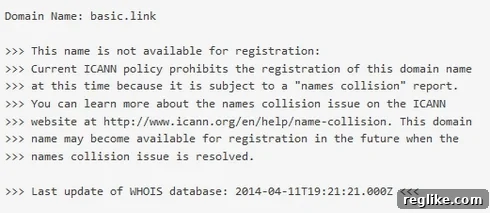
This direct and informative output eliminates guesswork. It immediately informs the user that the domain is blocked due to a name collision, rather than being a premium name or reserved for another reason. This level of transparency is a huge leap forward, transforming a previously opaque process into one that is clear and understandable.
The Broad Benefits of Clear Whois Messaging
Uniregistry’s adoption of clear name collision messaging within Whois reports delivers multifaceted benefits across the domain ecosystem:
- For Registrants: It drastically reduces frustration and confusion. Users can quickly understand *why* a domain is unavailable and make informed decisions, whether that means choosing an alternative name or waiting for a potential future release of the name collision domain. This builds trust and improves the overall user experience.
- For Registries and Registrars: This transparent approach is excellent for public relations. A common misconception among those unfamiliar with the intricate details of the new TLD program is that registries are arbitrarily withholding prime domain names. By clearly stating “name collision,” registries can educate the public and demonstrate their adherence to ICANN’s mandates for internet stability, countering accusations of hoarding or unfair practices. It also significantly reduces support inquiries related to domain unavailability, as users have immediate access to the explanation.
- For the New TLD Program’s Credibility: The new TLD program faced initial skepticism and ongoing challenges regarding transparency and public understanding. Initiatives like Uniregistry’s help to demystify complex technical requirements and foster greater confidence in the integrity and fairness of the expanded domain name space. It showcases a commitment to openness and responsible management of critical internet resources.
- Setting a New Industry Standard: Uniregistry’s pioneering move sets a higher bar for transparency in the domain industry. It encourages other registrars and registries to adopt similar best practices, ultimately leading to a more user-friendly and understandable domain registration environment across the board.
Beyond Collisions: A Holistic View of Domain Reservations
While name collisions are a significant factor, it’s worth noting that domains can also be reserved for other legitimate reasons. These might include:
- Premium Names: Domains deemed highly valuable by the registry due to their short length, common keywords, or brand potential.
- Reserved for Registry Operations: Names essential for the functioning of the TLD itself (e.g., specific administrative domains).
- Sunrise/Landrush Phases: Domains temporarily reserved during specific launch phases for trademark holders or early adopters.
- Governmental or ICANN Mandates: Specific names or categories of names that might be reserved based on broader policy or legal considerations.
The key takeaway from Uniregistry’s innovation is not just about name collisions, but about the *principle* of clear communication for *any* reserved status. Providing specific details empowers users and fosters a more transparent domain landscape.
The Future of Transparent Domain Registration
The clear messaging provided by Uniregistry in its Whois output represents a significant step forward for the domain registration industry. In an environment that is often perceived as opaque and overly technical, such initiatives build trust and empower users. By taking the guesswork out of domain availability, Uniregistry not only enhances the user experience but also plays a crucial role in demystifying the complexities of new TLDs and the essential measures taken to ensure internet stability.
This level of transparency should become the industry standard. As the internet continues to grow and new TLDs proliferate, providing clear, concise, and immediate reasons for domain unavailability will be paramount. It transforms a frustrating search into an educational moment, allowing users to understand the underlying mechanisms of the domain name system. Uniregistry’s foresight in this area is commendable, proving that even small changes in communication can have a profound positive impact on the overall user journey and the public perception of the domain industry.