
Dyson’s UDRP Challenge: Why a Bladeless Fan Knock-off Site Survived a Domain Dispute
Dyson, a name synonymous with groundbreaking design and relentless innovation, has consistently redefined everyday household appliances. From its revolutionary bagless vacuum cleaners to its high-tech hair dryers and air purifiers, the British technology company has cultivated a reputation for transforming the mundane into the extraordinary. However, with success often comes the unwelcome attention of counterfeiters and intellectual property infringers, a challenge Dyson recently faced in a prominent Uniform Domain-Name Dispute-Resolution Policy (UDRP) case concerning its iconic bladeless fan.
 The incident highlights a critical distinction in intellectual property law: the specific scope of UDRP as a tool primarily for combating cybersquatting, rather than a general remedy for all forms of trademark or copyright infringement. This article delves into the Dyson UDRP case, examining why a site explicitly selling knock-off Dyson bladeless fans was allowed to retain its domain name, and what this means for brand owners navigating the complex landscape of online brand protection.
The Genius Behind Dyson’s Bladeless Fan Innovation
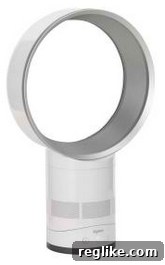
Dyson’s bladeless fan, officially known as the Dyson Air Multiplier, is a prime example of the company’s engineering prowess. Launched to much fanfare, it captivated consumers with its sleek aesthetic, innovative technology, and the promise of smooth, uninterrupted airflow without visible blades. Instead of traditional rotating blades, the device draws in air through its base and expels it through an annular jet, creating a powerful, consistent stream of air. This ingenious design not only offered enhanced safety, especially for households with children and pets, but also simplified cleaning and reduced noise levels compared to conventional fans.
The bladeless fan quickly became a premium product, positioned at the higher end of the market due to its advanced technology and superior design. Its distinctive appearance and functionality cemented its status as a symbol of modern domestic technology, making it a highly desirable item for consumers seeking both performance and style. This very success, however, made it a prime target for counterfeiters looking to capitalize on Dyson’s brand equity without investing in the original research, development, and stringent quality control.
The Scourge of Counterfeit Products and Brand Dilution
For a brand like Dyson, built on innovation and uncompromising quality, counterfeit products pose a significant threat. Knock-offs not only erode sales of genuine products but also dilute brand reputation when inferior imitations fail to meet the expected standards. Consumers, often lured by significantly lower prices, may unknowingly purchase a counterfeit, experience a poor quality product, and incorrectly attribute the negative experience to the original brand. This can lead to a severe loss of trust and loyalty, damaging years of careful brand building.
Furthermore, counterfeit electronics can present serious safety hazards. Unlike genuine Dyson products which undergo rigorous testing and adhere to strict safety certifications, knock-offs may not comply with safety regulations. This negligence can potentially lead to malfunctions, overheating, electrical fires, or other dangerous incidents. Protecting consumers from these risks, alongside safeguarding its intellectual property, is a paramount concern for Dyson and similar premium brands globally.
Understanding the UDRP: A Specialized Tool for Cybersquatting
When Dyson discovered the website bladelessfanonline.com openly selling what appeared to be unauthorized replicas of its bladeless fans, the company took legal action, filing a UDRP complaint with the World Intellectual Property Organization (WIPO). The UDRP is an administrative procedure established by the Internet Corporation for Assigned Names and Numbers (ICANN) to provide a streamlined, relatively inexpensive, and efficient mechanism for resolving disputes over domain names where there is clear evidence of “cybersquatting.”
To succeed in a UDRP complaint, a complainant like Dyson must typically prove three cumulative elements to the satisfaction of the panel:
- The domain name is identical or confusingly similar to a trademark or service mark in which the complainant has rights.
- The respondent (the domain name registrant) has no rights or legitimate interests in respect of the domain name.
- The domain name has been registered and is being used in bad faith.
It is crucial to understand that the UDRP is a narrow instrument with a specific focus. It is designed to address instances where someone registers a domain name primarily to capitalize on another party’s existing trademark, often with malicious intent to sell it back to the trademark owner, disrupt their business, or divert internet traffic for unfair commercial gain – this is the core definition of cybersquatting. The UDRP is explicitly not intended to be a substitute for traditional trademark infringement litigation or a general court for all intellectual property disputes.
The Dyson BladelessFanOnline.com Case: A Detailed Examination
Dyson’s complaint against bladelessfanonline.com hinged on the premise that the term “bladeless fan” had become so intrinsically linked to its product that the domain name itself constituted an infringement of its intellectual property rights. The website in question not only sold what appeared to be knock-off Dyson fans but also included descriptive blurbs and imagery clearly attempting to associate itself with Dyson, further suggesting an intent to piggyback on the brand’s established reputation.
However, the UDRP panelist, Staniforth Ricketson, faced a significant challenge in accepting Dyson’s core argument. While acknowledging the potential for consumer confusion and the clear commercial intent of the respondent to profit from Dyson’s innovation, Ricketson smartly adhered to the strictures and fundamental principles of the UDRP. His primary concern was whether Dyson could unequivocally establish trademark rights in the generic term “bladeless fan” itself, or demonstrate that the term had acquired “secondary meaning” – meaning that consumers primarily associated “bladeless fan” not merely as a generic descriptor for a type of fan, but specifically and exclusively with Dyson’s products.
The Panelist’s Scrutiny and the Absence of Direct Trademark Rights
Dyson was duly asked to provide concrete evidence of its trademark rights to the term “bladeless fan” or compelling proof of its secondary meaning. Despite the strong association consumers might naturally make between Dyson and this innovative product category, “bladeless fan” is, at its heart, a descriptive term for a type of fan that lacks visible blades. Trademark law generally makes it challenging to register purely descriptive terms as trademarks unless they have, through extensive use, marketing, and public perception, acquired distinctiveness, thereby establishing a secondary meaning in the minds of consumers. For example, “Apple” for computers is a distinctive mark, whereas “Sweet Apple” for fruit would typically be considered descriptive.
In this particular case, Dyson had not, and likely could not, secure a direct trademark registration for the generic descriptive term “bladeless fan” in a manner that would be broadly protective against its use in a domain name context without further, substantial proof of acquired distinctiveness. While Dyson certainly owns numerous powerful trademarks related to its brand (e.g., DYSON, AIR MULTIPLIER), the specific phrase “bladeless fan” was not among them in a legally enforceable capacity that applied to the domain name dispute.
Why the UDRP Complaint Failed: Distinguishing Cybersquatting from Broader Infringement
The panelist ultimately ruled against Dyson, denying the complaint. This decision was notably not made lightly, as evidenced by his concluding remarks, which expressed “considerable regret.” He explicitly acknowledged that there was “cogent evidence” strongly suggesting the respondent was engaging in conduct that could indeed be confusing to consumers and potentially constitute copyright infringement. However, his hands were tied by the specific, limited requirements and scope of the UDRP.
The core reason for the denial was Dyson’s inability to satisfy the first UDRP element: proving that the domain name `bladelessfanonline.com` was identical or confusingly similar to a trademark in which Dyson had existing, enforceable rights. Since “bladeless fan” was determined to be a descriptive term for which Dyson held no specific, broadly applicable trademark right that covered the domain name, the complaint could not proceed successfully under the UDRP framework.
The panelist’s profound concluding statement perfectly encapsulates the legal and ethical dilemma:
For the foregoing reasons, the Complaint is denied. The Panel reaches this conclusion with considerable regret, as there appears to be cogent evidence in the Complaint with respect to paragraphs 4(a)(ii) and (iii) that indicates that the Respondent is engaging in a course of conduct that may well be confusing and an infringement of copyright to boot. Such matters may give rise to other rights of action against the Respondent, but cease to be relevant to the present proceeding once the Complainant has failed to show that it has rights in a trademark that has been incorporated in that name.
This powerful excerpt unmistakably underscores the panelist’s recognition of potential wrongdoing by the respondent, yet highlights his unwavering commitment to the strict interpretation and application of UDRP rules. He explicitly states that while other legal actions might be available and justified, the UDRP mechanism is strictly limited to situations where a complainant can demonstrate clear, pre-existing trademark rights that have been incorporated into the disputed domain name.
Implications and Alternative Legal Avenues for Robust Brand Protection
The Dyson UDRP case serves as a crucial reminder for all brand owners: the UDRP is a sharp, specialized tool, not a universal hammer for all intellectual property infringements. Its effectiveness is contingent upon the clear existence of trademark rights directly reflected in the disputed domain name. When those rights are ambiguous, or when the domain name utilizes a descriptive term rather than a distinctive, registered trademark, the UDRP may not be the appropriate or successful recourse.
For Dyson, and other companies facing similar pervasive challenges from counterfeiters and unauthorized sellers, the denial of the UDRP complaint does not signify the end of their fight against such infringements. There are several powerful alternative legal avenues that could be pursued:
- Trademark Infringement Litigation: Dyson could pursue traditional litigation in national courts, arguing that the sale of knock-off products using the “bladeless fan” description, combined with overt references to Dyson and adoption of its product designs, constitutes trademark infringement under broader unfair competition laws, even if “bladeless fan” itself isn’t a registered trademark. Such a court case would focus on the overall likelihood of consumer confusion at the point of sale.
- Copyright Infringement: If the respondent copied Dyson’s website content, product images, marketing materials, or other creative works, Dyson could initiate robust copyright infringement proceedings. The panelist’s statement specifically mentions “infringement of copyright to boot,” strongly suggesting this was a viable and perhaps stronger path to pursue.
- Unfair Competition/Passing Off: These legal doctrines, prevalent in many jurisdictions, protect businesses from others misrepresenting their goods or services as those of another, even in the absence of a registered trademark for the specific term in dispute.
- Design Patent Infringement: Dyson could potentially hold design patents on the unique aesthetic elements of its bladeless fan, which would offer strong protection against visual imitations.
- Customs Enforcement: Actively working with customs authorities in various countries to intercept and seize shipments of counterfeit goods at borders, preventing them from entering the market.
- Platform Enforcement: Proactively reporting sellers of counterfeit products to major e-commerce platforms (e.g., Amazon, eBay, Alibaba) and social media sites, which typically have their own stringent brand protection policies and takedown procedures.
The Ongoing Battle: BladelessFanSmall.com and Beyond
The original article briefly mentions that Dyson also had a pending UDRP case against bladelessfansmall.com. Given the clear precedent set by the `bladelessfanonline.com` decision, it is highly probable that any similar UDRP complaint against `bladelessfansmall.com` would face an identical outcome, assuming the underlying facts regarding Dyson’s specific trademark rights for the descriptive term “bladeless fan” remain unchanged. This underscores the critical importance for Dyson to reassess its overall brand protection strategy and decisively consider these broader, more comprehensive legal avenues to combat the persistent and evolving problem of intellectual property infringement.
Conclusion: Strategic Brand Protection in the Digital Age
Dyson’s UDRP experience provides invaluable insights into the intricacies and limitations of online brand protection. While the UDRP is an indispensable, powerful tool for combating clear-cut cybersquatting involving registered trademarks, it is not a panacea for all forms of intellectual property infringement, especially when dealing with domain names that incorporate descriptive terms rather than distinctive, registered trademarks. The case highlights the critical importance for brand owners to adopt a multi-faceted and strategic approach:
- Proactively secure comprehensive trademark protection: This involves registering trademarks for brand names, logos, distinctive product features, and potentially even descriptive terms that have demonstrably acquired secondary meaning through extensive use and public association.
- Understand the precise scope and limitations of legal tools: Recognizing the specific strengths and limitations of different legal mechanisms, from UDRP to traditional litigation, copyright law, design patents, and unfair competition laws, is crucial for selecting the right tool for each infringement scenario.
- Develop a multi-faceted enforcement strategy: Combining domain name disputes with broader legal actions, customs interventions, and active platform takedowns is essential to effectively combat counterfeiting and brand abuse across all digital and physical fronts in today’s complex global marketplace.
Ultimately, while the panelist’s decision may have been disappointing for Dyson in the immediate context of the UDRP, it serves as a powerful and enduring reminder of the fundamental principles of trademark law and the absolute necessity of a strategic, well-defined, and adaptable brand protection strategy in an increasingly complex and interconnected global economy.