
Verisign’s Potential Shake-Up: A Deep Dive into the Future of Expired Domain Acquisitions
The acquisition of expired domain names in the highly coveted .com space is a fiercely competitive arena. It’s a game of speed, strategy, and often, sheer volume. For years, a specialized system has been in place, allowing “drop catchers” to swoop in and register valuable domain names the instant they become available. This intricate dance involves hundreds of registrars, all vying for the same prize. However, new developments suggest that Verisign, the authoritative registry for .com and .net domains, may be on the verge of fundamentally altering this long-standing system.
Understanding the Current Landscape of .COM Drop Catching
In the current ecosystem, when a domain name expires and isn’t renewed, it progresses through a redemption period and then eventually “drops” from the registry. This moment of release triggers an intense sprint among domain acquisition services. Specialized entities, widely known as drop catchers, employ sophisticated technology to identify and register these domains as soon as they become available to the public. The system as it exists today relies heavily on what’s often described as “well-timed firepower.” This refers to the capacity of drop catchers to leverage numerous owned-and-operated registrars, alongside strategic partnerships, to launch a coordinated effort aimed at registering as many desirable domain names as possible the very second they drop.
This established method has led to a highly optimized, almost industrialized process for securing valuable expired domains. From a single highly appealing domain name to entire portfolios of expiring assets, the demand remains consistently high due to the inherent value of strong web addresses. The financial stakes involved in securing these digital properties are significant, making any anticipated shift in this established mechanism a matter of great interest and potential concern for numerous players across the entire domain industry value chain.
Verisign’s Past Interventions and the Proliferation of New Registrars
This isn’t Verisign’s inaugural foray into influencing the drop-catching landscape. In previous instances, the registry implemented specific rate-limiting actions – essentially imposing caps on the number of queries or registration attempts a single registrar could make within a given timeframe. These actions, arguably designed to manage system load, ensure fair access, or prevent monopolization, inadvertently led to an “explosion in the number of new registrars created solely for grabbing dropping domains.” To circumvent these newly introduced rate limits, aggressive drop-catching operations simply expanded their network, establishing and registering more registrars to increase their cumulative “firepower” and maintain their competitive edge. This adaptive response vividly highlights the tenacity and resourcefulness inherent within the drop-catching community and underscores the persistent challenge Verisign faces in effectively regulating this dynamic segment of the market.
The impact of such extensive registrar proliferation hasn’t gone unnoticed by industry oversight bodies. ICANN, the Internet Corporation for Assigned Names and Numbers, has publicly predicted that a significant number of these registrars, estimated to be around 750, are expected to shut down over the next year. This forecast itself signals a period of consolidation, or perhaps a preemptive adjustment within the registrar market, potentially in anticipation of further regulatory actions or broader shifts in market dynamics dictated by the registry’s evolving policies.
The Game-Changing Patent Application: “Detecting and Mitigating Registrar Collusion”
The most compelling and recent evidence of Verisign’s intent to fundamentally reshape the domain acquisition process comes from a recently published patent application. The U.S. Patent and Trademark Office unveiled a highly detailed plan from Verisign titled “Detecting and Mitigating Registrar Collusion in Drop-Add Acquisitions of Domain Names” (pdf). This application, originally filed on December 31, 2015, outlines sophisticated methods designed to identify and effectively counteract cooperative strategies among registrars that aim to gain an unfair advantage in securing highly sought-after expired domain names.
At its core, the patent application describes an array of techniques and algorithms engineered to “figure out which registrars are working together to grab domains on behalf of clients.” This identified “collusion” isn’t necessarily illegal, but from Verisign’s perspective, it could potentially lead to an uneven playing field, strain critical registry resources, or simply go against the spirit of a fair and open domain allocation system. The comprehensive document details various data points, behavioral analytics, and pattern recognition methods that could be employed to detect indicators of registrars operating in concert rather than as truly independent entities, thereby revealing underlying network connections.
Understanding “Registrar Collusion” in the Context of Domain Drop Catching
The concept of “collusion” within this specific context refers to instances where multiple DNS registrars coordinate their efforts to register the same pool of desirable expired domain names. This coordination can manifest in numerous forms: sharing client lists and strategic targets, utilizing common technological infrastructure, operating from the same physical or virtual locations, or even being under common ultimate ownership despite presenting themselves as separate legal entities. The strategic objective behind such coordination is straightforward: by distributing registration requests across numerous seemingly independent registrars, a single large drop-catching operation can significantly increase its statistical chances of successfully acquiring a target domain name, especially when faced with Verisign’s pre-existing rate limits or other competitive forces. The patent application’s central aim is to unmask these intricate interconnected operations, moving beyond superficial appearances to identify the underlying network of relationships and strategic alliances.
Proposed Mitigation Strategies: Verisign’s Potential Interventions
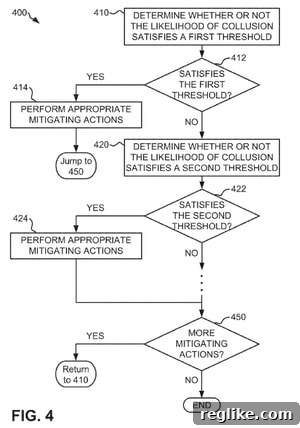
Beyond merely detecting such coordinated efforts, the patent application clearly articulates a range of potential “mitigating actions” that Verisign could implement once collusion is definitively identified. These proposed strategies are incredibly significant and possess the potential to have far-reaching, transformative consequences for the entire domain industry. The document explicitly states:
Examples of mitigating actions include logging the potential drop-add collusion between the pair of DNS registrars, notifying the registry or a user thereof of the potential drop-add collusion between the pair of DNS registrars, sending a request to the registry to throttle or block current and/or future domain name acquisition requests from one or both of the pair of DNS registrars, and the like.
These proposed actions span a spectrum from passive observation (such as detailed logging and internal notification systems) to active and direct intervention (specifically, the throttling or outright blocking of registration requests). The power to “throttle or block” domain name acquisition requests is particularly potent and noteworthy. It suggests that Verisign could directly interfere with the operational capacity of registrars deemed to be engaged in collusive activities. This level of direct control and oversight would fundamentally alter the competitive dynamics of drop catching, potentially favoring registrars that operate strictly independently and adhere to what Verisign perceives as fair play.
Implications for the Domain Industry and Broader Ecosystem
Verisign’s strategic move, as comprehensively outlined in this patent application, raises critical questions about the future operational mechanics of expired domain acquisition and the evolving role of the registry in market regulation. Why is Verisign pursuing this path now? Does the current drop-catching system “tax Verisign’s resources too much” in terms of system load and operational overhead? Or is “something else going on,” perhaps a desire to foster a more equitable, less cutthroat, and ultimately more stable environment for domain registration and renewal?
Impact on Registrars and Drop Catchers
For registrars, especially those business entities heavily invested in and reliant upon drop catching operations, these impending changes could necessitate a complete and radical overhaul of their existing business models and competitive strategies. Businesses that have been meticulously built on leveraging multiple registrar accounts for maximized speed and volume may find their core operating model fundamentally undermined. Conversely, smaller, truly independent registrars might perceive this as a unique opportunity for fairer competition, where technological prowess is balanced by adherence to new regulatory standards. Larger operations, meanwhile, might need to thoroughly reassess their internal structures and current practices to avoid being flagged for “collusion,” making the distinction between legitimate business partnerships and practices deemed “collusive” by Verisign incredibly crucial.
Fairness and Access to Expired Domains
From the broader perspective of individual domain buyers and entrepreneurs, these proposed changes could theoretically lead to a more transparent and potentially fairer system for acquiring valuable expired domains. If the playing field is indeed leveled, access to these highly sought-after domains might become less dependent on sheer technological firepower and brute-force registration attempts, and more on timely action and individual merit. This fundamental shift could, in turn, significantly affect the aftermarket for domains, potentially altering both pricing structures and the overall availability of premium expired names.
Verisign’s Evolving Role
This patent application unequivocally signals an expansion of Verisign’s role beyond merely managing the technical aspects of the .com and .net registries. It strategically positions the company as an active and influential regulator of market behavior within its domain. This enhanced oversight capability could be primarily aimed at ensuring the long-term stability and integrity of the DNS system, preventing potential abuses that could arise from unchecked competitive practices, or simply optimizing resource allocation at the registry level. However, it also inevitably raises important questions about the ultimate extent of a registry’s power and its direct influence over competitive practices among its officially accredited registrars.
The Future of Domain Drop Catching: A Shifting Paradigm
The combination of ICANN’s recent prediction regarding a significant number of registrar shutdowns and Verisign’s detailed, technologically advanced plan for detecting and mitigating collusion paints a very clear and compelling picture: the landscape of expired domain acquisition is unequivocally poised for significant and transformative change. The era of unchecked “firepower” achieved through an ever-expanding, intricate network of registrars might very well be drawing to a definitive close. Instead, a more controlled, potentially less fragmented, and rigorously regulated system could emerge, prioritizing stability and fairness.
While the full implementation details and the exact, granular impact of these potential changes remain to be seen, this patent application serves as an exceptionally strong and clear indicator of Verisign’s strategic direction. The entire domain industry, and particularly those specialized segments that are heavily reliant on drop catching, will undoubtedly need to adapt swiftly and strategically to these profound potential changes. The focus will likely shift from sheer volume and sophisticated coordination to more legitimate, transparent, and compliant registration practices, thereby fostering a new and evolving chapter in the highly dynamic and ever-important world of internet domain names.