
GoDaddy’s Strategic Shift: Unpacking Investor Day Insights on Business Segments and a Thriving Domain Aftermarket
In a significant move that garnered considerable attention from industry observers and investors alike, GoDaddy recently hosted its annual Investor Day following its earlier earnings announcement. This pivotal event provided a comprehensive overview of the company’s performance, strategic direction, and future outlook. For anyone invested in or observing the domain name industry, the presentation, available in its entirety here (PDF), offered several noteworthy insights, particularly concerning GoDaddy’s updated reporting structure and the booming domain aftermarket.
GoDaddy Streamlines Reporting: From Three Segments to Two
One of the most immediate and impactful announcements from GoDaddy’s Investor Day was the restructuring of its business segments. Historically, the company reported its financials across three distinct segments: “Hosting & Presence,” “Business Applications,” and “Domains.” This granular approach allowed for a clear understanding of the performance and growth trajectories of each core area of GoDaddy’s diverse business. However, the company has now opted for a more consolidated approach, introducing two new segments: “Applications & Commerce” and “Core Platform.”
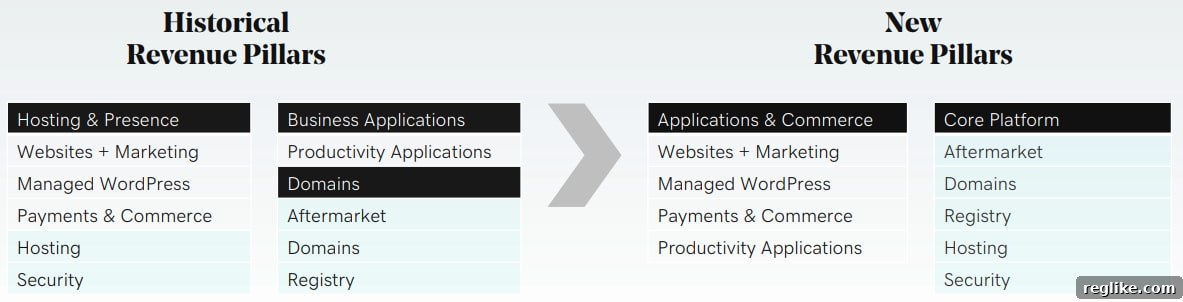
The transition to a two-segment model represents a significant shift in how GoDaddy intends to present its financial performance and strategic focus to the market. The new “Applications & Commerce” segment is designed to encompass solutions that empower businesses to build, manage, and grow their online presence and facilitate transactions. This would likely include components like website builders, e-commerce tools, email marketing, and potentially even specific applications that drive business functionality.
Conversely, the “Core Platform” segment is expected to house the foundational services that underpin GoDaddy’s offerings. This would typically include domain name registration and management, general web hosting services (excluding specialized managed solutions), and other critical infrastructure components that ensure the stability and accessibility of online presences. This reclassification merges previously distinct reporting lines, which naturally leads to questions about transparency and strategic intent.
Implications of the New Reporting Structure
Such a reorganization in reporting segments often serves as a signal, prompting closer scrutiny from financial analysts and industry stakeholders. When a company consolidates previously separate segments, it can sometimes be interpreted as an attempt to de-emphasize or, inadvertently, obscure the performance of specific underlying units. If one part of the business is experiencing slower growth or facing significant headwinds, combining it with a stronger, faster-growing segment can make its individual performance less apparent. This can complicate the ability of investors to pinpoint areas of concern or outperformance within the company’s diverse portfolio.
A particular point of contention for many domain industry observers is the absorption of the dedicated “Domains” business into the broader “Core Platform” segment. The domain registration business is often seen as a bellwether for internet growth and a foundational element of the online economy. Lumping it with other hosting components means that granular insights into the domain registration market – such as new registrations, renewals, and domain-specific revenue growth – will become less transparent. This reduction in detailed reporting can make it harder for the market to assess the health and strategic direction of GoDaddy’s core domain business, which historically has been a significant driver of its revenue.
Furthermore, the segmentation decision appears to create a somewhat convoluted split within the hosting business itself. While general hosting falls under “Core Platform,” specialized offerings like Managed WordPress are reportedly being placed within “Applications & Commerce.” While WordPress is indeed an application, many users choosing Managed WordPress solutions primarily view themselves as seeking a hosting provider that specializes in a particular platform. This distinction can blur the lines of what constitutes an “application” versus a “platform” service in the minds of customers and make it harder to draw clear comparisons between GoDaddy’s different hosting products and their respective market performances. This structural choice could suggest a strategic pivot towards emphasizing integrated application experiences over foundational infrastructure services, or it could simply be an operational realignment.
From a strategic standpoint, GoDaddy might be aiming to highlight its integrated ecosystem of solutions, presenting itself as a comprehensive partner for online ventures rather than a collection of disparate services. By grouping related offerings, they could be seeking to streamline their narrative, improve cross-selling opportunities, and align reporting with their long-term vision of empowering entrepreneurs with an end-to-end online presence and commerce toolkit. However, the trade-off is often a reduction in the detailed visibility that specific, high-interest segments like domains previously offered.
The Domain Aftermarket is Experiencing Unprecedented Growth
In contrast to the structural complexities of reporting, GoDaddy’s Investor Day presentation also shone a bright spotlight on a particularly vibrant and rapidly expanding area of its business: the domain aftermarket. The data presented painted a picture of a “sizzling” secondary market, indicating robust demand and significant value appreciation for premium domain names.
The domain aftermarket refers to the secondary market where previously registered domain names are bought and sold. Unlike new registrations, which involve acquiring a never-before-owned domain directly from a registrar, the aftermarket deals with domains that have been registered, expired, or are being actively sold by their current owners. This market is crucial for businesses and individuals seeking short, memorable, or highly relevant domain names that may no longer be available through standard registration processes.
GoDaddy provided compelling statistics to underscore the health and utility of this market. Notably, the company reported that “everyday entrepreneurs” are responsible for approximately 80% of aftermarket “retail inventory” purchases. This category specifically excludes domain auctions, where professional domain investors typically acquire significant volumes of inventory for future resale. The emphasis on “everyday entrepreneurs” highlights that the aftermarket isn’t just a playground for seasoned investors; it’s a vital resource for small and medium-sized businesses (SMBs) and startups looking to establish a strong, credible online identity. These buyers recognize the immense value of a high-quality domain name as a cornerstone of their brand and digital strategy.
High Lifetime Value and Remarkable Growth Trends
Further demonstrating the strategic importance of aftermarket customers, GoDaddy revealed a striking metric: the 24-month lifetime value (LTV) of a new aftermarket customer is 15 times greater than that of a new domain registration customer. It’s important to note that this LTV calculation specifically excludes the initial aftermarket domain purchase price itself, focusing instead on subsequent spending with GoDaddy. This substantial difference makes intuitive sense. Customers investing in premium aftermarket domains are typically more committed to their online ventures. They’ve already demonstrated a willingness to invest a significant upfront sum for their online identity, indicating a higher propensity to then spend more on hosting, website builders, security, and other value-added services necessary to bring their digital presence to life. These customers are primed to build out a robust online ecosystem, translating into sustained revenue for GoDaddy.
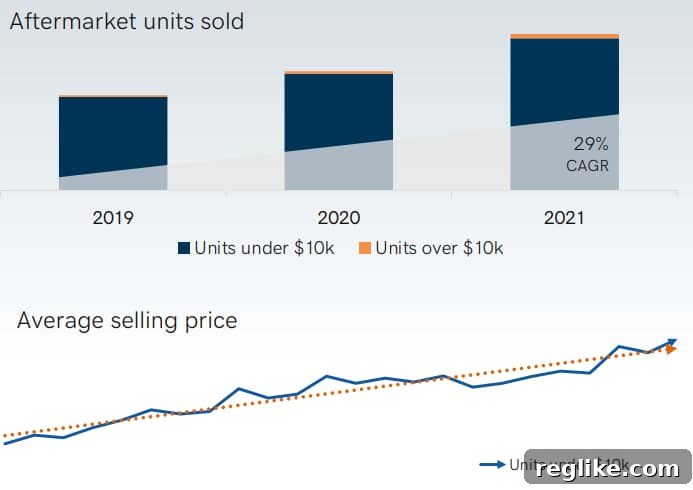
The growth trajectory of the aftermarket is equally impressive. GoDaddy reported that units sold in the aftermarket have grown at a compound annual growth rate (CAGR) of 29% since 2019. This consistent, high-percentage growth signifies a sustained and accelerating demand for secondary market domains. While the Investor Day presentation notably featured fewer y-axes on its graphs, making precise granularity challenging, the overall trend clearly indicates a market that is not only expanding in volume but also seeing an increase in the average selling price (ASP) of domains.
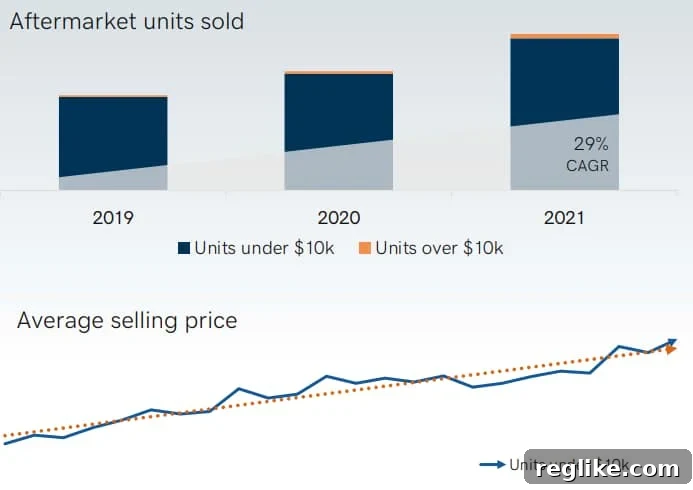
The combination of increasing unit sales and rising average selling prices points to a mature yet dynamic market where quality domain names are recognized as increasingly valuable digital assets. This trend is likely fueled by several factors: the ongoing digitalization of businesses worldwide, the saturation of the primary domain market for highly desirable names, and a growing understanding among entrepreneurs of the long-term brand equity and SEO advantages that a strong domain name can provide. GoDaddy, with its dominant market share in domain registration and its robust aftermarket platform, is exceptionally well-positioned to capitalize on these trends. By facilitating connections between sellers and eager buyers, and offering tools and services around these high-value transactions, GoDaddy continues to solidify its crucial role in the lifecycle of domain names.
In conclusion, GoDaddy’s Investor Day offered a dual narrative: a strategic realignment of its internal reporting structure aimed at a more integrated, applications-focused vision, and a resounding affirmation of the health and explosive growth within the domain aftermarket. While the former raises questions about transparency for specific business lines, the latter unequivocally demonstrates the enduring and increasing value of quality domain names in today’s digital economy, and GoDaddy’s pivotal role in facilitating this thriving market.