
The Swift Dismissal of the WorkBetter.com Cybersquatting Lawsuit: A Judge’s Stern Warning
In a significant development that underscores the complexities and sometimes contentious nature of domain name disputes, the cybersquatting lawsuit over WorkBetter.com has been voluntarily dismissed. This outcome came swiftly after a federal judge issued a scathing assessment, signaling a challenging path forward for the plaintiffs. The case, which pitted Office Space Solutions against long-time domain owner Jason Kneen, has drawn considerable attention for its dramatic turn of events and the judge’s candid remarks.
The saga began with Office Space Solutions, a company gearing up to launch a new business under the name “Work Better,” seeking to acquire the WorkBetter.com domain name. Their target, Jason Kneen, had registered the domain in 1999 – years before the plaintiff’s business concept materialized. The company initiated legal action, filing a cybersquatting lawsuit with the apparent goal of compelling a transfer of the valuable digital asset. However, as often happens in such disputes, the legal battle proved far more intricate than initially anticipated, ultimately culminating in a dismissal that leaves WorkBetter.com firmly in its original owner’s hands.
The Genesis of a Contentious Domain Dispute
Office Space Solutions embarked on a new venture, establishing a brand called “Work Better.” In today’s digitally driven economy, securing a congruent and impactful domain name is paramount for any new business. Consequently, the company set its sights on WorkBetter.com, a domain that perfectly mirrored its brand identity. However, they faced a formidable obstacle: the domain was already owned and had been for an extended period.
Jason Kneen had originally registered WorkBetter.com in 1999, securing it well over a decade before Office Space Solutions began its operations under a similar name. This long-standing registration proved to be a critical factor throughout the legal proceedings. Domain names, much like physical property, gain value and legitimacy through consistent ownership and use. Kneen’s early registration established a strong claim of prior rights, often a powerful defense against later trademark claims in the domain space.
Despite this, Office Space Solutions moved forward, filing a lawsuit in an attempt to leverage the Anticybersquatting Consumer Protection Act (ACPA). This federal law aims to protect trademark owners from individuals who register, traffic in, or use a domain name with a bad-faith intent to profit from the goodwill of someone else’s trademark. The plaintiffs contended that Kneen was cybersquatting, believing they had a rightful claim to the domain based on their new business venture. However, their legal strategy was about to face rigorous scrutiny in the courtroom, particularly concerning the critical element of “bad faith intent.”
A Critical Precedent: The Preliminary Injunction Hearing
A pivotal moment in the lawsuit occurred during a hearing for a preliminary injunction. A preliminary injunction is a powerful legal tool that, if granted, could have compelled Jason Kneen to immediately transfer or otherwise cease use of WorkBetter.com while the main lawsuit proceeded. This type of injunction is usually reserved for situations where immediate and irreparable harm is likely to occur without judicial intervention. For Office Space Solutions, securing a preliminary injunction would have been a significant early victory, effectively sidelining Kneen and granting them interim control over the domain.
However, the judge overseeing the case decisively denied the motion for a preliminary injunction. This denial was a clear indication of the court’s initial skepticism regarding the plaintiff’s claims. To secure a preliminary injunction, a plaintiff typically must demonstrate a strong likelihood of success on the merits, show that they will suffer irreparable harm without the injunction, and prove that the balance of equities favors them. The judge’s refusal to grant this early relief suggested that Office Space Solutions had failed to meet these high standards, casting an ominous shadow over their entire case. It implied that the judge did not perceive an immediate or overwhelming need to remove WorkBetter.com from Kneen’s control.
The denial served as a critical early setback for Office Space Solutions, signaling that their arguments might not hold up under closer legal examination. Such a refusal often prompts plaintiffs to re-evaluate the strength of their case, as it indicates a significant hurdle to overcome in proving their ultimate entitlement to the disputed domain name. This decision likely played a substantial role in the subsequent events that led to the lawsuit’s eventual dismissal.
Judge Kaplan’s Unsparing Assessment: “It Looked Like a Set Up”
The true turning point in this case came with Judge Lewis Kaplan’s extraordinarily candid remarks made in open court. While a full transcript is still being awaited, reports indicate that Judge Kaplan delivered a “blistering assessment” of the situation, going so far as to state that the case “looked like a set up.” This is a highly unusual and potent comment from a federal judge, typically indicating severe disapproval of the plaintiff’s motivations or the manner in which the lawsuit was brought forward.
The accusation of a “set up” carries significant weight, suggesting that the judge may have perceived the lawsuit not as a legitimate claim of cybersquatting, but perhaps as an opportunistic attempt to acquire a valuable domain name through legal pressure. Such a perception can severely undermine a plaintiff’s credibility and the perceived merits of their case. Judge Kaplan further distinguished between what he called “good cybersquatting cases and bad ones,” unequivocally categorizing the WorkBetter.com dispute as one of the “bad ones.” This explicit judicial opinion left little doubt about the court’s view on the strength and legitimacy of Office Space Solutions’ claims.
These judicial comments, delivered publicly, sent a clear and unmistakable signal. They strongly implied that the court viewed the lawsuit as frivolous or, at the very least, substantially lacking in merit under the Anticybersquatting Consumer Protection Act. For any legal team, receiving such direct and negative feedback from the presiding judge is a significant indicator that their case is likely doomed to fail. It highlights the judiciary’s role in upholding fairness and preventing the misuse of legal processes for commercial gain without a strong foundation.
The Voluntary Dismissal: Reading Between the Lines
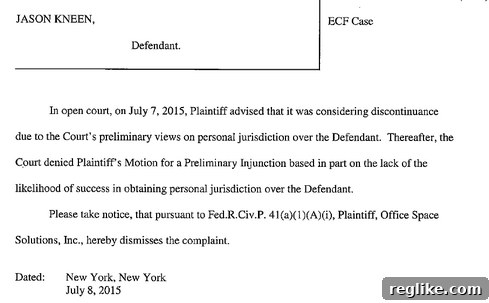
Following Judge Kaplan’s pointed remarks and the denial of the preliminary injunction, attorney Roman Popov of The Bostany Law Firm filed a notice of voluntary dismissal on behalf of Office Space Solutions. While the formal notice cited concerns about the court’s jurisdiction as the predicate for dismissal, the timing and context strongly suggest that the judge’s earlier assessment played a far more decisive role. It is common for parties to cite procedural reasons for dismissal, even when the underlying merits of the case have been critically undermined.
A voluntary dismissal means that the plaintiff, Office Space Solutions, chose to withdraw their lawsuit rather than proceeding to trial and facing a potentially unfavorable judgment. This decision, undoubtedly influenced by the judge’s “set up” comment and the classification of the case as “bad,” likely saved the plaintiff from further litigation costs, potential sanctions, and an outright loss that could have broader implications. It allowed them to exit the case on their own terms, albeit after a significant public rebuke from the bench.
The legal implications of a voluntary dismissal under these circumstances are significant. While it typically means the plaintiff cannot refile the exact same case against the same defendant on the same grounds (especially if it was dismissed “with prejudice,” although the type of dismissal here is not specified, given the context it’s likely a strategic retreat), it also avoids a definitive ruling that would have established precedent. Nevertheless, the public record of Judge Kaplan’s comments serves as a de facto ruling on the perceived weakness of the case, a strong deterrent for similar future litigation attempts against long-registered domain names.
Understanding Cybersquatting and the ACPA
To fully appreciate the context of this dismissal, it’s essential to understand the Anticybersquatting Consumer Protection Act (ACPA). Enacted in 1999, the ACPA was designed to combat the illicit practice of cybersquatting, where individuals register domain names that are identical or confusingly similar to established trademarks with the “bad-faith intent to profit” from that trademark. The law aims to protect businesses and consumers from deceptive practices online.
For a plaintiff to succeed in an ACPA lawsuit, they generally must prove two key elements: first, that their mark is distinctive or famous and that the domain name is identical or confusingly similar to their mark; and second, crucially, that the defendant registered, trafficked in, or used the domain name with a “bad-faith intent to profit” from their mark. This “bad-faith intent” is the lynchpin of most cybersquatting cases. The ACPA provides a list of nine non-exclusive factors courts consider when determining bad faith, including the defendant’s trademark rights, their prior use of the domain, and their intent to divert customers.
In the WorkBetter.com case, Jason Kneen’s registration of the domain in 1999, predating Office Space Solutions’ “Work Better” business, presented a formidable defense against the “bad-faith intent” claim. It’s difficult to prove bad faith against a trademark that did not exist at the time of domain registration. While trademarks can sometimes extend backwards through common law use, the clear timeline here strongly suggested that Kneen could not have intended to profit from Office Space Solutions’ trademark when it didn’t even exist. This historical fact alone likely made it an uphill battle for the plaintiffs to establish the core requirement of the ACPA, contributing significantly to the judge’s critical assessment.
The Significance for Domain Name Holders
The dismissal of the WorkBetter.com lawsuit carries profound significance for domain name holders, particularly those who have maintained their registrations for many years. This case serves as a powerful reassurance that merely owning a domain name that later becomes desirable to a new business is not, in itself, grounds for a successful cybersquatting claim. It reinforces the principle that legitimate prior registration, especially when predating the plaintiff’s trademark use, offers substantial protection against such lawsuits.
For companies like Office Space Solutions, the outcome underscores the critical importance of conducting thorough due diligence before embarking on costly and resource-intensive legal battles. Aggressively pursuing a domain name through litigation without a strong legal basis can not only be financially draining but also damaging to a company’s public image, especially when met with stern judicial criticism. Businesses are well-advised to explore all avenues, including direct negotiation, before resorting to litigation, particularly when the domain owner has a clear history of prior registration.
The case also highlights the high legal bar for proving “bad-faith cybersquatting.” The judiciary, as demonstrated by Judge Kaplan’s remarks, is clearly disinclined to entertain lawsuits that appear to be opportunistic attempts to dispossess legitimate domain owners. This protects the integrity of the domain name system and provides a measure of security for individuals and businesses who have invested in and maintained their digital assets over time. Owners of older domain names can take some comfort in this ruling, knowing that their long-standing registrations offer a robust defense against potentially unfounded claims.
Beyond the Courtroom: The Broader Landscape of Domain Disputes
This case also sheds light on the broader landscape of domain name disputes, which typically fall into two main categories: UDRP (Uniform Domain-Name Dispute-Resolution Policy) proceedings and ACPA lawsuits. While UDRP is an administrative process designed for faster, less expensive resolution of clear-cut cybersquatting cases, ACPA lawsuits are formal federal court actions that can involve extensive discovery, testimony, and significant legal costs. The choice of forum often depends on the complexity of the case, the desired remedies, and the strength of the evidence.
The WorkBetter.com case was an ACPA lawsuit, which, by its nature, demands a higher burden of proof and exposes both parties to greater financial and reputational risks. For plaintiffs, pursuing a weak ACPA case can result not only in dismissal but also potentially in adverse rulings that could impact future business endeavors or even lead to sanctions if the court deems the litigation to have been frivolous or vexatious. For defendants, even winning such a case incurs significant legal fees and stress, demonstrating why long-term domain holders must remain vigilant.
The judiciary’s stance in this instance serves as a reminder that the courts are not merely tools for brand owners to acquire desirable domains. They are guardians of legal principles, including property rights and fair commercial practices. The outcome of the WorkBetter.com case will undoubtedly be cited in future domain name disputes, particularly those involving long-held domains and accusations of a “set up,” influencing how both plaintiffs and defendants approach these complex legal challenges.
Conclusion: A Clear Message from the Judiciary
The swift and definitive dismissal of the WorkBetter.com cybersquatting lawsuit sends a clear and unambiguous message from the judiciary. What began as an attempt by Office Space Solutions to acquire a domain name for its new business quickly unraveled in the face of a skeptical court and a judge’s unvarnished criticism. Judge Lewis Kaplan’s powerful remarks, branding the situation as potentially a “set up” and labeling it a “bad” cybersquatting case, served as the ultimate catalyst for the plaintiff’s decision to voluntarily withdraw their claims.
This case is a stark reminder that simply desiring a domain name that is similar to one’s brand is not sufficient grounds for a successful cybersquatting lawsuit, especially when the domain has been legitimately registered for a substantial period. The Anticybersquatting Consumer Protection Act is a vital tool for combating genuine bad-faith domain registration, but it is not intended to be used as a mechanism for brand owners to circumvent fair market acquisition or to challenge legitimate, pre-existing domain ownership.
For Jason Kneen, the long-time owner of WorkBetter.com, the dismissal represents a victory, reaffirming his rights to a domain name he has held for many years. For the broader domain name community, it reinforces confidence in the stability of domain registrations and the integrity of the legal system in upholding property rights. While the future plans for Office Space Solutions and their “Work Better” brand remain to be seen without the exact-match domain, this legal episode stands as a significant cautionary tale, highlighting the severe repercussions of pursuing ill-conceived litigation in the dynamic and often intricate world of domain name disputes.