
Decoding Sedo’s Performance: A Comprehensive Look at Weekly Domain Sales
The domain name industry is a dynamic landscape, constantly evolving with shifts in market demand, technological advancements, and user behavior. Against this backdrop, reports on major marketplaces like Sedo often spark vigorous debate. Recently, Konstantinos Zournas at Online Domain published a thought-provoking article titled “Is Sedo Dying?”, which quickly captured attention within the community.
Konstantinos’s article presented data from a recent Sedo sales report, comparing it directly to the same week in the previous year. Specifically, he noted that last week saw 492 domains sold for $1.0 million, a considerable drop from 545 domains sold for $1.6 million during the corresponding week in 2015. His analysis highlighted several concerning points:
You can instantly see that absolute value has dropped by half a million (if you take out autism.rocks that is not the norm), there are only 59 domains reported this year compared to 218 last year, sold domains are a bit down, and “buy now” listings are up.
While such a sharp decline in a single week’s comparison certainly raises questions, relying on a solitary data point to infer the long-term health of a platform can be misleading. It’s crucial to consider the broader context. A significant factor influencing the reported figures, which Konstantinos may not have fully emphasized, is Sedo’s updated reporting policy: they now only publicly report sales exceeding $2,000. This policy change inherently reduces the number of publicly listed transactions, potentially skewing week-to-week comparisons if not accounted for.
Konstantinos did mention that he “checked many other weeks before these” when forming his conclusion, suggesting a broader, albeit unshared, review. However, to truly assess Sedo’s performance and address the “dying” narrative, a more comprehensive, long-term data analysis is essential. Is Sedo genuinely experiencing a downturn? Or is the current situation simply a normalization, perhaps a tapering off after what was likely an exceptional Q4 in 2015, heavily influenced by robust demand from China?
To provide a clearer, more nuanced perspective, I have undertaken a detailed charting of all Sedo’s weekly sales reports, extending back to the first week of January last year. For instances where Sedo combined sales reports (e.g., a two-week report following holiday periods), I meticulously divided these totals evenly across the respective weeks to maintain consistency. It’s also worth noting that Sedo appeared to skip one weekly report last year, resulting in a single-week gap in my historical data. Furthermore, Sedo often rounds its weekly transaction numbers, meaning the reported totals might not always be perfectly exact. Despite these minor data limitations, this longitudinal approach offers a far more robust foundation for analysis than any single-week snapshot.
SEDO WEEKLY SALES (VALUE) 2015-PRESENT
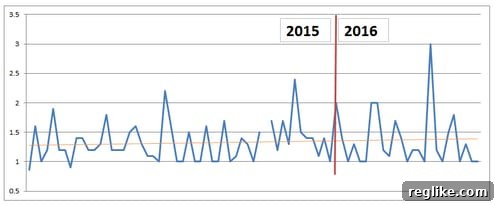
When examining the weekly sales value data, a consistent pattern of choppiness emerges. Sales figures fluctuate considerably from one week to the next, reflecting the inherent volatility of the premium domain market, where a single high-value transaction can significantly impact weekly totals. Despite this inherent variability, the orange trendline superimposed on the chart indicates an overall upward trajectory in sales value over the period. This positive trend is undoubtedly bolstered by a few particularly strong weeks towards the end of 2015 and into the current year, likely driven by significant individual domain sales or concentrated periods of buyer activity.
Intriguingly, when we aggregate the data, the total reported sales for the first 25 weeks of the current year are slightly higher than those recorded during the first 25 weeks of the previous year. This performance even surpasses the total sales from the *last* 25 weeks of 2015, a period widely recognized for its intense Chinese demand, which fueled unprecedented activity in the domain aftermarket. This suggests that while individual weeks might show dips, the overall value generated by Sedo has remained remarkably resilient, or even grown, highlighting its continued role in facilitating high-value domain transactions.
SEDO TRANSACTION VOLUME 2015-PRESENT
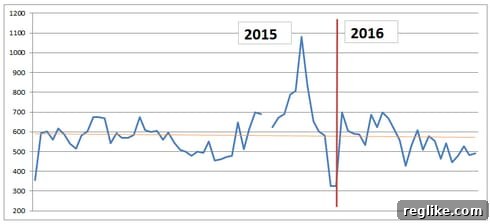
Shifting our focus to transaction volume, a different, yet equally insightful, picture unfolds. The chart clearly illustrates a pronounced spike in late 2015. This surge in volume can be directly attributed to the massive demand, primarily from China, for short, desirable domains such as three- and four-letter (LLL, NNNN) combinations, as well as specific new gTLDs. This period represented a unique market phenomenon, unlikely to be sustained long-term.
Following this exceptional period, the past few months have indeed shown a noticeable reduction in weekly transaction volume compared to earlier highs. The data reveals that the average weekly volume over the past 12 weeks stands at approximately 517 transactions, a decrease from the 586 transactions recorded during the same 12-week period a year prior. This isn’t an isolated anomaly; the first 25 weeks of this year averaged 553 transactions, compared to 584 in the corresponding period last year. Consequently, the trendline for transaction volume indicates a gentle but consistent downward movement.
When analyzing these two metrics together – a stable or slightly increasing sales value alongside a decreasing transaction volume – it suggests a potential shift in the market dynamics on Sedo. It could imply that while fewer domains are being sold, the average value per transaction is increasing, indicating a stronger focus on higher-priced, more premium inventory. This would align with Sedo’s updated reporting threshold, filtering out lower-value sales and focusing the spotlight on more significant deals. This perspective offers a more nuanced understanding than a simple declaration of decline, highlighting adaptability within the platform.
I hope this extended data analysis provides a more comprehensive and well-rounded perspective on Sedo’s sales performance, moving beyond the limitations of a single-week snapshot. The domain market is complex, and understanding its movements requires an examination of trends, not just momentary fluctuations.
Beyond the raw data, it’s critical to acknowledge that the fundamental reality of domain name marketplaces is undergoing a profound transformation. The traditional model, where a significant number of end-users would directly navigate to platforms like Sedo.com or Afternic.com with the explicit intent of searching for and acquiring domains, is becoming less prevalent. While these platforms remain vital for professional domain investors, brokers, and specific premium transactions, the primary drivers of domain sales for a wider audience have largely shifted.
Today, there are essentially two major, increasingly dominant channels through which domain sales primarily occur:
1. **People landing on a parked page:** This passive discovery model is incredibly effective. A potential buyer types in a domain name they believe might be available or lands on it through a typo, only to find a professionally designed landing page clearly indicating that the domain is for sale. These pages, often managed by marketplace providers, act as highly targeted storefronts, capturing intent at its peak moment.
2. **People seeing an exact-match syndicated listing at a domain registrar:** Many domain registrars now seamlessly integrate aftermarket listings directly into their search results. If a desired domain is already registered, the registrar will often display alternative premium versions or present the option to purchase the exact-match domain from an aftermarket provider. This “point-of-purchase” availability significantly streamlines the acquisition process, making it frictionless for potential buyers who might not even be aware they are interacting with a secondary market.
Marketplaces that effectively leverage and dominate these two channels are undoubtedly best positioned for long-term success in the current domain economy. Sedo, with its robust parking solutions and extensive syndication network, especially with major registrars, is actively participating in these crucial sales funnels. However, the decreasing reliance on direct marketplace traffic means platforms must continuously innovate in how they reach potential buyers. The rise of sophisticated brokerage services, private sales, and targeted outreach also plays a crucial role in the high-end segment, where Sedo’s premium brokerage team remains a significant player. The ecosystem is no longer solely about discoverability on a single platform but about integrated visibility across the entire web presence of domain sales.
In conclusion, the narrative that Sedo is “dying” appears to be an oversimplification, if not an outright misinterpretation, of complex market dynamics. While transaction volume has seen a decline from its extraordinary peaks, particularly after the intense Chinese-fueled demand, the overall sales value has held steady or even shown growth, suggesting a focus on higher-quality, more valuable transactions. Sedo, like other major players in the domain industry, is navigating a transforming landscape where the mechanisms of discovery and sale are evolving. Its continued relevance will depend on its ability to adapt its strategies to meet buyers where they are – whether on parked pages, through registrar integrations, or via expert brokerage services. The domain name industry is not static, and Sedo’s performance reflects this ongoing adaptation rather than an impending demise.