
Tucows is embarking on a significant strategic overhaul, restructuring its three core business units to operate as distinct, stand-alone entities. This move is poised to unlock new growth opportunities, enhance operational focus, and provide greater clarity for investors in a rapidly evolving technological landscape.
Tucows Unveils Strategic Reorganization: A New Chapter for Growth and Focus
Tucows (NASDAQ: TCX), a venerable name in internet services, recently announced its 2021 financial results and, more importantly, a profound reorganization designed to propel the company into its next phase of growth. The strategic shift, articulated through a comprehensive video presentation, positions Tucows’ diverse operations for enhanced autonomy and market-specific agility. This restructuring aims to maximize the potential of each business line by treating them as independent ventures under the overarching Tucows umbrella.
Navigating Financials Amidst Transformative Change
Analyzing Tucows’ 2021 financials requires careful consideration, primarily due to the strategic divestiture of its Ting mobile business. This significant transaction naturally complicates direct comparisons to previous reporting periods, making historical trend analysis less straightforward. Despite these challenges, the company reported an overall slight decrease in annual revenues. However, a closer look at the fourth quarter of 2021 reveals robust momentum, with revenues climbing by an impressive 16.5% compared to Q4 2020. This quarter-over-quarter growth signals a strong underlying performance and a positive trajectory as the company sheds legacy operations and sharpens its focus on core high-growth areas.
The domain registration business, a cornerstone of Tucows’ identity and a consistent revenue generator, maintained its stability. While top-line revenues in this segment remained essentially flat for the year, the underlying efficiency and profitability surged. The domains business notably achieved a record year for both gross margin and adjusted EBITDA, underscoring its resilience and continued capacity to generate significant cash flow. This performance highlights the intrinsic value and mature stability of the domain name industry, which provides a reliable foundation for Tucows’ more capital-intensive ventures.
The Rationale Behind the Reorganization: Unlocking Value and Agility
For some time, Tucows has operated with three distinct business lines. However, the latest announcement signifies a deeper, more fundamental change: these lines will now function as truly separate businesses, each with its own operational mandate and strategic direction. This move is not merely an administrative reshuffle but a deliberate strategy to foster greater independence, accountability, and market responsiveness across the organization. By empowering each unit to operate with increased autonomy, Tucows aims to accelerate innovation, optimize resource allocation, and attract specialized talent within each vertical.
A Visionary Leader’s Distinctive Communication
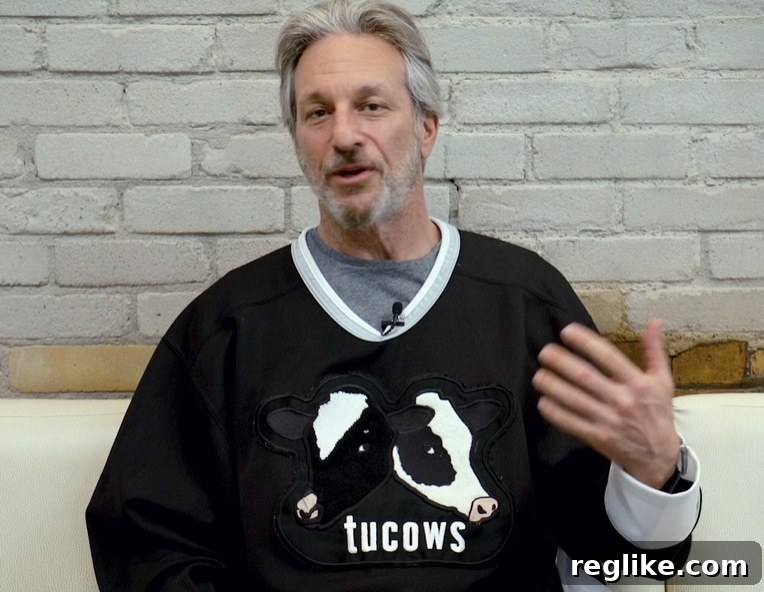
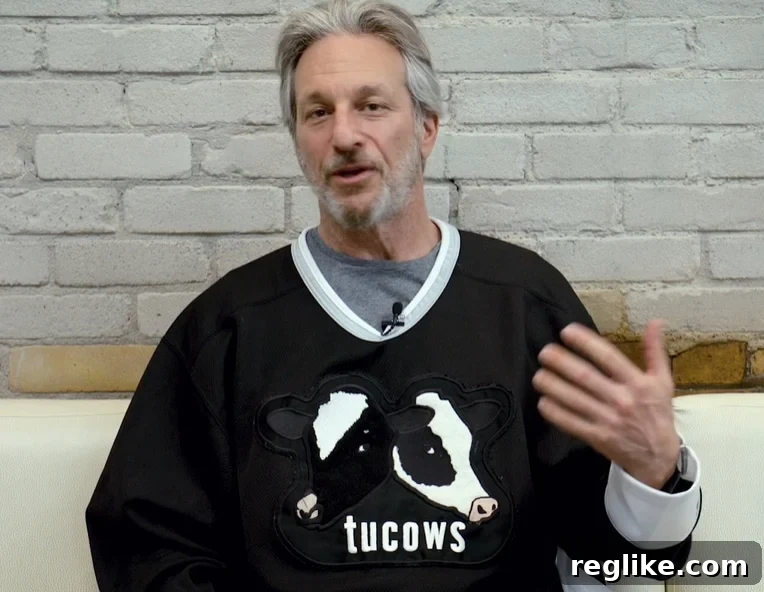
To convey the significance of this organizational transformation, Tucows CEO Elliot Noss adopted a unique and memorable communication approach in the announcement video. He appeared in four different outfits, two of which notably captured attention. One saw Noss in a formal coat and tie—a rare sight for the usually more casually dressed executive—symbolizing the serious and strategic nature of the change. The other featured him prominently in a Tucows hockey sweater (as pictured above), a nod to the company’s playful spirit and Canadian roots, while reinforcing the unified brand identity that underpins the diverse operations. This distinct presentation style not only captured interest but also subtly underscored the individual identities of the businesses while reiterating their shared lineage.
The Three Pillars: Tucows Domains, Ting Fiber, and Wavelo Software
Under the new structure, TCX will function as a holding company, overseeing three primary operating units: Tucows Domains, Ting (its fiber-to-the-home internet service), and Wavelo (the newly branded telco billing and customer service software unit). This holding company model allows for centralized strategic oversight while decentralizing day-to-day operations. Crucially, essential corporate functions such as Finance, Human Resources, Legal, Mergers & Acquisitions, and IT will remain centralized under TCX. However, their costs will be meticulously allocated to the individual businesses, ensuring transparency and accountability. A forward-looking aspect of this design is the provision for individual business units to potentially internalize these shared functions in the future, offering flexibility as they scale and mature.
Tucows Domains: The Enduring Core
Tucows Domains remains a global leader in internet services, standing as the world’s second-largest domain registrar. This business unit is the bedrock of Tucows, providing stable revenue and robust cash flow that often fuels the more capital-intensive ventures. In an increasingly digital world, domain names are fundamental digital assets, serving as critical infrastructure for businesses and individuals alike. The domain business’s consistent performance, marked by record gross margins and adjusted EBITDA despite flat revenue, demonstrates its operational efficiency and strategic importance. Its future growth avenues include the continued expansion of new generic top-level domains (gTLDs), premium domain sales, and value-added services such as advanced security and domain management tools. The stability of Tucows Domains provides a vital foundation, allowing the company to strategically invest in high-growth areas.
Ting Fiber: Powering the Future of Connectivity
Ting, Tucows’ ambitious fiber-to-the-home internet service, represents a significant growth engine. The market for high-speed fiber internet is experiencing exponential demand, driven by increasing data consumption, remote work trends, and the proliferation of connected devices. Building out a fiber network is a highly capital-intensive undertaking, requiring substantial upfront investment. Recognizing this, a pivotal aspect of the reorganization is enabling Ting to raise capital independently. This strategic move frees Tucows, the parent company, from the substantial financial burden of Ting’s network expansion, allowing the fiber business to accelerate its build-out plans and compete more aggressively in the burgeoning broadband market. The company anticipates announcing new financing for Ting’s fiber network expansion in the near future, signaling a dedicated path for its rapid growth. With Ting securing its own funding, Tucows plans to continue its share buyback program this year, further enhancing shareholder value.
Wavelo: Revolutionizing Telco Software Solutions
The third pillar, Wavelo, is the new brand identity for Tucows’ telco billing and customer service software unit. Wavelo is positioned to provide innovative software solutions specifically designed for internet service providers (ISPs) and telecommunication companies. This unit leverages Tucows’ deep expertise in managing complex internet infrastructure and customer relationships, offering advanced platforms for billing, customer management, service provisioning, and network operations. In a competitive telecom landscape, efficient and scalable software is paramount for managing subscriber growth and ensuring superior customer experiences. Wavelo aims to empower telcos to streamline operations, reduce costs, and enhance customer satisfaction through its cutting-edge offerings. The rebranding signifies a renewed focus and market-oriented strategy for this enterprise software business, positioning it for significant expansion within the global telecommunications sector.
Elliot Noss on Web3: A Glimpse into the Digital Frontier
Beyond the immediate organizational changes, Elliot Noss dedicated a notable portion of his prepared remarks during the earnings call to a forward-looking perspective on Web3. His commentary underscores Tucows’ commitment to understanding and adapting to the future of the internet. Noss articulated his belief in the transformative power of Web3, stating:
When we look back ten years from now, I believe we will see that Web3 – and at its simplest I use that term to mean publicly verifiable distributed databases – will have had a similar impact to that of the Internet in the 1995 to 2005 time period. It impacted virtually every business – and of course some more than others. Where the OG Internet created a global set of connections, Web3 will mostly impact identity, finance, and governance. And every leader in my position needs to be thinking about what these changes will mean for their business.
Noss’s comparison of Web3’s potential impact to that of the early internet is profound. The period between 1995 and 2005 witnessed the foundational commercialization and global expansion of the internet, fundamentally reshaping industries worldwide. By framing Web3, or “publicly verifiable distributed databases,” in this context, Noss highlights its potential to introduce a similar, albeit different, paradigm shift.
The emphasis on identity, finance, and governance as primary areas of impact is particularly relevant to Tucows’ operations. In the realm of identity, domain names already serve as a crucial component of digital identity. Web3, with its focus on decentralized identifiers and self-sovereign identity, could profoundly influence how digital identities are managed and verified, potentially creating new opportunities or challenges for domain registrars. For finance, the rise of decentralized finance (DeFi) and blockchain-based financial instruments could reshape payment systems and asset ownership, areas where Tucows’ existing infrastructure and Wavelo’s software solutions might find innovative applications.
Furthermore, Web3’s impact on governance, through decentralized autonomous organizations (DAOs) and transparent, immutable record-keeping, could influence corporate structures, digital rights, and even internet governance itself. As a long-standing participant in internet infrastructure, Tucows is uniquely positioned to observe and potentially contribute to these evolving frameworks. Noss’s call for every leader to consider these changes underscores the proactive and visionary approach Tucows is taking to remain at the forefront of technological evolution.
Interested parties can delve deeper into his insightful comments by reviewing the full transcript of his remarks about Web3 here (pdf).
Looking Ahead: A Future of Focused Innovation
The reorganization of Tucows into three distinct, independently operating businesses marks a pivotal moment for the company. By granting each unit the autonomy to pursue its specific market opportunities, raise dedicated capital (as seen with Ting), and develop specialized leadership, Tucows is strategically positioning itself for accelerated growth and enhanced shareholder value. This streamlined structure is expected to improve operational efficiencies, clarify investment narratives, and foster a more agile and responsive corporate culture, ready to tackle the complexities and opportunities of the digital future, including the transformative potential of Web3.