
Unpacking Domain Name Trends: The Divide Between Startups and Established Tech Giants at CES
The Consumer Electronics Show (CES) in Las Vegas is a monumental convergence of innovation, drawing in approximately 3,500 exhibitors and over 150,000 attendees annually. This massive event serves as a crucial barometer for emerging technologies and market trends. Beyond the dazzling displays of gadgets and groundbreaking inventions, a subtle yet fundamental aspect of digital identity often reveals interesting strategic choices: the domain names companies choose to represent themselves online. As an attendee, my focus naturally gravitated towards observing these digital addresses, uncovering distinct patterns that underscore the evolving landscape of online branding and corporate identity.
My observations at CES brought to light a fascinating dichotomy in domain name strategies, particularly between burgeoning startups and well-entrenched industry leaders. It became evident that while the digital world offers an ever-expanding array of top-level domains (TLDs), traditional choices continue to hold significant sway for certain players, while others are keen to explore novel alternatives. This article delves into these intriguing domain dynamics, offering insights into the decisions that shape a company’s initial digital footprint and long-term brand presence.
The Elusive .Tech: A Surprising Absence at CES
One of the most striking observations concerned the relatively new .tech top-level domain. Despite CES itself adopting CES.tech for its official website and branding for this year’s show, the TLD was conspicuously absent within the exhibition halls. I meticulously scanned booths, marketing materials, and digital displays, yet I can count the number of times I encountered CES.tech at the event on absolutely zero fingers. This stark reality raises questions about the practical adoption and on-the-ground visibility of even officially endorsed new gTLDs, especially in such a tech-focused environment.
While generating hundreds of thousands of visits to CES.tech is undoubtedly a success for the domain, its lack of physical exposure at the show itself suggests a disconnect. One might assume that an event dedicated to technology would be the ideal stage for a domain like .tech to shine, yet it appeared to struggle for recognition amidst the noise. I did, however, come across a single instance of a company utilizing a .tech domain on a business card. Intriguingly, this particular company opted for a hybrid approach, using a .com domain for its primary website while reserving the .tech address for email communications. This strategic split might indicate an attempt to leverage the specific connotation of “.tech” for internal or niche communication, while relying on the established trust and familiarity of “.com” for broader web presence and brand recognition. This scenario highlights the ongoing challenges new TLDs face in achieving widespread adoption and integrating seamlessly into established brand identities, particularly when competing with the ubiquitous .com.
.Com Reigns Supreme: The Undisputed Choice for Established Giants
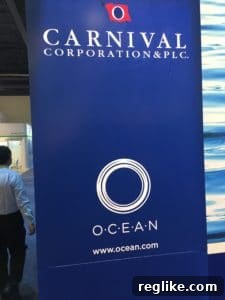
In stark contrast to the subtle presence of .tech, the dominance of the venerable .com domain name for established companies was overwhelmingly clear – and frankly, entirely expected. Giants of industry, with their vast resources and long-standing brand equity, consistently leaned on the familiarity and trustworthiness that .com inherently offers. A prime example was the cruise line Carnival, which commanded an immense booth – more akin to a multi-story building – proudly displaying its newly acquired Ocean.com domain name. This bold showcase wasn’t just about a website address; it was a powerful statement about their brand’s digital cornerstone.
The investment Carnival made to acquire Ocean.com, reportedly from prominent domain investor Richard Lau, was undoubtedly substantial. However, considering the colossal sums these corporations pour into their broader technology infrastructure, advertising campaigns, and overarching brand initiatives, the cost of a premium .com domain represents a strategic percentage. For established players, a .com domain isn’t merely an address; it’s a foundational asset that encapsulates trust, credibility, and global recognition. It acts as an anchor in a tumultuous digital sea, providing a stable and universally understood point of contact for customers. The psychological impact of a .com — its instant recognition and implicit authority — is invaluable for brands seeking to project permanence, reliability, and leadership within their respective industries. For companies like Carnival, Ocean.com isn’t just a domain; it’s a critical component of their expansive “OCEAN” branding strategy, designed to resonate deeply with consumers and signify a forward-thinking, yet dependable, digital future.

Startups Embrace the New Frontier: Diverse TLDs and ccTLDs
Moving away from the established corporate booths into the bustling startup sections of CES, a distinctly different picture emerged. Here, the traditional dominance of .com diminished, replaced by a vibrant experimentation with new TLDs (nTLDs) and country code TLDs (ccTLDs). These nascent companies, often constrained by budget and the unavailability of desirable .com names, demonstrated a greater willingness to explore alternative domain extensions. Common choices included catchy, short domains on extensions like .io and .co, which have gained significant traction within the tech startup ecosystem for their perceived innovation and availability.
While the overall presence of new TLDs wasn’t overwhelming, the willingness to stray from .com was palpable. I specifically noted a company utilizing a .solutions domain, clearly leveraging the semantic relevance of the extension to convey its business purpose. Another venture had adopted a .us domain name, potentially targeting a specific geographic market or simply finding a more suitable and available name under this ccTLD. For startups, these alternative TLDs offer several compelling advantages: they can be more affordable than premium .com domains, provide greater flexibility in finding short and memorable names, and can even contribute to a specialized brand identity (e.g., .io for input/output, resonating with developers). However, this choice also comes with potential trade-offs, such as a possible reduction in immediate trust for a general audience unfamiliar with newer extensions, and the challenge of establishing memorability against the deeply ingrained .com standard. Nonetheless, for startups striving for distinction and agility, these varied TLDs represent an exciting frontier in carving out a unique digital presence.
Global Perspectives on Digital Identity: A Tale of Two Strategies
Beyond the choice of TLD, another fascinating distinction I observed was the varying prominence of domain names displayed by companies from different geographical regions. North American and European companies, for instance, typically showcased their domain names prominently and proudly on their booths, often integrating them into large-scale branding. This approach aligns with a Western marketing philosophy that emphasizes direct online access and brand recall via a distinct web address. The domain name acts as a clear call to action and a primary point of digital engagement for potential customers and partners.
In contrast, many Asian companies exhibited a markedly different approach. Despite often presenting cutting-edge technology and innovative products, their domain names were frequently less visible, or even entirely absent from their primary branding displays. This observation struck me as particularly intriguing, especially given that many of these companies were operating in highly competitive technology commodity markets. In such environments, differentiation is paramount, and a strong, memorable domain name could serve as a powerful branding tool, helping to distinguish one company from another in a crowded marketplace. This difference in strategy could be attributed to several factors: varying cultural attitudes towards direct branding, a greater reliance on platform-centric digital ecosystems (where a company’s presence on a major e-commerce or social platform might be prioritized over a standalone website), or perhaps a focus on product specifications and features over universal digital identity. Regardless of the reasons, this discrepancy highlights a potential missed opportunity for global branding and direct customer engagement, underscoring the universal importance of a clear, prominent digital address in today’s interconnected world.
Conclusion: The Evolving Landscape of Digital Identity
My journey through CES offered a revealing snapshot of the current state of domain name strategies within the tech industry. It vividly illustrated the enduring strength of .com for established, trust-driven brands, which prioritize universal recognition and brand equity above all else. Simultaneously, it showcased the innovative spirit of startups, who are embracing new TLDs and ccTLDs as a means to achieve unique branding, overcome availability challenges, and target niche markets. The surprising under-representation of .tech at a technology show, alongside the observed geographical disparities in domain prominence, further underscores the complex and dynamic nature of digital identity in a globalized market.
Ultimately, the choice of a domain name is far more than a technical decision; it is a strategic branding statement that reflects a company’s stage of growth, target audience, and market positioning. As the digital landscape continues to evolve, so too will the approaches to selecting and leveraging these crucial online identifiers. Understanding these trends is essential for any business aiming to forge a strong, memorable, and effective presence in the ever-expanding digital realm.