
Rightside’s Strategic Blueprint: Unveiling Success in the New gTLD Landscape
In the dynamic world of domain names, public companies offer an invaluable window into their operations, providing a level of transparency rarely seen with private entities. Rightside (NASDAQ: NAME) serves as a stellar example, offering detailed insights into its strategic decisions and initial performance in the burgeoning new Top-Level Domain (TLD) market. This comprehensive analysis dives deep into Rightside’s inaugural Investor & Analyst Day presentation, dissecting their innovative approach to TLD acquisition, premium domain identification, and the financial results that underscore their pioneering spirit.
For those keen to explore the full breadth of the presentation, the complete audio and slides are available here. However, for a condensed yet thorough overview, continue reading as we uncover the pivotal strategies and impressive early outcomes discussed by Rightside’s key executives.

Building a Robust Portfolio: Rightside’s Domain Acquisition & Monetization Strategy
Matt Overman, Rightside’s VP of Aftermarket and Premium Domains, kicked off the discussion by highlighting the company’s unique advantage in acquiring valuable domain assets. Rightside benefits from a ‘first look’ at expired domains hosted on its registrar platforms. This preferential access allows them to either integrate these domains into their proprietary portfolio or monetize them through established channels like NameJet. This strategic capture, coupled with calculated bulk acquisitions, has enabled Rightside to amass a formidable portfolio exceeding 300,000 domains.
Beyond .COM: Leveraging Existing Traffic for New TLDs
With the advent of new TLDs, Rightside strategically pivoted its monetization efforts. Previously, their owned and operated domains, predominantly .coms, were used to exclusively promote the sale of other .com domains. Now, these high-traffic pages serve a dual purpose: they continue to facilitate .com sales while also vigorously promoting Rightside’s extensive catalog of premium new TLDs. This innovative approach transforms existing digital real estate into a powerful marketing engine for their expanding range of top-level domains, effectively cross-promoting their diverse offerings.
Unlocking Value: The Premium Domain Strategy
Rightside has developed a sophisticated strategy for identifying and selling premium domains within the new TLD ecosystem. Many of these highly desirable domains are offered as “buy-it-now” options through various registrars and sales venues, typically priced between $30 and $5,000. Domains valued above $5,000 usually enter a more personalized negotiation process, reflecting their significant market value and strategic importance.
The company has achieved considerable success in selling premium new TLDs, with sales ranging from four to six figures. Some notable examples of these lucrative transactions include:

These sales channels are diverse, ranging from third-party brokers (e.g., reverse.mortgage) for highly specialized domains, to Rightside’s dedicated retail team, and direct “buy-now” sales facilitated through their extensive registrar network. This multi-pronged sales approach ensures maximum market reach and efficient monetization of their premium assets.
A Booming Portfolio: Zero Carrying Costs for New TLDs
Overman underscored the dramatic expansion of Rightside’s domain portfolio. In addition to its existing 300,000 legacy domains, the company now boasts over 700,000 domains priced above standard retail rates within its new TLDs. A critical advantage of these new TLD premium domains is their lack of ongoing carrying costs, a stark contrast to many traditional domain investments. This cost-efficiency significantly enhances profitability and reduces financial overhead, making the new TLD portfolio a highly attractive asset class for Rightside.
The Science of Selection: Rightside’s Data-Driven TLD & Premium Domain Identification
Scott Ryder, VP of Product at Rightside, shed light on the meticulous methodology the company employs to select which TLDs to pursue. This data-intensive approach led to distinct outcomes compared to other applicants, as later noted by Matt Delgado, with an impressive 28 out of Rightside’s 35 acquired TLDs being uncontested. This highlights the precision and foresight embedded in their selection process.
Strategic TLD Acquisition: A Multi-faceted Data Approach
Rightside’s TLD selection process is rooted in a comprehensive analysis of various data points. They scrutinize registration data for keywords prevalent in existing domains, leverage extensive search data to gauge public interest and trends, analyze industry-level information to identify high-growth sectors, and even consult census data for demographic insights. Furthermore, they evaluate the potential for premium name development within a given TLD and analyze advertising data, such as Cost Per Click (CPC) prices, to assess monetization potential and market demand. This holistic data-driven approach minimizes risk and maximizes the likelihood of acquiring valuable and uncontested TLDs.
The same robust data infrastructure is instrumental in identifying which specific domains within their new TLDs should be designated as premium, thus commanding prices above standard registration fees.
A compelling example of this methodology involves the word “ninja.” Rightside observed approximately 95,000 Twitter profiles incorporating this term. This insight not only indicated that .ninja would be a promising TLD application but also provided granular data from these profiles to pinpoint specific premium domain candidates within the .ninja namespace.
Introducing the “Premium Domain Platform”: Scalable & Cost-Effective Identification
Recognizing the need for a systematic approach, Rightside established a specialized team in 2012 dedicated to identifying premium domains across its entire portfolio. Their goal was to create a method that was both scalable and cost-effective. The culmination of their efforts was the “Premium Domain Platform,” an advanced system designed to leverage a multitude of data points, including existing domain registrations, advertising CPC prices, and social media trends. This raw data was then augmented with expert editorial insights tailored for each specific TLD, generating a comprehensive candidate list for further analysis.
For instance, the .rehab TLD initially yielded an astonishing 600,000 premium candidates. Through successive layers of analysis and refinement via the Premium Domain Platform, this list was meticulously whittled down to a more manageable 23,000 domains. CEO Taryn Naidu later noted that while some TLDs had an abundance of premium domains, others, depending on their niche, had considerably fewer, illustrating the platform’s adaptability.
Beyond simply identifying obvious premium names, the system proved adept at uncovering “surprises” within various namespaces. Initially, Rightside might have conceptualized .rehab as primarily catering to health and addiction recovery. However, the platform revealed significant demand and potential for finance and real estate terms, such as credit.rehab and house.rehab, expanding the perceived scope and value of the TLD.
Ryder emphasized that this sophisticated system is in a state of continuous improvement, constantly integrating new data derived from Rightside’s recent TLD launches. This iterative process ensures that their models remain current, accurate, and highly effective for analyzing future TLD opportunities.
Strategic Operations: Mastering Contention & Valuation
Matt Delgado, SVP of Operations, elaborated on Rightside’s strategies for navigating contention sets and determining appropriate bidding amounts during TLD auctions. This crucial aspect of their operations involves rigorous valuation and risk assessment.
Beyond Registrations: Comprehensive Valuation Metrics
Building on Ryder’s emphasis on existing domain registrations as a marker – for example, identifying over 400,000 existing domains containing some form of “consulting” to inform the value of related TLDs – Delgado detailed additional data points considered by Rightside. For the .reviews TLD, they factored in the over 50 million local businesses listed on Yelp. For .social, they considered the 30 million SMB pages on Facebook as potential targets. They also meticulously analyzed targetable professional audiences, such as the nearly 150,000 law students and 1 million licensed lawyers for .attorney and .lawyer, or the over 430,000 members of the IEEE for .engineer. These specific, quantifiable metrics provide a solid foundation for their valuation models.
To establish a robust valuation for each TLD, Rightside conducts a detailed discounted cash flow (DCF) analysis. This financial model allows them to project future cash flows and discount them back to a present value, providing a clear financial threshold for acquisition. Crucially, Rightside maintains a disciplined approach: they only pursue TLDs in contention if the acquisition cost remains within their predetermined valuation range. Their models are dynamic, continually updated with early new TLD registration numbers to refine future valuations and ensure agility in a rapidly evolving market.
A particularly intriguing revelation from Delgado was Rightside’s innovative funding mechanism for its TLD applications. The company has essentially financed its 35 successful TLD applications through capital generated by strategically withdrawing or selling other applications. This shrewd financial maneuver demonstrates a keen understanding of the new TLD auction landscape and a commitment to self-sustaining growth.
Financial Performance: Early Successes in the New TLD Market
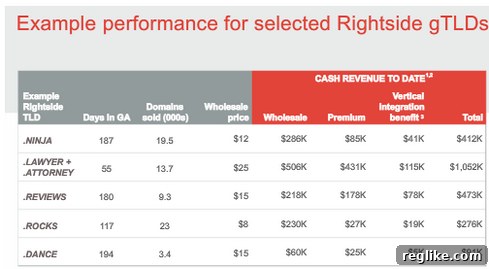
Tracy Knox, CFO of Rightside, presented a compelling chart illustrating the initial financial results from five of Rightside’s TLDs launched to date, as of November 30:
Deconstructing Revenue Streams: Wholesale, Premium, and Vertical Integration
The financial data presented offers a granular view of Rightside’s revenue streams. The “Wholesale” column represents the revenue received by Rightside as the registry for standard domain registrations. The “Premium” column signifies additional income derived from various sources, including early access periods like Sunrise and Landrush/EAP (Early Access Program), as well as the sales of premium domain names. The “Vertical Integration Benefit” is a testament to Rightside’s comprehensive business model, accounting for the markup generated by Rightside’s own registrars from selling Rightside-owned domains. As SVP Steve Banfield previously noted, Rightside registrars contribute approximately a quarter of all Rightside SLD (Second-Level Domain) registrations to date, underscoring the synergistic benefits of their integrated operations.
Highlighting Standout Performers: .lawyer, .attorney, .reviews, and .ninja
A striking observation from the chart is the substantial premium revenue generated by TLDs such as .lawyer, .attorney, and .reviews. These figures clearly indicate strong market demand and successful monetization strategies for highly targeted professional and service-oriented namespaces.
The performance of .Ninja also merits special attention. Despite having only 19,500 domains registered as of November 30, this TLD grossed an impressive $412,000. Notably, .Ninja was an uncontested application, meaning Rightside faced no competition for its acquisition. On a gross revenue basis, this TLD effectively paid for its application fee within a mere few months, demonstrating remarkable profitability and rapid return on investment, validating Rightside’s meticulous TLD selection process.
Navigating the Landscape: The Case of .Dance
While some TLDs like .ninja enjoyed rapid success, others, such as .Dance, experienced a slower initial uptake. With 3,400 registrations, .Dance is progressing at a more measured pace. However, even with these comparatively modest numbers, it has already recouped approximately half of its application fee. This illustrates the long-term potential of TLD investments and the varied trajectories of success within the new gTLD market, where patience and sustained marketing efforts play a crucial role.
Conclusion: Rightside’s Pioneering Path in the Digital Frontier
Rightside’s inaugural Investor & Analyst Day provided an invaluable look into the strategic depth and operational prowess of a leading player in the new gTLD space. Their data-driven approach to TLD acquisition, sophisticated premium domain identification platform, disciplined auction strategy, and robust financial performance metrics collectively paint a picture of a company adept at navigating the complexities and capitalizing on the immense opportunities within the evolving digital landscape. As the new TLD market continues to mature, Rightside’s foundational strategies and early successes position it as a formidable and innovative force, poised for sustained growth and continued leadership in shaping the future of the internet’s address book.