Attorney’s Controversial LinkedIn Post Sparks Outrage Over “Manipulation of TMs” and “Reverse Domain Name Hijacking”
The world of intellectual property law and domain name disputes is often contentious, but a recent revelation involving a lawyer’s professional profile has sent shockwaves through the industry. The controversy centers around a statement made by an attorney, where he explicitly listed “manipulation of TMs and common law marks to achieve UDRP ‘reverse domain name hijacking'” as part of his professional responsibilities. This startling admission, found on a publicly accessible LinkedIn profile, raises serious ethical questions and has ignited a fierce debate about the integrity of certain legal practices in domain dispute resolution.
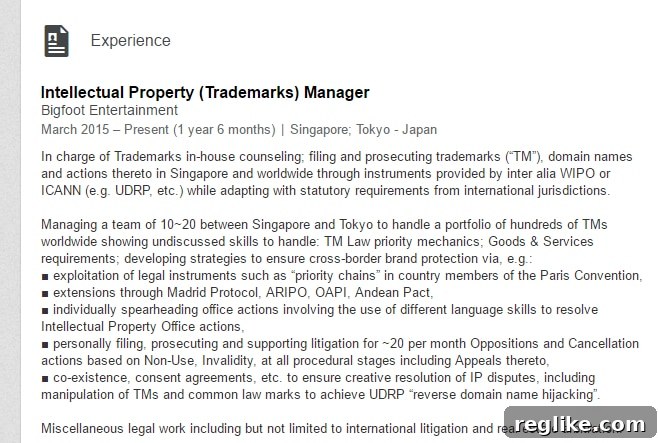
The spotlight first fell on Bigfoot Entertainment, a company frequently associated with various intellectual property and domain name related activities. As observers delved deeper into the operations and affiliations of Bigfoot Entertainment, a discovery was made that exposed a particularly troubling aspect of its legal strategy. The LinkedIn profile of Marco Notarnicola, an attorney associated with Bigfoot Entertainment, contained language that many found to be not only astonishing but also deeply concerning given the sensitive nature of domain name disputes and trademark law.
Upon reviewing the attorney’s LinkedIn profile, the specific claim that caused such an uproar was immediately apparent. It appeared under the section detailing his responsibilities and expertise:
co-existence, consent agreements, etc. to ensure creative resolution of IP disputes, including manipulation of TMs and common law marks to achieve UDRP “reverse domain name hijacking”.
The inclusion of terms like “manipulation of TMs” (Trademarks) and “reverse domain name hijacking” (RDNH) in a professional summary by an attorney is, to put it mildly, deeply perplexing and alarming. Such a statement, suggesting a deliberate intent to pervert the course of justice in domain disputes, flies in the face of established legal ethics and the fundamental principles of fair play in intellectual property law.
Understanding UDRP and the Gravity of “Reverse Domain Name Hijacking”
To fully grasp the magnitude of this statement, it’s essential to understand the mechanisms involved. The Uniform Domain-Name Dispute-Resolution Policy (UDRP) is an internationally recognized administrative procedure designed to resolve disputes between trademark holders and domain name registrants. Established by the Internet Corporation for Assigned Names and Numbers (ICANN), the UDRP provides an efficient and relatively inexpensive alternative to traditional litigation for resolving certain types of domain name conflicts. Under the UDRP, a complainant (trademark holder) must prove three elements to succeed:
- The domain name is identical or confusingly similar to a trademark or service mark in which the complainant has rights.
- The registrant has no rights or legitimate interests in respect of the domain name.
- The domain name has been registered and is being used in bad faith.
The UDRP is a vital tool for legitimate brand protection, yet it is not without its vulnerabilities. One of the most egregious abuses of the UDRP system is known as “Reverse Domain Name Hijacking” (RDNH).
What is Reverse Domain Name Hijacking (RDNH)?
Reverse Domain Name Hijacking occurs when a trademark holder files a UDRP complaint in bad faith, attempting to obtain a domain name from a legitimate registrant. The purpose of an RDNH attempt is not to protect a legitimate trademark, but rather to harass the domain owner, disrupt their business, or simply acquire a desirable domain name without paying for it. Panelists appointed to resolve UDRP disputes have the authority to make a finding of RDNH if they determine that the complainant knew or should have known that they did not have the rights to the domain name, or that they were misrepresenting facts to unfairly gain control of a domain.
A finding of RDNH is a serious indictment of a complainant’s conduct and their legal counsel. It implies a deliberate misuse of an administrative process designed for legitimate disputes. For an attorney to openly state that their role includes manipulating marks to “achieve” such an outcome is not just an ethical lapse; it suggests a fundamental disregard for the integrity of the UDRP process and the principles of fair competition.
The Troubling Concept of “Manipulation of TMs and Common Law Marks”
The phrase “manipulation of TMs and common law marks” itself is deeply unsettling. Trademark law is built on principles of distinctiveness, use, and preventing consumer confusion. “Manipulation” in this context could imply several unethical and potentially illegal actions, such as:
- Creating phantom rights: Fabricating or exaggerating the scope of trademark rights where none legitimately exist, or where they are extremely weak.
- Misrepresenting use: Claiming use in commerce that is non-existent or minimal to establish common law rights over a domain name.
- Broadening scope: Illegitimately attempting to expand the scope of a registered trademark beyond its actual goods and services to encompass the activities associated with a domain name.
- Abuse of process: Using legal technicalities or loopholes to manufacture a claim of infringement that would otherwise not stand up to scrutiny.
Such tactics undermine the very foundation of trademark protection, turning it into a weapon for opportunistic gain rather than a shield against legitimate infringement. For a legal professional, whose role is to uphold the law and ensure fair representation, to engage in or advocate for such manipulation is a profound betrayal of their professional duties and ethical obligations.
A Strategic Blunder and Ethical Quagmire
Beyond the ethical implications, the public disclosure of such a statement on a professional networking site like LinkedIn represents an extraordinary strategic misstep. In the realm of domain disputes, UDRP proceedings are often highly scrutinized. Any party facing a UDRP complaint from Bigfoot Entertainment or any affiliated entity could now potentially use this attorney’s own words as evidence in their response. It provides undeniable proof of an alleged intent to engage in bad-faith practices, severely damaging the credibility of any future complaint filed by the firm or its clients.
The statement effectively hands ammunition to any potential respondent. It suggests a pre-meditated strategy to circumvent the legitimate purpose of the UDRP, turning a supposedly impartial dispute resolution mechanism into a tool for achieving a desired outcome through questionable means. This could lead to panelists scrutinizing complaints from Bigfoot Entertainment and its counsel with an even higher degree of skepticism, making it more challenging for them to succeed even in genuinely meritorious cases.
The Attempted Clarification: A Further Conundrum
In response to the initial outcry and inquiries, the attorney in question reportedly updated his LinkedIn profile. The revised statement read:
co-existence, consent agreements, etc. to ensure creative resolution of IP disputes, including manipulation of TMs and common law marks to recognize cases of UDRP “reverse domain name hijacking”.
While the word “achieve” was replaced with “recognize cases of,” the core problem persists, and arguably, the revision introduces new layers of illogicality. How does one “manipulate” trademarks to “recognize” cases of RDNH? The concept is inherently nonsensical. Manipulation implies active, intentional alteration or influence to gain an advantage, not a passive recognition of an existing state.
If the intent was to recognize when *others* are engaging in RDNH, the phrasing “manipulation of TMs” remains entirely out of place. One does not manipulate trademarks to identify someone else’s wrongdoing; rather, one analyzes the existing facts and legal precedents. The revised statement, instead of clarifying, further obfuscates the attorney’s true intent and underscores a lack of understanding or perhaps an unwillingness to fully retract a questionable position.
The inconsistency is further highlighted by the mention of other professionals. As the original article implies, if the attorney is so adept at “recognizing cases of RDNH” through trademark manipulation, why would a peer, Romon Popov, who filed a UDRP for Slized.com, allegedly not “recognize” if that case itself constituted an RDNH attempt? This disconnect casts a shadow of doubt over the firm’s internal ethical compass and its understanding of the very principles it claims to navigate.
Broader Implications for the Domain and IP Communities
This incident sends a chilling message to the broader domaining community, which often finds itself at the receiving end of UDRP complaints. Domain investors, legitimate businesses, and individuals who register domain names in good faith depend on a fair and impartial dispute resolution process. Statements like the one under scrutiny erode trust in the system and contribute to a perception that the UDRP can be weaponized by those willing to bend ethical boundaries.
For the intellectual property community, it serves as a stark reminder of the importance of professional ethics and accountability. Lawyers hold a position of trust, and any suggestion of deliberately manipulating legal instruments to achieve unjust outcomes damages the reputation of the entire profession. Bar associations and regulatory bodies may need to consider how such public declarations align with codes of professional conduct.
Conclusion: Upholding Integrity in Domain Name Disputes
The controversial statement made by the attorney associated with Bigfoot Entertainment underscores a critical need for transparency and unwavering ethical conduct in the resolution of domain name disputes. While “co-existence” and “consent agreements” represent legitimate and desirable outcomes for IP disputes, the inclusion of “manipulation of TMs and common law marks to achieve UDRP ‘reverse domain name hijacking'” presents an unacceptable departure from professional standards.
Whether an unfortunate misstatement, an ill-advised boast, or a deliberate declaration of intent, the original and even the revised LinkedIn entry highlight a profound misunderstanding or disregard for the principles underpinning trademark law and the UDRP. The integrity of the domain name system, and indeed the broader legal profession, relies heavily on the commitment of its practitioners to fairness, honesty, and adherence to established ethical guidelines. Such incidents serve as a vital wake-up call, emphasizing that accountability and ethical conduct must remain paramount in all facets of intellectual property litigation and dispute resolution.