
Trademark Squatting Spree: An Audacious Attempt to Claim Global Brands and Celebrity Names
In a move that has sent ripples through the intellectual property community, an entity known as Trademark King Inc. has embarked on an ambitious, and arguably misguided, campaign to file trademark applications for an extensive list of highly recognizable brand names, celebrity personas, and their corresponding domain names. This widespread filing spree raises critical questions about trademark intent, brand protection, and the often-misunderstood nuances of intellectual property law.
This isn’t the first time Trademark King Inc., linked to an individual named Douglas Lehocky, has made headlines for such unconventional tactics. A few weeks prior, the Indiana-based company drew attention for attempting to trademark “Trademarking.com,” a domain name already owned by prominent domain investor Rick Schwartz. When confronted about the existing ownership of the domain, Lehocky’s response was notably bold: he asserted that prior domain ownership was irrelevant. His perspective, as communicated, was that securing the trademark first would grant him superior rights, empowering him to demand the domain’s transfer, even through legal channels if necessary. He further posited that his experience in buying and selling trademarks provided him with a unique insight into the process, suggesting an understanding that might be at odds with established legal precedents.
The Escalation: From Single Domain to Global Brand Targets
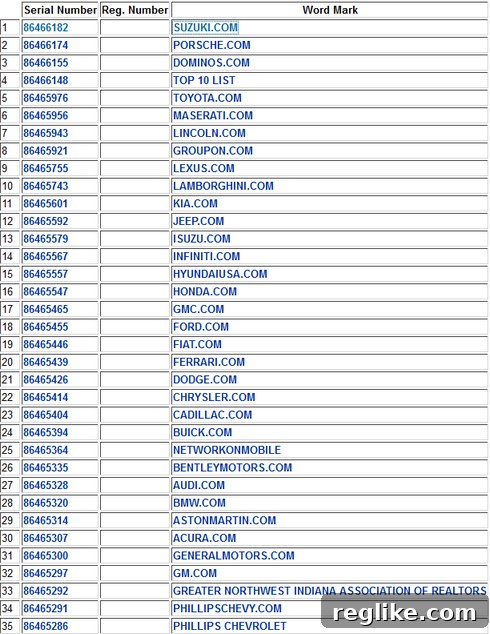
What initially seemed like an isolated, albeit misguided, trademark application has now revealed itself as part of a much larger and more aggressive strategy. Recent checks of the United States Patent and Trademark Office (USPTO) applications database expose a pattern of filings targeting an astonishing array of high-value intellectual property. Trademark King Inc. is not merely focused on a single niche; their filings span multiple industries and categories, reflecting a broad attempt to claim ownership over some of the world’s most valuable brands.
The list of targeted entities reads like a who’s who of global commerce and popular culture. Major automotive manufacturers, with their instantly recognizable names and vast market presence, are among the primary targets. Beyond the automotive sector, the applications extend to include world-renowned celebrity names such as music icon Elton John, baseball legend Pete Rose, and boxing immortal Muhammad Ali. For each of these prominent figures, corresponding domain names have also been included in the trademark applications, hinting at a clear strategy to leverage both brand identity and online presence.
The ambition doesn’t stop there. Trademark King Inc. has also filed applications related to some of the internet’s most dominant platforms and major consumer brands. These include names like Google.com, Target.com, YouTube.com, Twitter.com, and Facebook.com. Furthermore, iconic sporting events and leagues are not exempt from this expansive filing spree, with applications observed for NCAA Final Four, NFL.com, NBA.com, and NHL.com.
A comprehensive list of these audacious applications filed by Trademark King Inc. can be reviewed here, offering a detailed look at the extent of this filing campaign.
Understanding the Trademark “Goods and Services” Description
Each trademark application requires a specific description of the “goods and services” for which the mark will be used. For the applications filed by Trademark King Inc., the descriptions consistently fall under International Class 035 (IC 035), which pertains to Advertising and Business services. The precise wording used is:
IC 035. US 100 101 102. G & S: Brand development and evaluation services in the field of trademarks, trade names, and domain names.; Creating trademarks for others.
These descriptions indicate an intent to provide services related to brand development, evaluation, and the creation of trademarks for third parties. While these services are legitimate business activities, the critical issue arises when these service descriptions are paired with trademark applications for names already famously and extensively used by other entities. The claimed “first use” dates for these applications are primarily in late November, a detail that is often crucial in establishing trademark rights.
The Legal Roadblocks: Why This Strategy is Likely to Fail
The strategy employed by Trademark King Inc. fundamentally misunderstands key principles of intellectual property law in the United States. While filing a trademark application is a procedural step, the actual rights to a trademark are predominantly established through “use in commerce” and public recognition, particularly for well-known brands. Here’s why this approach is fraught with legal peril:
1. Common Law Trademark Rights and Famous Marks
Many of the brands and names targeted – Google, Facebook, NFL, Elton John – possess incredibly strong common law trademark rights, accumulated over years, sometimes decades, of consistent and extensive use in commerce. These rights exist even without a federal registration. For “famous marks,” the standard of protection is even higher, offering broader safeguards against dilution and tarnishment. Attempting to trademark these names for “brand development services” will almost certainly be rejected on the grounds that it creates a likelihood of confusion with the existing, famous brands.
2. Likelihood of Confusion
The cornerstone of trademark law is preventing a “likelihood of confusion” among consumers. Would a consumer reasonably believe that “Brand development and evaluation services” offered under the name “Google” are somehow affiliated with, endorsed by, or originated from Google LLC? The answer is overwhelmingly yes. The USPTO examiners will rigorously assess this likelihood, and the proposed marks for established brands are highly likely to be refused on these grounds.
3. Bad Faith and Trademark Squatting
Filing trademark applications primarily to profit from the goodwill of another’s brand, or with the intent to extort payment for the rights, is considered “bad faith.” This practice, often referred to as trademark squatting, is generally not tolerated by the USPTO or the courts. While the applicant might argue legitimate intent for their services, the pattern of targeting globally recognized brands and corresponding domain names strongly suggests an underlying motive to capitalize on existing fame rather than genuinely build a new brand. Such intent can lead to a refusal of registration and potential legal repercussions.
4. The Anti-Cybersquatting Consumer Protection Act (ACPA)
Regarding the domain names listed in the applications (e.g., Google.com, NFL.com), the Anti-Cybersquatting Consumer Protection Act (ACPA) provides strong legal recourse for trademark owners against those who register, traffic in, or use a domain name identical or confusingly similar to a distinctive or famous trademark with a bad-faith intent to profit from that mark. Douglas Lehocky’s expressed intent to “take down” domain names based on trademark filings could be interpreted as a bad-faith intent, leaving him vulnerable to legal action under the ACPA.
5. USPTO Examination and Opposition Proceedings
Even if an application manages to navigate the initial stages, the USPTO’s examination process involves a thorough review by an examining attorney who searches for prior marks. Given the prominence of the targeted names, it’s highly improbable that these applications would pass without a refusal. Furthermore, should any of these applications be published for opposition, the actual brand owners (e.g., Google, NFL, the estates of celebrities) would have a robust legal avenue to formally oppose the registration, citing their prior rights and the likelihood of confusion or dilution.
The Inevitable Clash: Big Brands Won’t Wait and See
While an individual like Rick Schwartz might adopt a “wait-and-see” approach, relying on the strength of his existing domain ownership and the impracticality of such a challenge, multi-billion dollar corporations and celebrity estates operate differently. These entities possess vast legal resources and are fiercely protective of their intellectual property, which represents billions in brand equity and goodwill. They understand that allowing such filings to proceed unopposed could set a dangerous precedent or dilute the strength of their marks.
For Trademark King Inc. to expect a lucrative payoff from these filings would be a profound miscalculation. Major corporations do not typically pay “ransom” for what they already legitimately own. Instead, they will deploy their legal teams to swiftly and decisively challenge such applications, not just to prevent registration but potentially to seek damages, legal fees, and even sanctions against the applicant for engaging in vexatious litigation or bad-faith practices.
The costs involved in prosecuting and defending trademark applications and potential lawsuits are staggering. For the applicant, this represents significant filing fees, potentially substantial legal counsel fees, and the risk of adverse judgments. For the established brands, it’s an investment to protect their core assets, an investment they are more than willing to make.
Lessons for Brand Owners: Proactive Vigilance is Key
This saga serves as a powerful reminder for all brand owners, from burgeoning startups to global enterprises, about the critical importance of proactive intellectual property protection. Regularly monitoring trademark applications, registering your marks in all relevant classes, and vigilantly defending your domain names are not merely optional steps but essential components of a robust brand strategy. The digital age has made brand identity more vulnerable to opportunists, necessitating constant vigilance against trademark squatting and cyber-squatting.
Conclusion: A High-Stakes Gamble with Predictable Outcomes
The aggressive trademark filing strategy by Trademark King Inc. represents a high-stakes gamble built on a flawed interpretation of intellectual property law. While the audacity of the filings is undeniable, the legal framework is overwhelmingly designed to protect genuine brand owners who have established their rights through diligent use and investment. The USPTO’s role is to uphold the integrity of the trademark system, ensuring that consumers are not confused and that true innovators and brand builders are safeguarded.
The impending confrontations between Trademark King Inc. and the formidable legal teams of the targeted global brands and celebrities are likely to result in a resounding reaffirmation of established intellectual property principles. In this arena, legitimate use, prior rights, and good faith intentions will almost certainly prevail over speculative filings, underscoring the fundamental purpose of trademark law: to protect consumers and reward innovation, not opportunism.