
The High-Stakes Battle for France.com: Jean-Noël Frydman’s Quest for Supreme Court Intervention
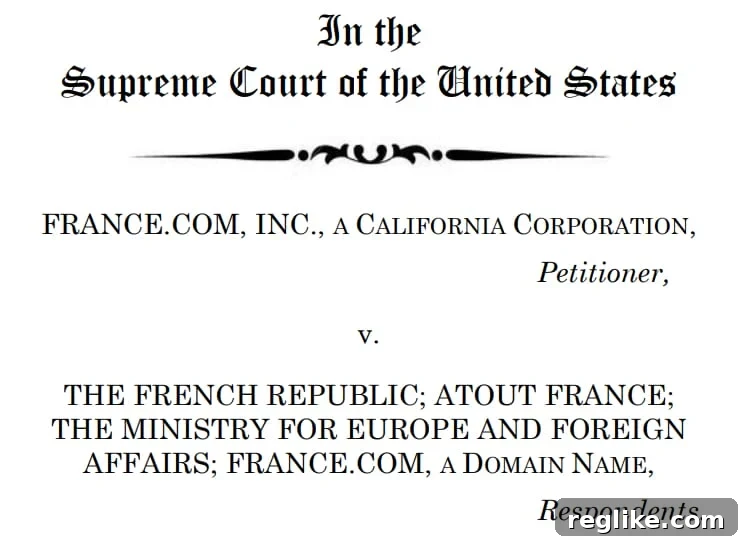
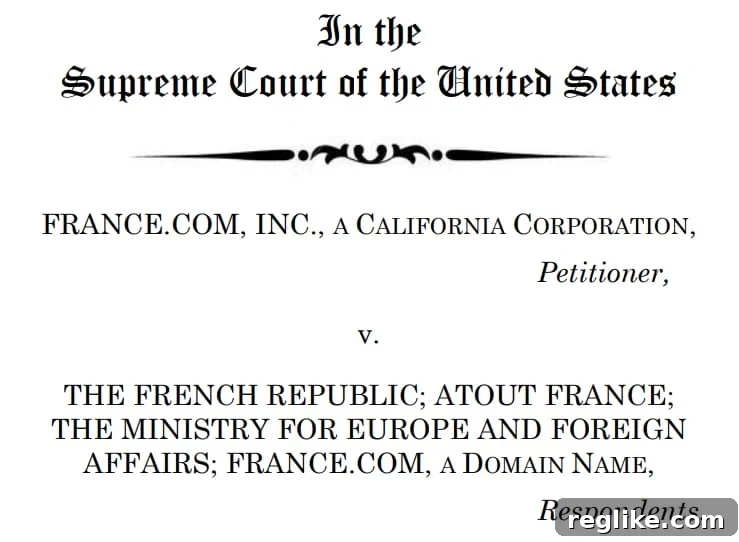
The digital realm, often perceived as a borderless frontier, frequently clashes with the sovereignty of nations. Few cases illustrate this tension as vividly as the protracted legal saga surrounding the France.com domain name. At its heart lies a relentless battle between Jean-Noël Frydman, a pioneering entrepreneur who registered the domain in 1994, and the French Republic, which asserts an inherent right to control its national identity online. After years of litigation spanning two continents, the dispute has now reached the highest court in the United States, as Frydman petitions the U.S. Supreme Court to weigh in on this unprecedented case.
A Digital Pioneer’s Vision: The Genesis of France.com
In the nascent days of the internet, when many were still grappling with the concept of email, Jean-Noël Frydman displayed remarkable foresight. In 1994, he registered “France.com,” securing what would become one of the most valuable and iconic domain names associated with a sovereign nation. For over two decades, Frydman’s company, France.com, Inc., built a thriving enterprise around this digital asset. It evolved into a comprehensive online portal, serving as a vital resource for travel, culture, news, and information related to France. Millions of users, from tourists planning their dream vacations to Francophiles seeking cultural insights, relied on the platform built by Frydman. The domain name wasn’t merely an address; it was a brand, a global gateway to everything French, carefully cultivated and maintained by Frydman’s dedication.
The value of France.com extended far beyond its immediate commercial success. It represented a prime example of early internet entrepreneurship, where visionaries claimed digital territory that would later become fiercely contested. Frydman’s operations generated substantial revenue, fostered cultural exchange, and employed numerous individuals, contributing significantly to the online travel and information sector. For twenty-four years, France.com, Inc. operated unhindered, a testament to the legitimacy of its registration and the robust business model it employed.
The French Republic’s Claim to Digital Sovereignty
The serenity of Frydman’s digital domain was shattered in 2014 when the French Republic, through its tourism agency Atout France and the Ministry for Europe and Foreign Affairs, intervened in a trademark dispute initiated by Frydman’s company in Paris against a Dutch entity. This intervention marked the beginning of a relentless legal campaign by the French government to reclaim the France.com domain name. The core of their argument was a bold assertion of national sovereignty: under French law, the name “France” cannot be appropriated or used commercially by a private enterprise. The government contended that doing so violates the French Republic’s exclusive right to its name and infringes on its sovereignty, viewing the domain as a national emblem rather than a commercial asset.
The French government successfully convinced successive courts in France that it, and not a private entity based in the U.S., should rightfully own France.com. These rulings were grounded in the principle that a nation’s name is inalienable and essential to its identity and public interest. For Frydman, these decisions represented a severe blow, effectively stripping him of an asset he had legally registered and meticulously developed for decades. The culmination of this phase of the dispute came in 2018 when, armed with a copy of the Paris Court of Appeals decision, the French government approached Web.com, Frydman’s domain registrar. Citing the French court orders, Web.com transferred the France.com domain name to the French Republic, effectively dismantling Frydman’s business overnight and severing his connection to the digital identity he had pioneered.
Shifting Battlegrounds: The U.S. Courts and Sovereign Immunity
Undeterred by the loss of his domain in France, Jean-Noël Frydman brought his fight to the United States. In 2018, he initiated legal proceedings in a U.S. court, seeking to challenge the domain transfer and regain control of France.com. His company, France.com, Inc., is a California corporation, and the domain registrar, Web.com, is based in the U.S., providing a jurisdictional basis for the American lawsuit. However, the French Republic swiftly invoked a powerful legal defense: sovereign immunity under the Foreign Sovereign Immunities Act (FSIA).
The FSIA is a U.S. federal law that generally shields foreign states from lawsuits in U.S. courts, with specific, limited exceptions. The French government argued that its actions in reclaiming France.com were governmental, not commercial, and therefore protected by this act. Frydman’s legal team likely countered by arguing for exceptions to the FSIA, such as the “commercial activity” exception, contending that the French government’s actions had a direct commercial effect in the United States and were undertaken in a commercial capacity. They might also have argued that the domain transfer constituted a taking of private property without due process, an action that should not be shielded by sovereign immunity.
Despite Frydman’s arguments, the Court of Appeals for the Fourth Circuit ultimately sided with the French government, upholding its claim of sovereign immunity. This decision was a significant setback, as it effectively blocked Frydman’s ability to sue the French Republic in U.S. federal courts. Following this ruling, Frydman petitioned the appeals court for an en banc rehearing, a request for the full panel of appellate judges to reconsider the case, typically reserved for cases of exceptional importance or to resolve conflicts within the circuit. However, his petition was rejected, signaling the exhaustion of his options at the appellate level.
The Supreme Court Awaits: A Landmark Petition for Certiorari
With avenues in both French and U.S. appellate courts exhausted, Jean-Noël Frydman’s fight for France.com now rests on the slender hope of intervention from the U.S. Supreme Court. Frydman has formally petitioned for a writ of certiorari, requesting the nation’s highest judicial body to review his case. A writ of certiorari is a discretionary order, meaning the Supreme Court is not obligated to hear the case. It typically grants certiorari only for cases that present significant legal questions, involve conflicts among lower courts, or touch upon issues of profound national importance.
Frydman’s petition undoubtedly highlights several critical legal questions that could warrant Supreme Court review. These include the interpretation and application of the Foreign Sovereign Immunities Act in an era of globalized digital assets, the extent to which a foreign government can assert sovereign rights over a generic country-name domain registered by a private entity in another nation, and the implications for property rights in the digital age. The case pits fundamental concepts of internet governance and private ownership against claims of national sovereignty, raising complex questions about the interplay of international law and domestic jurisdiction. A Supreme Court decision, whether to grant or deny certiorari, would send a powerful message about how such disputes will be handled in the future. If granted, the Court’s ultimate ruling could establish a precedent with far-reaching consequences for domain ownership, digital sovereignty, and the limits of sovereign immunity in the context of international commercial activity.
Wider Implications: Digital Sovereignty and the Future of the Internet
The France.com saga transcends a mere dispute over a website address; it delves into fundamental questions about national identity in the digital age and the control over symbolic online assets. This case is not isolated; it resonates with broader discussions about “digital sovereignty,” where nations seek to exert control over their digital borders, data, and online presence. While country-code top-level domains (ccTLDs) like .fr are clearly under the control of their respective nations, generic top-level domains (gTLDs) like .com present a more complex scenario when they directly reference a country name.
The “incredible value” of the France.com domain name is undeniable. Beyond its potential market price, it represents unparalleled branding power and a direct, intuitive link to an entire nation’s tourism, culture, and economy. The implications of this dispute extend to other generic domains that bear the names of countries (e.g., Italy.com, Spain.com) and the businesses built around them. If the French government’s stance is fully validated, it could set a precedent where other nations might attempt to reclaim similar high-value, country-specific domains, potentially destabilizing established property rights in the digital space and creating a new frontier of international legal conflict.
For international businesses and internet governance bodies, the outcome of Frydman’s petition and any subsequent Supreme Court review will be closely watched. It could influence how domain name registrars operate, how international trademark laws interact with national sovereignty claims, and how the global internet community balances the principles of open access and private ownership against the assertions of national states. This long and arduous fight, spearheaded by Jean-Noël Frydman, underscores the persistent tension between the global, decentralized nature of the internet and the enduring power of national borders and laws. The digital battle for France.com is far from over, and its resolution promises to shape the landscape of digital sovereignty for years to come.
Jean-Noël Frydman hasn’t given up yet. His unwavering determination reflects not just the commercial value of his lost business, but a deeper principle about the rule of law and the rights of innovators in the digital age. As the U.S. Supreme Court considers his petition, the world watches to see if this pivotal case will indeed become a landmark in the ongoing evolution of internet law and international relations.