
Beyond Registrations: A Deeper Look into Top-Level Domain Success Metrics
The digital landscape is constantly evolving, with new top-level domains (TLDs) frequently joining the internet’s extensive directory. As the internet continues to expand and new gTLDs roll out, assessing their success becomes increasingly vital. While traditional metrics offer a foundational understanding, a more nuanced approach is necessary to truly gauge a TLD’s health and impact.
For years, the success of a TLD has been primarily measured through straightforward, quantifiable metrics. These have certainly served their purpose, providing registries, investors, and the wider domain community with critical insights. However, as the ecosystem matures and specialized TLDs emerge, the limitations of these conventional yardsticks become more apparent.
Traditional TLD Evaluation: A Necessary But Incomplete Picture
When evaluating TLD performance, several key indicators immediately come to mind. These metrics are often the first point of reference for industry analysts and stakeholders:
Domains Under Management (DUM): The Volume Metric
Often referred to as total domains or total registrations, Domains Under Management (DUM) is arguably the most straightforward metric. It quantifies the sheer number of domain names registered under a specific TLD. Registries, in particular, pay close attention to this figure as it directly reflects their market share and potential reach. A high DUM count can indicate strong initial interest and widespread adoption, signaling a TLD’s perceived value in the marketplace. However, DUM alone doesn’t reveal the quality of these registrations; it doesn’t differentiate between actively used websites, parked domains, or speculative holdings.
Registry Revenue: The Financial Health Indicator
From a registry’s perspective, revenue is paramount. This metric is influenced by several factors, including the base registration fees, renewal rates, and crucially, the sale of premium domains. Some TLDs strategize by charging higher initial prices or by offering a significant number of premium names at elevated costs, directly impacting their revenue streams. High revenue ensures the financial sustainability of a registry, allowing for continued investment in infrastructure, marketing, and community support. While essential for business operations, revenue figures don’t necessarily reflect the utility or success of individual websites built on the TLD.
Community Service & Specific Use Cases: The Qualitative Dimension
For certain TLDs, particularly those designed for specific communities or purposes (e.g., .org for non-profits, .edu for educational institutions, or emerging niche gTLDs like .photography or .doctor), “success” can be more challenging to quantify. Here, fuzzy numbers around how well the TLD serves its intended community or facilitates its specific use case come into play. This might involve evaluating user engagement, the creation of relevant content, or the extent to which the TLD fosters a sense of identity and belonging for its users. These qualitative assessments, while vital for certain TLDs, are inherently subjective and harder to standardize across the entire domain landscape.
Introducing a New Lens: Evaluating Active Website Success
While the aforementioned metrics provide valuable data, they often fall short in answering a critical question: how many registrants are genuinely creating *successful, active websites* using a particular TLD? The true health of a domain space isn’t just about how many names are registered, but how many of those names are being actively developed into thriving online presences that generate traffic, engage users, and contribute meaningfully to the web.
To address this gap, we propose an alternative, complementary method for evaluating TLD success: analyzing the prevalence of active and high-traffic websites built on a given TLD. This approach shifts the focus from mere registration volume to actual utility and value creation.
Leveraging Third-Party Data: The Alexa Top Million Proxy
A readily available and widely recognized source of data for this kind of analysis is Alexa’s list of top million sites. While the methodology and impact of services like Alexa have evolved over time, its historical role as an indicator of web traffic and popularity makes it a useful proxy for identifying “successful” websites. For the purpose of this analysis, a site’s presence in the Alexa Top Million suggests it is generating significant traffic and maintaining a notable online footprint.
By cross-referencing the number of domains from the Alexa Top Million list with the total number of registered domains for various TLDs, we can derive insights into how effectively each TLD fosters active and visible websites. For a truly comparative analysis, it’s crucial to consider TLDs that provide transparent monthly reporting to organizations like ICANN and possess a substantial number of registrations (e.g., over 50,000) to ensure statistical relevance.
The numbers generated from such an analysis offer a compelling new perspective:
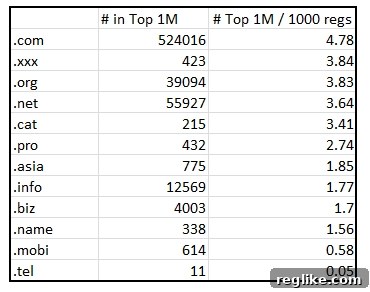
As illustrated by the conceptual data, such an analysis typically presents two critical columns. The first column would display the absolute number of sites under a specific top-level domain that rank within Alexa’s Top Million. This figure gives an initial sense of a TLD’s overall representation among highly trafficked sites. However, to truly understand the efficiency and inherent quality of a TLD, the second column becomes indispensable. This metric shows how many domains per 1,000 registered for the TLD are featured in Alexa’s Top Million. This normalized value allows for a fair comparison between TLDs of vastly different sizes, highlighting which TLDs have a higher proportion of actively successful websites relative to their total registrations.
Nuances and Limitations of the “Active Success” Metric
It’s important to acknowledge that no single metric is perfect, and this approach, while insightful, comes with its own set of considerations and potential “holes” that need to be understood for a comprehensive evaluation:
- Varying TLD Purposes: Some TLDs are not primarily intended for traditional websites. For instance, a TLD like .tel, while registrable, is designed more for contact information and digital identity than for hosting extensive web content. Measuring its success purely by website traffic might be misleading. Similarly, TLDs like .app might see more success through API usage or mobile app integrations rather than purely web-based traffic.
- Niche vs. General TLDs: The gross number of domains in the top million might not fully capture the success of niche TLDs. A TLD like .wine might have fewer total registrations and thus fewer sites in the Alexa Top Million than .com, but a very high percentage of its registered domains might be actively used by vineyards, sommeliers, and wine enthusiasts, indicating strong success within its specific vertical. The “per 1,000 domains” metric helps mitigate this, but context is always key.
- Definition of “Success”: What constitutes a “successful site” can be subjective. While Alexa traffic is a good proxy, success can also mean achieving specific business objectives (e.g., lead generation, e-commerce sales, brand building) that aren’t always directly proportional to general web traffic rankings. A highly specialized B2B site might have lower traffic but generate substantial revenue.
- Data Source Reliability: While Alexa has been a long-standing source, the landscape of web analytics is dynamic. Other proxies for site success could include search engine indexing, backlink profiles, social media engagement, and domain authority scores. Relying on a single source, even a prominent one, requires acknowledging its inherent biases and limitations.
Nonetheless, despite these nuances, looking at the proportion of active, successful sites within a TLD provides another interesting and highly valuable way to cut the data, offering insights beyond simple registration counts.
Insights from Country Code Top-Level Domains (ccTLDs)
Analyzing country code Top-Level Domains (ccTLDs) adds another layer of complexity and intrigue to this discussion. Tracking their total registration numbers can be more challenging due to varied national regulations, diverse reporting standards, and sometimes less centralized data availability compared to generic TLDs (gTLDs) managed by ICANN.
Interestingly, when examining the “active success” metric, some ccTLDs demonstrate exceptional performance. For example, specific data points often reveal that domains like .gr (Greece), .jp (Japan), and .ru (Russia) show remarkably high rankings overall, sometimes even well ahead of the global powerhouse, .com, on a normalized basis. This superior performance can be attributed to several factors:
- Strong Local Preference: In many countries, there is a strong cultural or legal preference for using the local ccTLD for businesses and individuals operating within that nation. This fosters a vibrant local internet ecosystem.
- Less Speculation: Compared to highly global and often speculative gTLDs like .com, many ccTLDs have stricter registration requirements (e.g., local presence), which can lead to a higher percentage of domains being registered for actual development and use rather than for parking or reselling.
- Active Local Content: A high concentration of local content and services often thrives on ccTLDs, attracting consistent local traffic and engagement, thus increasing their chances of ranking highly in web traffic metrics.
This observation underscores the importance of considering the specific context and purpose of a TLD. While .com remains dominant in sheer volume, the effectiveness and utility rate of certain ccTLDs within their respective geographies offer a powerful testament to their success.
The Future of TLD Evaluation: A Holistic Approach
As the domain name industry continues to mature, especially with the ongoing rollout of new gTLDs, the methods we employ to assess TLD success must evolve in tandem. Relying solely on registration figures or revenue, while important, paints an incomplete picture. The “active success” metric, by focusing on the number of thriving websites, adds a crucial dimension to this evaluation.
For registries, this data suggests a shift in focus from merely accumulating registrations to actively fostering an environment where registrants can build successful online presences. This could involve providing better development tools, offering educational resources, building vibrant user communities, and promoting best practices for website creation and growth. The goal should be to encourage not just registration, but active and valuable utilization of domain names.
For registrants, this analysis reinforces the importance of choosing a TLD that aligns with their goals and audience, and crucially, committing to developing a high-quality, engaging website. A domain name is merely an address; its true value is unlocked through the content and functionality it hosts.
Ultimately, a holistic approach that integrates traditional metrics with more qualitative and usage-based indicators like the “active success” metric will provide the most comprehensive understanding of a TLD’s true health and its contribution to the broader internet ecosystem. This multi-faceted evaluation will be key to navigating the increasingly complex and diverse world of top-level domains.