
The global economy has undeniably entered a period of significant uncertainty, marking its first recessionary phase since the Great Recession of 2008. While the underlying causes for these downturns differ vastly – one stemming from a financial crisis, the other catalyzed by a global pandemic – the prevailing sentiment across industries remains one of profound unpredictability. In these turbulent times, understanding how various sectors react to economic pressure is crucial. This analysis delves into the domain industry, examining its resilience and evolution by comparing its performance during the 2008 recession with its current trajectory in 2020, offering insights into potential future trends.
The year 2020 stands as a watershed moment in history. What began with the anticipation of an overdue economic slowdown quickly transformed into an unprecedented global health crisis, leading to widespread lockdowns and a fundamental shift in daily life. Years from now, we will undoubtedly reflect on 2020 with a blend of disbelief and recognition for the monumental changes it ushered in. This unique juncture also provides an opportune moment to revisit the 2008 recession, our most recent benchmark for understanding economic downturns, and extract relevant lessons for the digital age.
Navigating Past Storms: Lessons from the 2008 Recession
For the burgeoning new domain industry, the current economic climate represents its inaugural encounter with a global recession. Consequently, looking back at the performance of legacy domain trends immediately preceding and following 2008 offers invaluable, albeit imperfect, guidance. To this end, we meticulously analyzed available data for years surrounding the 2008 crisis, focusing on key metrics for established Generic Top-Level Domains (gTLDs).
The data from this period provides a clear picture of how the domain market reacted to severe economic headwinds. Between 2004 and 2008, the annual growth in DUMs (Domains Under Management) for legacy gTLDs exhibited robust expansion, consistently increasing by at least 20% year-over-year. However, the onset of the 2008 recession marked a significant deceleration in this growth. In 2008, the year-over-year growth rate dropped notably to approximately 12%, followed by a further dip to around 6% in 2009. This sharp decline underscored the immediate impact of economic contraction on business expansion and digital investment.
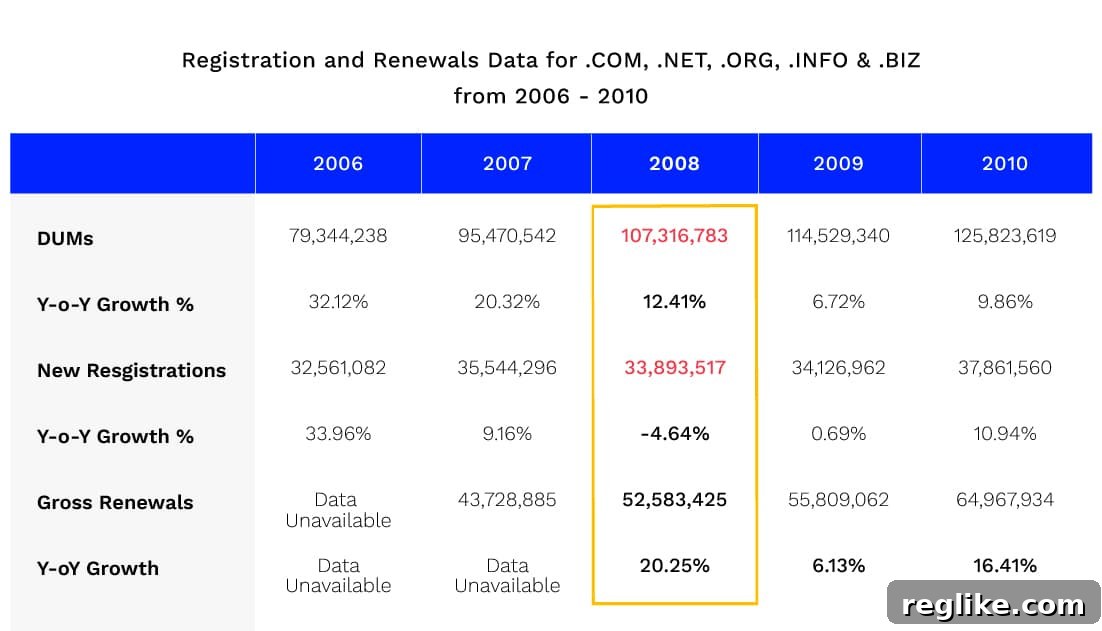
Assumptions and Data Details:
- Legacy gTLDs included in this analysis are .com, .net, .org, .info, and .biz.
- New registration data for .COM & .NET in ICANN Reports commences from April 2007. Data for 2003-2006 was estimated using Blended Retention Ratios, with Q1 2007 based on Quarterly Ratios.
- New registration data for .ORG & .BIZ in ICANN Reports begins from January 2007. Data for 2003-2006 was similarly estimated based on Blended Retention Ratios.
- All primary data was sourced from ICANN Monthly Registry Reports (https://www.icann.org/resources/pages/registry-reports).
Beyond initial registrations, renewal rates also served as a critical indicator of market health. The first-year renewal rates for legacy gTLDs experienced a significant downturn in 2009, plummeting to 45% from an average of approximately 58% in the preceding years. This decline can be attributed to a confluence of factors: the pervasive negative market sentiment, the speculative nature of some domain registrations, and the immense financial pressure on businesses, many of which were forced to cut non-essential expenses or ceased operations altogether. The quality and intended use of domain names also played a role; domains registered purely for speculative purposes, without a clear business plan, were often the first to be abandoned.
Additional Data Considerations:
- The numbers presented for DUMs and growth rates specifically pertain to .com, .net, .org, .info, and .biz domains.
- All data was diligently gathered from ICANN Monthly Registry Reports (https://www.icann.org/resources/pages/registry-reports).
- A second and subsequent year retention rate of 85% was assumed for calculation purposes.
The Unprecedented Surge: Domain Registrations in Early 2020
Fast forward to 2020, and the initial response from the domain industry has been remarkably different. Publicly available data indicates a notable surge in domain name registrations since February 2020. Legacy gTLDs, specifically, witnessed an approximately 5% jump in new registrations in March 2020, followed by an even more significant 10% increase in April 2020, when compared to their average monthly registrations in 2019. This unexpected spike suggests a unique reaction to the current crisis.
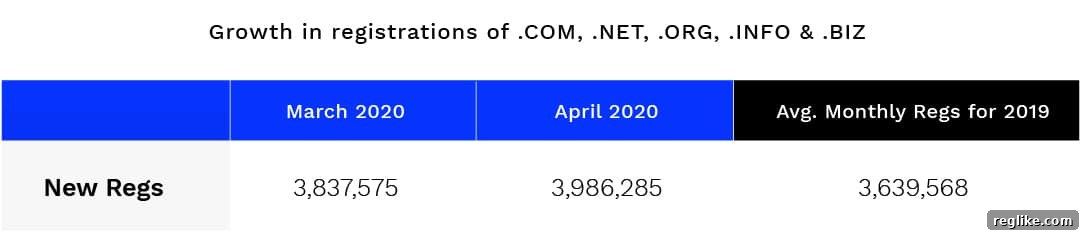
This surge is indeed positive news for our industry. At Radix, for instance, we observed a substantial 15-20% rise in overall registration volumes. This growth wasn’t confined to standard domain registrations; premium domain registrations also saw a 22% increase, contributing to a 15% boost in premium domain revenue between March and May, compared to the preceding six months. This trend was particularly evident across our portfolio:
- .online domains experienced a remarkable 45% increase in premium registrations and a 38% rise in revenue.
- .store domains saw an even more dramatic uptake, with a 70% increase in premium registrations and a staggering 93% surge in revenue.
Such figures clearly indicate a widespread urgency among businesses across various sectors to establish or enhance their online presence. The demand for meaningful, brandable domain names, especially those that directly communicate a business’s purpose, has become paramount in this rapidly digitizing environment. Companies are actively seeking digital identities that resonate with their offerings, whether it’s an online presence (.online) or an e-commerce storefront (.store).
However, despite these encouraging figures, it is premature to celebrate unequivocally. While we anticipate that a significant portion of these new registrations will be backed by genuine, long-term usage, we must also acknowledge the possibility that some of this surge could be the result of knee-jerk, reactive decisions made under duress. Businesses, suddenly forced into remote operations or online sales, may have rushed to secure domains without fully developed strategies. Therefore, a cautious approach is warranted when projecting future renewal rates. The true test of these registrations will come in the subsequent years, revealing which ones translate into sustainable online ventures.
A New Digital Paradigm: Why This Time is Different
Crucially, we cannot overlook the fundamental differences between the current socio-economic landscape and that of 2008. The world in 2020 is immeasurably more reliant on the internet than it was a decade ago. In 2008, the internet was a significant tool; in 2020, it is an indispensable utility, foundational to almost every aspect of modern life and commerce. The pandemic has not merely accelerated a pre-existing trend; it has dramatically intensified and solidified the transition from offline to online for virtually every business and institution globally.
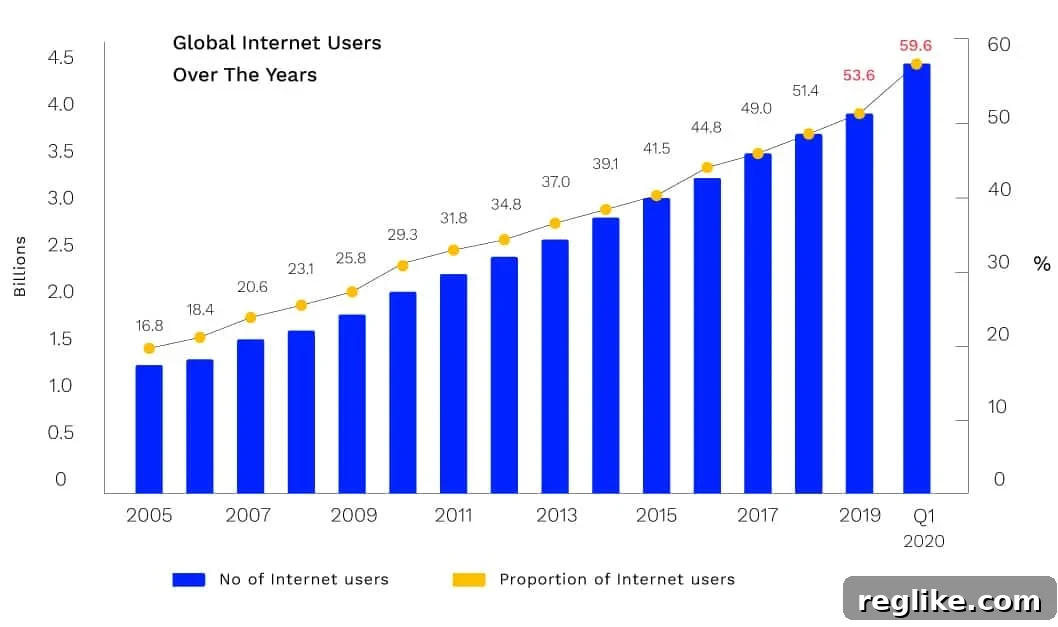
The sheer number of global internet users has exploded since 2008, transforming the digital landscape. This unprecedented reliance creates a unique scenario for the domain industry. Small businesses that once relied solely on brick-and-mortar operations are now pivoting to e-commerce; educational institutions are shifting to virtual learning platforms; healthcare providers are adopting telehealth solutions; and remote work has become the new norm for millions. Each of these transitions necessitates a robust, reliable, and easily discoverable online presence – starting with a domain name.
The demand for domain names is no longer just about establishing a website; it’s about securing a digital identity, a brand’s cornerstone in a world where physical proximity has been restricted. Domains facilitate communication, transactions, education, and entertainment on a scale unimaginable just a few years ago. As more businesses, government services, and even local community groups rapidly evolve their technology usage, the domain industry finds itself at the very heart of this digital transformation, playing a truly crucial and enabling role.
The Road Ahead: Balancing Caution with Optimism
Given these contrasting dynamics – the cautionary tales from 2008 versus the unprecedented digital acceleration of 2020 – predicting the future of the domain industry becomes a complex exercise. At Radix, we operate on data-driven insights. Yet, at this unique juncture, historical data, while informative, cannot provide a foolproof roadmap for what lies ahead. The fundamental shift in internet dependency introduces variables that simply didn’t exist in previous recessions.
While the initial surge in registrations in 2020 may carry a degree of speculative behavior, the overarching trend of digital adoption points towards a more resilient and growth-oriented future for the domain industry. The current economic climate, unlike 2008, is actively pushing more individuals and entities online out of necessity. This isn’t merely a reactive measure but a fundamental reshaping of how businesses operate and how consumers engage.
Therefore, while proceeding with caution is prudent, particularly concerning renewal rates, there is also ample reason for optimism. The domain industry is not merely weathering a storm; it is an essential enabler in the global digital transformation. Providers must focus on offering value, fostering meaningful usage, and supporting businesses in their online journey. The long-term success of these new registrations will depend on their integration into viable, sustainable online strategies. The future, while uncertain, strongly suggests an increasingly vital role for domain names in an ever-more connected world.