
Unveiling Verisign’s Vision: A Patented System for Securing Future Domain Name Rights Through “Encoding Domains”
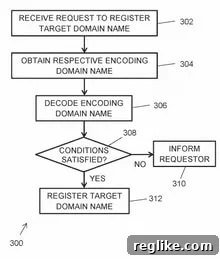
In a groundbreaking move poised to reshape the landscape of domain name acquisition and management, Verisign (NASDAQ: VRSN), the esteemed steward of the lucrative .com registry, has initiated a novel strategy by filing two intriguing patents. These intellectual property applications detail an innovative method for acquiring future rights to domain names, long before they become officially available. This ingenious approach, centered around what Verisign terms “encoding domains,” introduces a fascinating new dimension to the domain ecosystem, prompting industry observers to ponder the strategic implications for one of the internet’s foundational companies.
While both patent applications were filed concurrently, only one has seen the light of day thus far. Application number 15/488984, titled “Domain Name Registration Reservation Through the Use of Encoding Domain Names,” was originally submitted on April 17, 2017, and recently made public. This document outlines a sophisticated system designed to allow individuals or entities to reserve a priority claim on specific domain names that are currently registered but are anticipated to become available at a future date. The accompanying, yet unpublished, patent application, “Domain Name Registration Reservation Through the Use of Encoding Domain Names for Pools,” hints at an even broader scope, suggesting the ability to reserve rights for a collection or “pool” of domain names. The full implications of this twin-patent strategy remain partially veiled, awaiting the public release of the second application.
The core innovation described in the published patent application revolves around a meticulously designed system for “backordering” domain names. This mechanism springs into action when a domain name becomes available due to a predetermined event, such as its expiration on a specific date, or when its current registrant actively chooses to relinquish ownership. Unlike traditional backordering services that often engage in a competitive “drop-catching” frenzy, Verisign’s proposed system introduces a structured and potentially more orderly method for securing these valuable digital assets, fundamentally altering the competitive dynamics of domain acquisition.
Understanding the Mechanics: How “Encoding Domains” Function
At the heart of this patented system lies the concept of an “encoding domain.” This isn’t a traditional domain name in the sense of hosting a website or email services. Instead, it serves as a unique digital placeholder, explicitly created and registered to represent a future right to another, target domain name. The encoding domain itself would either directly embed crucial information about the reserved right or, alternatively, refer to an external database that meticulously manages and tracks these rights. This clever distinction allows for flexibility in how the rights are stored and managed, potentially accommodating a vast number of reservations without overburdening the DNS itself.
The rights secured through an encoding domain can be highly specific, targeting a single, identified domain name, or they can be broader, encompassing a designated “pool” of domain names. The application provides two illuminating examples that clarify this distinction:
-
Specific Domain Reservation: Imagine you’re interested in acquiring “example.com” should it expire on a particular date. The patent suggests an encoding domain name such as “dn–example-20170328.com”. In this construct, “dn” likely signifies “domain name,” followed by the target domain “example” and the specific deletion date “20170328.” Registering this encoding domain would effectively reserve your right to register “example.com” on March 28, 2017, provided it becomes available.
-
Pool of Domain Reservations: For a broader approach, consider the scenario where you wish to secure a first-priority right to select any domain name that becomes available on a particular day. An encoding domain name like “dp–20170326-1.com” could be utilized. Here, “dp” might stand for “domain pool,” followed by the date “20170326” and a priority rank “1.” This encoding domain grants the holder the premier claim to any domain deleted on March 26, 2017, offering a versatile option for those looking to capitalize on general domain availability rather than a single specific target.
One of the most compelling aspects of this patented system is the inherent transferability of these encoding domains. Much like conventional domain names, the ownership of an encoding domain can be bought, sold, and transferred between parties. This implies that the underlying right to a future domain name can also be seamlessly transferred. For instance, if you hold the first-priority right to register “example.com” upon its expiration, you could, in essence, sell and transfer that valuable right to another interested party simply by transferring the ownership of the corresponding encoding domain. This introduces a fascinating new asset class into the domain aftermarket, creating fresh opportunities for investors and brokers.
Furthermore, the patent envisions a system that accommodates multiple, ranked rights to the same target domain. This means that more than one party could express interest in a particular domain name, each holding a different priority level. For example, one entity might possess the first-priority right to register “example.com,” while another holds a second-priority right. Should the holder of the first right fail to exercise their option, the second-priority holder would then have the opportunity to claim the domain. This multi-tiered system adds a layer of sophistication and potential fairness to the backordering process, moving beyond a simple “first-come, first-served” model.
Verisign’s Strategic Play: Unpacking the Motivations
This ingenious yet complex idea immediately sparks a myriad of questions, particularly regarding the strategic intentions of Verisign, an entity that holds significant influence over the internet’s most critical namespace, .com. What grander scheme might Verisign be orchestrating with this innovative patent portfolio? While the complete picture may only emerge with the publication of the second patent application, several compelling theories suggest Verisign’s multifaceted motivations:
1. Capturing a Share of the Expiration Market Profit
The most direct and perhaps controversial interpretation is that Verisign aims to insert itself directly into the highly profitable domain expiration and drop-catching market. Currently, this ecosystem generates substantial revenue for registrars, backorder services, and domain investors who vie fiercely for expiring domain names. By establishing a formalized system for reserving future rights, Verisign could effectively capture a portion of this significant profit pool. However, such a move would undeniably be controversial, likely inviting intense scrutiny from regulators and antitrust bodies. Critics might argue that it leverages Verisign’s unique position as the registry operator to create an unfair competitive advantage, potentially stifling innovation and competition within the existing drop-catching industry.
2. Bringing Order and Predictability to the Expiration Process
Alternatively, Verisign’s true objective might be to introduce much-needed order and transparency to the often chaotic and resource-intensive existing expiration process. Currently, when a domain name expires, numerous registrars and drop-catching companies simultaneously “ping” Verisign’s systems, attempting to be the first to re-register the coveted name. This can lead to system strain and an unpredictable “race” for valuable domains. Verisign could leverage the encoding domain system to streamline this process by granting registrars a predetermined number of encoded domains for each day, effectively allocating ranked rights to domains scheduled to expire. This would transform a frenetic race into a more structured allocation, aligning with Verisign’s previously demonstrated interest in exploring ways to modify the drop process to enhance efficiency and fairness across the ecosystem.
3. Facilitating New Top-Level Domain (TLD) Launches and Allocation
The patent’s concept could also find significant application in the dynamic world of new top-level domains. New TLDs frequently launch with “pools” of premium or reserved domain names that require a structured allocation mechanism. The encoding domain system could provide an elegant solution for this. It could enable the allocation of ranked selection rights on the very day a new TLD is released, allowing interested parties to secure priority claims to desirable names without a free-for-all rush. The patent text explicitly states that encoding domains can reside in a different TLD than the one for which rights are granted. This crucial flexibility means that, for example, a right to a domain in a yet-to-be-launched new TLD could be reserved using an encoding domain within a well-established TLD like .com, providing a stable platform for future reservations.
4. Revolutionizing the Domain Aftermarket
Beyond expirations and new launches, this system holds significant potential to transform the domain aftermarket. Imagine a scenario where an individual or business identifies a currently registered domain name that they desperately wish to acquire but is not actively for sale. Through Verisign’s proposed system, they could register an encoding domain for that specific target domain, signaling their interest and a willingness to pay a set price. This act could trigger a notification or an offer to the current domain owner, inquiring whether they would be willing to relinquish their rights for the specified amount. If the owner accepts, the right embedded in the encoding domain would then be exercised, facilitating a structured and transparent transaction. This mechanism could inject new life into the aftermarket, creating a more efficient pathway for buyers to express intent and for sellers to monetize dormant assets, moving beyond traditional cold outreach or speculative inquiries.
Broader Implications and Industry Concerns
While various aspects of this patent are undoubtedly innovative and intriguing, they also cast a long shadow of concern over several key stakeholders within the domain industry. Registrars, who currently derive significant revenue from drop-catching and backordering services, could see their business models profoundly impacted or even disrupted. Domain investors, whose strategies often hinge on acquiring expiring valuable domains, may need to adapt to a new paradigm where priority rights are established much earlier in the domain lifecycle. Similarly, specialized drop-catching companies, built entirely around the current expiration mechanics, could face an existential threat if Verisign’s system becomes widely adopted.
Beyond these immediate industry-specific concerns, there’s a broader philosophical question about the role of a registry operator like Verisign. With its immense power and control over the .com namespace, any move to centralize or monetize aspects of domain acquisition traditionally handled by the market could invite rigorous examination regarding market fairness, competition, and potential overreach.
Verisign’s Enduring Patent Strategy: A Long-Term Vision
Reflecting on this patent application also offers insights into Verisign’s overarching intellectual property strategy. Back in 2013, Verisign publicly discussed the monetization of its extensive patent portfolio. However, this discussion was subsequently, at least publicly, tabled. It’s plausible that asserting patents directly against other registries or industry players could be perceived as a substantial risk for Verisign, especially while it remains committed to diligently holding onto its critical .com contract and navigating regulatory landscapes, such as its Cooperative Agreement with the NTIA (National Telecommunications and Information Administration).
However, once Verisign secures and clears its Cooperative Agreement with the NTIA, a potentially ingenious strategic option emerges: the sale of its entire patent portfolio to a third-party entity, coupled with a license-back agreement. This maneuver would allow Verisign to continue leveraging its patented technologies in its core operations without the direct burden or public relations fallout associated with patent enforcement. Such a strategy would afford Verisign a substantial financial gain from the sale, while simultaneously creating an “arm’s-length” distance from any aggressive actions the patent buyer might choose to take against other market participants. This would strategically position Verisign to profit from its innovations while mitigating direct controversy, cementing its long-term influence in the evolving digital asset economy.
In conclusion, Verisign’s “encoding domains” patent represents a significant conceptual leap in how domain name rights are conceived, reserved, and transferred. It signals a potential paradigm shift, moving towards a more structured and perhaps more centralized approach to managing future domain availability. The full impact will unfold as Verisign’s strategy becomes clearer, particularly with the eventual publication of its second, related patent. For now, the domain industry watches with keen interest, poised for what could be a transformative chapter in the history of internet infrastructure.