
Kassey Lee explores the dynamic landscape of domain name and website usage across China, drawing insights from the latest industry data.
In the vast and rapidly evolving digital realm of China, fundamental questions often arise for global businesses and astute domain investors alike: Does the venerable .com still hold its unchallenged supremacy? What is the true significance and market penetration of the country-code top-level domain .cn? And beyond these two giants, are there any other domain extensions that warrant close observation within this unique market? To provide comprehensive answers, this analysis delves into the findings of the authoritative annual publication, “China Statistical Report on Internet Development,” with a particular focus on its most recent release.
Unlocking China’s Digital Growth: A Market with Immense Potential
Before diving into the specifics of domain usage, it’s crucial to grasp the overarching digital landscape. China currently boasts an astounding 772 million internet users, a figure that dwarfs many national populations. However, this impressive number represents only approximately 56% of the nation’s total populace. This significant gap is not a limitation but rather a profound indicator of the enormous room for future growth. As more Chinese citizens gain internet access, the demand for a myriad of online products and services will inevitably skyrocket, directly fueling the necessity for more innovative and accessible websites.
This potential is further illuminated when examining the number of operational websites within China. The reported count has expanded to 5.3 million, yet this figure remains strikingly modest when juxtaposed with the approximately 90 million companies registered by the National Bureau of Statistics of China. This substantial disparity can be attributed to several factors: many companies may not yet have an online presence, while others primarily conduct their business through established e-commerce platforms such as JD.com or social media ecosystems like WeChat. Nevertheless, a growing trend indicates that these businesses will eventually seek to establish their own proprietary websites. The drive behind this transition is a desire for greater brand control, direct customer engagement, independent data ownership, and enhanced search engine optimization (SEO) capabilities—all critical components for sustainable long-term growth. Consequently, we can anticipate a sustained and robust demand for domain names in China for the foreseeable future, making it a compelling market for strategic investment and development.
Navigating the Ebb and Flow: A Historical Perspective of the Chinese Domain Market
The total number of registered domains in China reached an impressive 38 million by December 2017, reflecting a market that has experienced significant expansion and intriguing fluctuations over the years. Understanding these historical trends is key to forecasting future movements and making informed decisions.
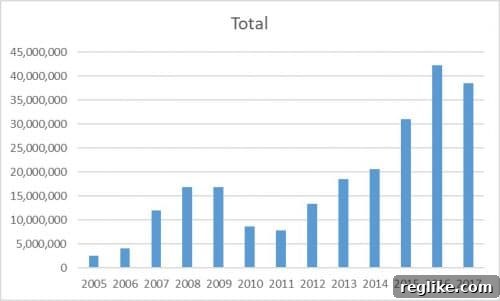
A glance at the historical data reveals a dramatic surge in the market during 2007. This period was largely characterized by speculative fervor, particularly for .cn domains, which were made exceptionally attractive by registration fees as low as 30 cents per domain. This ultra-low entry barrier, combined with growing interest in the Chinese market, led to a boom driven more by speculative investment than by genuine end-user demand. However, this speculative bubble was short-lived. In 2009, the Chinese government introduced stringent new regulations requiring all domain owners to submit detailed personal information and photo identification. This measure, aimed at increasing transparency and combating illicit online activities, significantly impacted the market, causing a sharp decline in registrations. The new rules were particularly challenging for international investors, many of whom found compliance difficult or simply chose to let their domains lapse. Major domain registrars also reacted; Godaddy, for instance, even temporarily suspended .cn registrations in 2010 and did not reinstate the service until early 2016, highlighting the significant disruption caused by the policy change.
The market demonstrated resilience, initiating a recovery phase around 2012, propelled by a healthier underlying demand for both .cn and .com domains from actual businesses and end-users. This period marked a shift towards more organic growth. Yet, another wave of speculative activity emerged between 2015 and 2016, leading to rapid growth rates of 51% and 36% respectively. This resurgence was fueled by new investment trends, specifically “Chip” domains (referring to short, valuable Chinese premium domains) and long number domains, which gained popularity due to cultural associations with luck and prosperity in China. However, like its predecessor, this speculative cycle eventually cooled. As the profitability of these domains diminished and holding costs accumulated, many investors opted to let their registrations expire, contributing to a notable drop in the overall domain count in 2017. These cycles of boom and bust underscore the importance of understanding both real demand and speculative influences in the Chinese domain market.
Dominant Players and Emerging Contenders: A Deep Dive into Domain Extensions
Beginning in 2013, the official survey provides valuable granular data on the performance of individual domain extensions within China. This allows for a more detailed analysis of market share and growth trajectories for key TLDs.
| Year | 2013 | 2014 | 2015 | 2016 | 2017 |
|---|---|---|---|---|---|
| cn | 10829480 | 11089231 | 16363594 | 20601491 | 20845513 |
| com | 6311480 | 7949939 | 10997941 | 14345243 | 11307915 |
| net | 743996 | 910031 | 1415001 | 1633071 | 1288239 |
| info | 64515 | 47624 | 26107 | 224321 | 1170601 |
| org | 164476 | 232614 | 397970 | 330457 | 253819 |
| biz | 51742 | 85483 | 70770 | 210062 | 154322 |
| .中国 (China) | 274553 | 285395 | 352785 | 474115 | 1895745 |
| Others | 369 | 209 | 1396346 | 4456942 | 1564201 |
| Total | 18440611 | 20600000 | 31020514 | 42275702 | 38480355 |
The Reigning Powers: .com and .cn
From the data, it is unequivocally clear that .cn and .com remain the undisputed major players in the Chinese domain market. With market shares typically hovering around 50% for .cn and 30% for .com, these two extensions together command the vast majority of registrations. Both are deeply entrenched as mainstream extensions within China’s digital ecosystem and have maintained their strong positions for over a decade. For any entity considering investment or establishing a digital presence in China, these are the primary candidates for consideration. While .com often reigns supreme in terms of premium pricing and global recognition, .cn holds the title as the queen in terms of sheer quantity and local relevance. In corporate China, particularly among larger enterprises and those with international aspirations, .com is frequently the first and preferred choice due due to its universal trust and brand equity.
For those specifically looking to invest in or utilize .cn domains, an important nuance is the structure of these domains. Single-dot (second-level) .cn domains, such as example.cn, are overwhelmingly the norm, accounting for approximately 80% of all .cn registrations. In contrast, the largest third-level domain category, .com.cn (e.g., example.com.cn), holds a much smaller share, around 11%. This preference for simpler, single-dot domains aligns with a broader global trend towards brevity and ease of recall for consumers. Simplified domain structures enhance user experience and facilitate more streamlined branding efforts.
Beyond the Giants: Extensions to Watch
While .com and .cn dominate, other extensions show interesting patterns. The .net extension, for instance, has demonstrated consistent growth, expanding from a mere 0.2 million registrations in 2005 to approximately 1.3 million by 2017 (disregarding the short-term speculative peaks). This indicates a steady, underlying demand, likely from businesses and individuals seeking alternatives to the more saturated .com and .cn spaces.
More notably, both .info and the Chinese-character domain .中国 (China) are extensions that warrant close attention. Both broke the significant 1 million registration mark in 2017, signalling their increasing acceptance and utility within the market. .info, as a more general informational TLD, may appeal to a diverse range of users. The growth of .中国 is particularly significant as it represents a cultural embrace of local language domains, aligning with national pride and catering to a vast population that primarily uses Chinese characters. To a lesser extent, .biz has also shown an increase in registrations, albeit with more modest numbers.
Unfortunately, many of the newer generic top-level domains (gTLDs) launched in recent years remain categorized under the “Others” segment in the report. This suggests that, individually, they have not yet achieved sufficient scale or market penetration to warrant separate listing, indicating that the Chinese market, while vast, remains largely conservative in its adoption of new domain extensions, preferring the established and trusted options.
Key Considerations for Engaging the Chinese Digital Consumer
The “China Statistical Report on Internet Development” also offers invaluable insights extending beyond mere domain statistics, providing crucial context for anyone aiming to successfully interact with Chinese internet users and potential domain buyers. One of the most distinctive features of China’s digital evolution is its unique trajectory: the nation largely “skipped” the traditional desktop PC era, transitioning directly into a mobile-first, and now increasingly mobile-only, internet age. As a direct consequence, a staggering 98% of all internet users in China access the web primarily through their mobile phones.
This mobile-first imperative has profound implications for digital strategy. If your objective is to market or sell domains to Chinese buyers, it is absolutely paramount that your sales landing pages, promotional materials, and any online presence are meticulously designed and optimized for mobile devices. A website that is not responsive, loads slowly on mobile, or provides a poor user experience on a smartphone will likely deter Chinese prospects instantly, regardless of the value proposition of your domain.
Furthermore, communication preferences in China differ significantly from many Western markets. A remarkable 92% of Chinese internet users rely heavily on messaging applications, most notably WeChat, as their primary tool for daily communication. WeChat, far more than just a messaging app, is an expansive ecosystem encompassing social networking, mobile payments, e-commerce, and various daily services. Chinese consumers are perpetually active on these platforms, engaging with them 24/7. This widespread adoption means that leveraging messaging apps for business communication can yield significantly faster and more direct responses from Chinese buyers compared to traditional email, which, while used, is far less popular and often less effective for rapid engagement in China. Integrating WeChat or similar platforms into your communication strategy is not just an advantage; it’s a necessity for effective outreach.
The Bright Future of the Chinese Domain Market
In summation, the future trajectory of the Chinese domain market appears undeniably bright, with continued growth and evolution expected. The sheer scale of its internet user base, combined with the increasing digitalization of its economy, ensures a steady stream of demand. Within this dynamic landscape, .com firmly maintains its position as the king, particularly favored by corporate China for its global recognition, established trust, and its ability to command premium prices. Alongside it, .cn stands as the queen, dominating in terms of sheer registration numbers, driven by wider availability, strong local relevance, and often more accessible pricing points compared to its global counterpart.
Looking ahead, domain extensions such as .info and the culturally significant .中国 (China) are emerging as key players to watch. Their recent growth trajectory suggests increasing adoption and relevance, potentially offering new avenues for investors and businesses seeking to establish a targeted presence. As China’s digital economy matures and expands further, understanding these nuances and adapting to the mobile-first, social-driven consumer behavior will be crucial for success in this captivating and continually expanding domain market.