
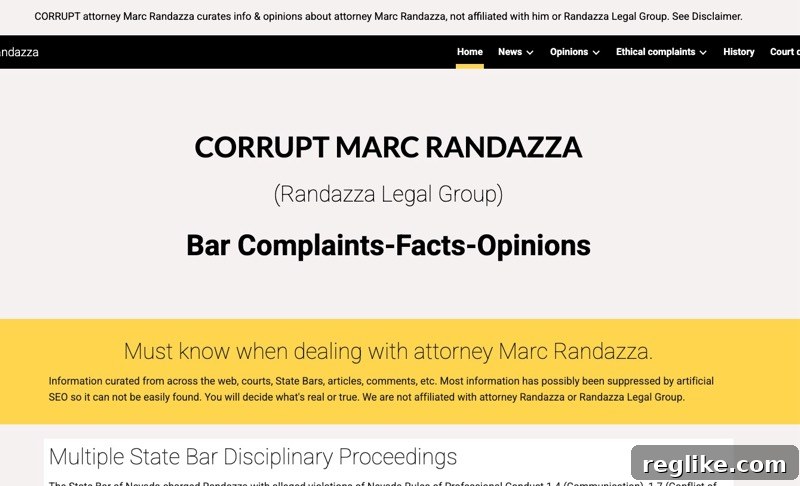
UDRP Victory for Gripe Site: ‘CorruptRandazza.com’ Case Upholds Free Speech in Domain Disputes
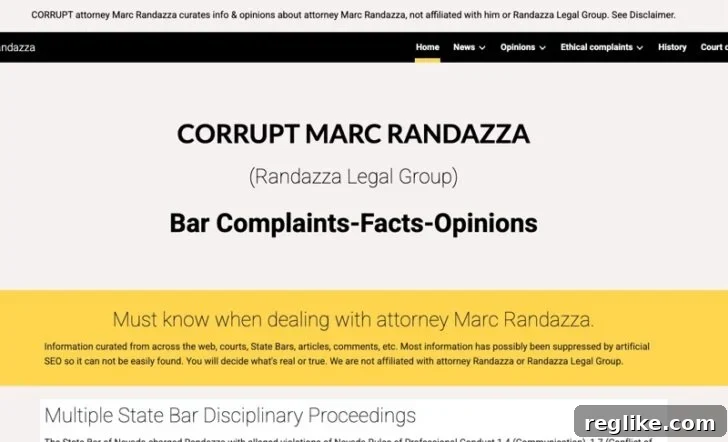
In a significant decision highlighting the delicate balance between trademark rights and freedom of expression online, prominent attorney Marc John Randazza has lost a cybersquatting dispute filed against a critical gripe site. The case, involving the domain name CorruptRandazza.com, has set a notable precedent, distinguishing legitimate criticism from actionable cybersquatting under the Uniform Domain-Name Dispute-Resolution Policy (UDRP).
Randazza initiated the complaint targeting CorruptRandazza.com, a website dedicated to publishing various allegations and complaints against him. Initially, the dispute was lodged against Dwight Schar Victims Inc., but Don Karl Juravin was subsequently added as a respondent. This addition is particularly noteworthy given the extensive and often contentious legal history between Randazza and Juravin, a rivalry that has frequently played out in various courtrooms and dispute forums.
Understanding the UDRP: A Framework for Domain Name Disputes
To fully grasp the implications of this decision, it’s essential to understand the UDRP. The Uniform Domain-Name Dispute-Resolution Policy is a streamlined administrative procedure designed to resolve disputes concerning abusive domain name registrations, commonly known as cybersquatting. Established by the Internet Corporation for Assigned Names and Numbers (ICANN), the UDRP allows trademark holders to seek the transfer or cancellation of domain names that unlawfully infringe upon their trademarks.
For a complainant to succeed under the UDRP, they must prove three cumulative elements:
- The domain name is identical or confusingly similar to a trademark or service mark in which the complainant has rights.
- The respondent has no rights or legitimate interests in respect of the domain name.
- The domain name has been registered and is being used in bad faith.
Gripe sites, by their nature, often challenge the second and third elements, arguing that their use of a domain name incorporating a trademark is legitimate criticism and not an attempt to profit from or mislead consumers about the trademark holder’s brand. This particular case hinged precisely on these nuances, demonstrating the UDRP’s limitations when it comes to regulating freedom of speech and critical commentary.
The Critical Distinction: “Corrupt” as a Game-Changer
Central to Panelist Lawrence K. Nodine’s decision was the presence of the word “corrupt” within the disputed domain name. Nodine explicitly differentiated this case from a prior UDRP victory Randazza secured against Juravin, which involved the domain marcrandazza.legal. In that earlier case, Randazza successfully obtained a UDRP transfer.
Panelist Nodine articulated the crucial difference:
Respondent is not impersonating Complainant. The inclusion of the term “corrupt” in the Disputed Domain Name plus the very clear critical content on the related website prevents Internet users from mistakenly perceiving that the Disputed Domain Name is sponsored or affiliated with Complainant. The inclusion of “corrupt” in the Disputed Domain Name also distinguishes Complainant’s prior case against Respondent, which, unlike the present case, considered and transferred a domain name that did not include a derogatory term, and, accordingly, failed the impersonation test.
This statement underscores a fundamental principle in domain name disputes: the intent behind the registration. When a domain name like marcrandazza.legal is registered without any clear indicator of criticism, it can easily be perceived as an official or endorsed site, thus failing the “impersonation test.” Users might mistakenly believe it’s affiliated with Marc Randazza himself. However, by adding an unequivocally derogatory term like “corrupt,” the domain immediately signals that it is a site of criticism, complaint, or opposition. This clear intent prevents user confusion and nullifies the argument that the site is trying to impersonate or deceptively associate with the trademark holder. It shifts the domain from potential cybersquatting to protected free speech.
Beyond Traditional Commercial Use: Randazza’s Argument Dismissed
Another key aspect of the panelist’s decision involved the dismissal of Randazza’s argument regarding “commercial advantage.” Randazza contended that while the domain’s “use is not commercial in the traditional sense of directing users to a competitor, he is using the Infringing Domain Name for commercial advantage by trying to deprive parties with whom he is currently in litigation of their counsel of choice.”
Panelist Nodine, however, rejected this expansive interpretation of “commercial use.” UDRP panels typically interpret “commercial use” in the context of generating direct economic benefit, diverting traffic for sales, or misleading consumers for profit. While the existence of a gripe site could indirectly affect a professional’s reputation or client acquisition, framing this as “commercial advantage” in the UDRP sense proved unsuccessful. This ruling reinforces the idea that the UDRP is a specific tool for trademark infringement and cybersquatting, not a general mechanism to suppress all forms of criticism that might have incidental financial or reputational consequences. Forcing parties out of their choice of counsel, while potentially disruptive, does not squarely fall within the UDRP’s established definition of bad faith commercial use.
A History of Domain Disputes: Randazza’s UDRP Record
Marc Randazza is no stranger to the world of domain name disputes. His firm has been a legal representative in dozens of UDRP disputes, underscoring his extensive experience in this specialized area of law. His track record includes both wins and losses, each case contributing to the evolving landscape of domain name jurisprudence.
For instance, in 2012, Randazza won a UDRP against a detractor who had registered domains referring to Randazza’s family. Such cases often involve different considerations, particularly when domain names are registered with clear malicious intent, harassment, or to target individuals’ personal lives rather than their professional conduct or services. The distinction lies in whether the domain primarily aims to impersonate, confuse, or genuinely harass, versus clearly communicate criticism or opinion.
The earlier win against Juravin over marcrandazza.legal further highlights this point. That domain, without a critical modifier, could be seen as an attempt to capitalize on Randazza’s personal brand name in a way that implies endorsement or official status. This contrasts sharply with CorruptRandazza.com, where the explicit addition of “corrupt” signals a clear intent to criticize, thus establishing a legitimate interest under UDRP guidelines for non-commercial, critical expression.
Broader Implications: Gripe Sites, Free Speech, and UDRP Boundaries
The decision in the CorruptRandazza.com case carries significant implications for both trademark holders and individuals operating gripe sites. It serves as a strong affirmation of free speech principles in the digital realm, particularly regarding critical commentary about public figures or professionals.
For trademark holders, this case is a reminder that the UDRP is not a universal tool to stifle all criticism. Simply because a domain name incorporates a trademark does not automatically qualify it for transfer if that domain clearly indicates a critical or non-affiliating purpose. Attempting to use UDRP to suppress legitimate critique can often backfire, drawing more attention to the criticism and potentially establishing unfavorable precedents.
For gripe site operators and those wishing to express critical opinions online, this decision offers a measure of protection. It suggests that by clearly signaling their critical intent through the domain name itself (e.g., “corrupt,” “sucks,” “scam”), they can better defend against UDRP complaints. This strengthens the position of individuals who use domain names to voice their concerns and opinions, provided their actions align with genuine, non-commercial criticism and do not constitute an attempt to defraud or mislead consumers.
Ultimately, this case reinforces the delicate balance that UDRP panels must strike between protecting intellectual property rights and safeguarding fundamental rights to freedom of expression. It clarifies that a domain name used for genuine, clearly identifiable criticism, even when containing a trademarked name, often falls outside the scope of abusive registration under the UDRP. The presence of a derogatory or critical modifier acts as a vital signpost for internet users, preventing confusion and upholding the spirit of open discourse online.
Key Takeaways from the CorruptRandazza.com Decision
The CorruptRandazza.com UDRP decision provides several crucial insights into the evolving landscape of domain name disputes. It firmly establishes that adding a clearly critical or derogatory term to a domain name can be a decisive factor in distinguishing legitimate criticism from cybersquatting. This distinction protects free speech online and places clear boundaries on what constitutes “bad faith” and “commercial use” within the UDRP framework. This case will undoubtedly serve as a key reference point for future UDRP panelists grappling with the intersection of trademark law and freedom of expression in the digital age.