CanadaDrugs.com vs. CanadaRugs.com: Unpacking a Unique Typosquatting Claim in a Domain Name Dispute

fire your lawyer in the morning.
In the complex and often contentious world of online intellectual property, domain name disputes are a common occurrence. Businesses frequently find themselves battling over website addresses that they believe infringe on their trademarks or attempt to capitalize on their established brand identity. However, every so often, a case emerges that highlights the nuances, and sometimes the absurdities, inherent in these legal skirmishes. One such memorable case involved a prominent online pharmacy, CanadaDrugs.com, and an seemingly unrelated domain, CanadaRugs.com, leading to a unique UDRP (Uniform Domain Name Dispute Resolution Policy) claim that questioned the very definition of a “typo.”
This particular dispute, adjudicated by the National Arbitration Forum, offers valuable insights into how panelists interpret claims of typosquatting and trademark infringement in the digital realm. It serves as a compelling reminder that while brand protection is paramount, the arguments presented must stand up to scrutiny, especially when dealing with words that, despite their phonetic similarities, carry entirely distinct meanings.
Understanding the Uniform Domain Name Dispute Resolution Policy (UDRP)
Before diving deeper into the specifics of the CanadaDrugs.com versus CanadaRugs.com saga, it’s crucial to grasp the framework within which such disputes are resolved. The UDRP is an international policy established by the Internet Corporation for Assigned Names and Numbers (ICANN) to provide a streamlined, administrative process for resolving conflicts over domain names, particularly those involving alleged cybersquatting or typosquatting.
The primary goal of the UDRP is to offer a more efficient and less costly alternative to traditional litigation for trademark owners seeking to recover domain names that have been registered and used in bad faith. To succeed in a UDRP complaint, the complainant, who is typically the trademark owner, must demonstrate three critical elements to the panel:
- The disputed domain name is identical or confusingly similar to a trademark or service mark in which the complainant has rights. This is often the foundational element, requiring a clear link between the domain and the established brand.
- The respondent (the domain name registrant) has no rights or legitimate interests in respect of the domain name. This element examines whether the respondent has a legitimate claim to the domain, such as using it in connection with a bona fide offering of goods or services, or being commonly known by the domain name.
- The domain name has been registered and is being used in bad faith. Bad faith can manifest in various ways, including registering the domain primarily for the purpose of selling it to the trademark owner for a profit (cybersquatting), preventing the trademark owner from reflecting their mark in a corresponding domain name, or intentionally attempting to attract internet users to the respondent’s website by creating a likelihood of confusion with the complainant’s mark.
All three of these elements must be proven by the complainant for the UDRP panel to order the transfer or cancellation of the disputed domain name. Failure to prove even one element results in the denial of the complaint.
The Online Pharmacy’s Bold Claim: “Rugs” as a Typosquatting Variant of “Drugs”
CanadaDrugs.com, a well-known online pharmacy operating under its distinctive brand, initiated a UDRP complaint against the owner of CanadaRugs.com. At first glance, the two domain names appear distinct. One clearly denotes pharmaceuticals, while the other refers to floor coverings. However, the complainant presented an argument that was, to put it mildly, unconventional.
The core of CanadaDrugs.com’s argument rested on the assertion that CanadaRugs.com was a clear case of typosquatting. They contended that the respondent had merely “removed the letter ‘d’ from the spelling of the word ‘Drugs’” in their domain name. The complainant argued that this omission was not sufficient to differentiate the domain name from their own well-established brand and registered marks, and that it was an intentional effort to capitalize on internet users’ typographical errors, thereby diverting traffic meant for their online pharmacy.
Complainant submits that the Domain Name is confusingly similar to its website and Canada Drugs Marks and that respondent has merely removed the letter “d” from the spelling of the word “Drugs” in the Domain Name. Complainant also submits that this omission of the letter “d” constitutes typosquatting and that Respondent has registered the Domain Name in an effort to take advantage of internet users’ typographical errors. Complainant argues that this alteration is not sufficient to distinguish the Domain Name from its own domain name and registered marks.
The very premise of this argument raises eyebrows. While typosquatting typically involves common misspellings (e.g., “gogle.com” for “google.com”) or slight omissions/additions of letters that result in a non-word or an irrelevant word but with clear intent to confuse, “Rugs” is unequivocally a distinct and widely understood word. It refers to an item of home décor, entirely separate from medicinal products. The question that immediately comes to mind is: did the complainant’s legal team truly believe that internet users would mistakenly type “CanadaRugs.com” when searching for an online pharmacy, or that they would be confused into thinking it was related to CanadaDrugs.com?
The Respondent’s Defense and the Panel’s Pragmatic Decision
The owner of CanadaRugs.com, for their part, presented a straightforward defense. The website itself was described as a parked page featuring links specifically related to rugs. This direct association of the domain name with its content further undermined the complainant’s argument of confusion or bad faith intent to profit from a typo. The content on CanadaRugs.com bore no resemblance to pharmaceuticals, healthcare, or any services offered by an online pharmacy.
When the case reached the UDRP panelist, the outcome hinged primarily on the first element: whether the disputed domain name was “confusingly similar” to CanadaDrugs.com’s marks. The panelist wisely acknowledged the complainant’s argument regarding the single-letter difference but found it insufficient to establish confusing similarity. The crucial factor was the distinct meaning of the word “Rugs.”
The panelist noted that while removing a single letter could, in some contexts, lead to confusing similarity (e.g., if “Drugs” became “Rugs” in a medical context where “Rugs” had no other meaning), here, “Rugs” is a common English word with an entirely different and established meaning. This distinct semantic difference effectively negated the claim of confusing similarity. Since the complainant failed to satisfy the first of the three essential UDRP elements, the complaint was denied.
For the sake of “completeness,” as is often the practice, the panelist briefly considered the remaining two elements (rights or legitimate interests, and bad faith registration and use), also finding in favor of the respondent. However, the failure on the first element was decisive.
The Overlooked Aspect: Reverse Domain Name Hijacking (RDNH)
An interesting side note to this case, and one that highlights a potential flaw in the adjudication, is the respondent’s request for a finding of Reverse Domain Name Hijacking (RDNH). RDNH occurs when a complainant uses the UDRP process in bad faith to attempt to unfairly obtain a domain name from its legitimate owner. This typically involves filing a complaint that the complainant knows, or reasonably should know, cannot succeed, often with the intention of harassing the respondent or forcing them to incur legal costs.
Given the rather tenuous nature of CanadaDrugs.com’s “typosquatting” argument—claiming “Rugs” was merely a typo of “Drugs”—many might argue that this case presented a strong candidate for an RDNH finding. The complainant was a large, established entity, and their legal counsel should have recognized the fundamental difference between the two words. Despite the respondent explicitly asking for an RDNH finding, the panelist, for reasons not detailed, neglected to consider it in the final decision. This omission is significant, as RDNH findings serve as an important deterrent against abusive UDRP filings, ensuring the policy isn’t misused as a tool for aggressive brand expansion.
Broader Implications and Lessons for Brand Protection
This case, while seemingly minor, offers several critical lessons for businesses engaged in online brand protection and for individuals who find themselves on the receiving end of UDRP complaints:
- Due Diligence is Key: Complainants must conduct thorough due diligence before filing a UDRP. Legal arguments, especially those alleging typosquatting, must be grounded in common sense and linguistic reality. Simply having a one-letter difference is not enough if the resulting word has a distinct, non-confusing meaning.
- Context Matters: The context of the domain name’s use and the nature of the words involved are paramount. A single letter difference between two words with entirely different meanings (e.g., “Drugs” vs. “Rugs”) will likely be treated differently than a single letter difference between a brand name and a clear misspelling that creates a non-word or highly similar sounding variant.
- The Role of Content: The actual content hosted on the disputed domain plays a significant role. In this case, CanadaRugs.com featured rug-related links, reinforcing the legitimacy of its name and its lack of connection to pharmaceuticals.
- RDNH as a Deterrent: The importance of Reverse Domain Name Hijacking as a mechanism to discourage abusive UDRP filings cannot be overstated. When a case is clearly without merit, an RDNH finding can send a strong message and protect legitimate domain owners.
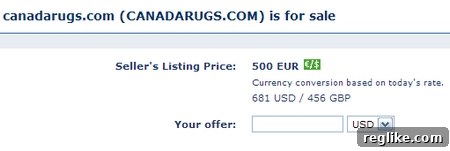
- Cost vs. Value: Perhaps the most striking irony in this particular case was revealed when it came to light that CanadaRugs.com was available for purchase on Sedo for a modest sum of 500 EUR. This raises questions about the cost-effectiveness of pursuing a UDRP complaint for a domain that could have been acquired directly for a relatively small fee, especially when the legal arguments were so weak. The legal expenses incurred in filing and prosecuting a UDRP often far exceed such a direct acquisition cost.
The CanadaDrugs.com vs. CanadaRugs.com dispute serves as a colorful illustration of the challenges and sometimes peculiar claims that arise in domain name law. It underscores the UDRP panel’s commitment to a balanced approach, distinguishing between genuine attempts at confusion and simple phonetic coincidences where distinct meanings prevail. Ultimately, common sense and a robust understanding of trademark law remain the most potent tools in navigating the digital landscape.