
Historic Digital Artifact: World Wide Web Source Code NFT Sells for Over $5 Million
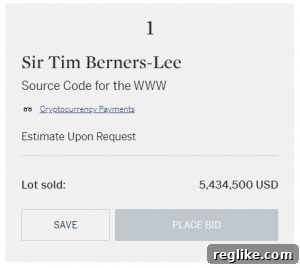
In a landmark event that underscored the burgeoning value of digital heritage, an anonymous buyer recently paid an astonishing $5,434,500 for a Non-Fungible Token (NFT) commemorating the creation of the World Wide Web. This unprecedented sale, orchestrated by the esteemed auction house Sotheby’s, captured global attention, highlighting the profound impact of Sir Tim Berners-Lee’s groundbreaking invention and the revolutionary potential of NFTs in preserving and monetizing digital milestones.
The auction represented a unique opportunity to own a piece of internet history, directly linked to the very foundation of the modern digital age. The “This Changed Everything” NFT, as it was aptly titled, wasn’t merely a static digital image but a comprehensive collection of digital mementos personally curated by the web’s creator himself, Sir Tim Berners-Lee.
The “This Changed Everything” NFT: A Deep Dive into its Components
The auctioned NFT package was a meticulously crafted digital artifact designed to capture the essence and origin of the World Wide Web. It comprised four distinct yet interconnected “mementos,” each offering a unique perspective on Berners-Lee’s monumental achievement:
1. The Original Source Code Files
At the heart of the NFT was an animated visualization of the original, time-stamped files containing the source code written by Sir Tim Berners-Lee for the World Wide Web. This wasn’t merely a picture of code, but an actual digital representation of the foundational instructions that brought the web to life. Spanning approximately 9,555 lines, this code encompasses the three core languages and protocols that define the web: HTML (Hypertext Markup Language), HTTP (Hypertext Transfer Protocol), and URIs (Uniform Resource Identifiers). Owning this means possessing a digital representation of the very building blocks that underpin nearly every interaction we have online today. It’s a direct link to the genesis of global digital communication.
2. An Animated Video of the Code Being Written
Accompanying the source code was a captivating animated video. This dynamic visual representation simulated the process of the code being written, line by line, on a terminal. It offered bidders a visceral, almost poetic, experience of watching the web unfold in real-time. This artistic rendering goes beyond mere documentation; it transforms the technical act of coding into a performance, providing a deeper appreciation for the meticulous effort and intellectual prowess required to construct such a complex system from scratch. The simulation adds an emotional and experiential layer to the raw data of the source code, making the history feel alive.
3. A Scalable Vector Graphics (SVG) File of the Full Code
The NFT package also included an SVG (Scalable Vector Graphics) file that contained a comprehensive visual representation of the entire source code. Unlike raster images that pixelate when scaled, SVG files are resolution-independent, meaning this digital artwork can be viewed at any size without loss of quality. This ensures the long-term integrity and accessibility of the code’s visual presentation as a piece of digital art. The SVG format is particularly suitable for displaying intricate details of text and diagrams, making it an ideal medium for preserving and appreciating the aesthetic and structural beauty of the web’s foundational code in a highly durable and adaptable digital format.
4. A Digital Letter from Sir Tim Berners-Lee
Adding an invaluable personal touch, the fourth component was a digital letter penned by Sir Tim Berners-Lee himself. This letter served as a reflective essay, offering his unique insights into the creation of the web, his vision for its future, and his personal journey in bringing this revolutionary technology to the world. Such a direct communication from the creator adds immense historical and sentimental value, providing context and perspective that only he can offer. It’s not just an artifact; it’s a direct message from the architect of our digital age, sharing his thoughts on the profound invention that reshaped human society.
Sir Tim Berners-Lee: Architect of the World Wide Web
Sir Tim Berners-Lee, a British computer scientist, forever changed the course of human history with his invention of the World Wide Web in 1989 while working at CERN. His vision was to create a decentralized information management system that would allow scientists globally to share information seamlessly. What began as a tool for academic collaboration quickly blossomed into the largest and most transformative communication platform ever conceived. Berners-Lee famously chose not to patent his invention, instead making it freely available to the world, a decision that fostered unparalleled innovation and democratized access to information on a global scale. This decision paved the way for the internet we know today, connecting billions and revolutionizing industries from commerce and education to entertainment and social interaction. His commitment to an open and accessible web continues to inspire technological development and advocacy for digital rights.
Understanding NFTs and Their Role in Digital Ownership
Non-Fungible Tokens (NFTs) have emerged as a groundbreaking technology, fundamentally reshaping our understanding of ownership in the digital realm. An NFT is a unique digital identifier recorded on a blockchain, which is a distributed public ledger. Unlike cryptocurrencies such as Bitcoin or Ethereum, which are fungible (meaning each unit is interchangeable with another), NFTs are non-fungible. This means each NFT is distinct and cannot be replaced by another identical item. This uniqueness allows NFTs to represent ownership of specific digital assets, including art, music, videos, collectibles, and in this historic case, the source code of the World Wide Web.
The value of an NFT stems from its provable scarcity, verifiable authenticity, and the immutable record of its ownership on the blockchain. For digital creators and collectors alike, NFTs provide a mechanism to establish and trade ownership of digital items in a transparent and secure manner, addressing a long-standing challenge in the digital world where replication is often effortless. The sale of Berners-Lee’s WWW source code NFT validates the growing recognition of NFTs as legitimate instruments for commemorating and owning significant historical and cultural digital artifacts.
The Auction and Its Astonishing Price Tag
The auction for “This Changed Everything” was conducted by Sotheby’s, a venerable institution with a storied history in fine art and collectibles, now embracing the digital frontier. The sale generated considerable buzz within both the tech and art communities. Starting at a relatively modest $1,000, the bidding quickly escalated, reflecting the immense historical significance and the intense interest from collectors globally. In the final moments of the auction, the price stood at $4.5 million, but a last-second surge pushed the final hammer price, including the buyer’s premium, to an incredible $5,434,500. Interested parties can still explore the details of this historic auction on Sotheby’s website.
This remarkable figure places the WWW source code NFT among the most expensive NFTs ever sold, underscoring not just the speculative interest in digital assets, but also a profound respect for the foundational technology it represents. The price is a testament to the World Wide Web’s enduring legacy and its unparalleled impact on human civilization, now concretized in a unique digital form. The rapid increase in the final seconds is a common phenomenon in high-stakes auctions, often indicating intense competition among a few determined bidders vying for a truly unique and irreplaceable item.
Preserving Digital Heritage in the NFT Era
The sale of the World Wide Web’s source code as an NFT marks a pivotal moment in the discourse surrounding digital heritage. Historically, preserving cultural artifacts has involved physical conservation, but the digital age presents new challenges and opportunities. NFTs offer a novel framework for documenting, authenticating, and transferring ownership of digital creations, ensuring that historically significant digital assets like the WWW’s source code can be preserved and appreciated for generations to come.
This event paves the way for future initiatives to tokenize and secure other vital digital milestones, from the first email to iconic software developments. By creating a unique, verifiable digital token for such an artifact, its provenance is established on the blockchain, providing an undeniable record of its origin and ownership. This move by Sir Tim Berners-Lee and Sotheby’s sets a powerful precedent, merging the worlds of historical preservation, cutting-edge technology, and high-stakes collecting, solidifying the role of NFTs as a legitimate medium for safeguarding our collective digital past.
Conclusion: A New Chapter for Digital History and Ownership
The auction of Sir Tim Berners-Lee’s World Wide Web source code NFT for over $5.4 million is far more than just another record-breaking sale in the volatile NFT market. It is a profound statement on the value we place on digital innovation, the enduring legacy of groundbreaking inventors, and the transformative power of emerging technologies like blockchain and NFTs.
This event solidifies the World Wide Web’s place not only as the cornerstone of our connected world but also as a highly valued cultural artifact in the digital realm. It underscores the potential for NFTs to act as guardians of digital heritage, offering a new paradigm for ownership and preservation. As the digital landscape continues to evolve, this historic sale will undoubtedly be remembered as a crucial moment where the past, present, and future of internet technology converged in a single, invaluable non-fungible token, setting a new benchmark for digital provenance and collector interest.