
The Evolving Digital Landscape: Why .App and .Blog Domains Are Shaping the Future
The digital realm is in a perpetual state of flux, constantly redefined by innovation and shifting user behaviors. At the core of this evolution lies the domain name system, the fundamental framework that organizes the internet. Domain names are far more than just web addresses; they are digital identities, crucial for branding, marketing, and online presence. In recent times, two particular top-level domains (TLDs) have captured significant attention and investment: .App and .Blog. Their high-profile acquisitions and burgeoning popularity underscore a pivotal moment in the domain market, signaling new directions for how businesses and individuals establish their digital footprints.
This article delves into the strategic importance of these domains, examining the substantial investments made, their current popularity, and what their rise means for the future of online branding and communication. We’ll explore why, despite the enduring dominance of .com, specialized TLDs like .App and .Blog are becoming indispensable tools in an increasingly niche-driven digital world.
Unpacking the Million-Dollar Acquisitions: .App and .Blog
The digital real estate market, much like its physical counterpart, is driven by location, relevance, and strategic value. The recent acquisitions of the .App and .Blog TLDs stand as testament to this, reflecting profound confidence in their future potential.
Google’s Game-Changing Investment in .App
Google, a global tech behemoth, made headlines with its substantial investment in the .App top-level domain. Just last week, the tech giant secured the rights to the .App TLD for a whopping $25 million. This colossal sum is not merely a transaction; it’s a strategic declaration. Google’s backing signifies a deep commitment to fostering a secure, identifiable, and highly discoverable ecosystem for mobile applications.
The implications for developers and businesses are immense. The .App domain provides an intuitive and instantly recognizable home for applications, streamlining user access and enhancing brand recall. With Google at the helm, the .App TLD is set to prioritize security, likely enforcing HTTPS for all registered domains from the outset. This move will not only bolster user trust but also align perfectly with Google’s broader initiative to promote a more secure web. For any entity focused on app development, owning a relevant **.App domain** name could become a critical component of their launch and marketing strategy, offering a dedicated space that clearly communicates purpose.
The Enduring Value of .Blog in the Digital Age
Hot on the heels of the .App acquisition, the .Blog TLD also changed hands for an undisclosed sum, confirmed to be an eight-figure deal. This significant valuation unequivocally refutes any notion that blogging is an antiquated practice. Instead, it underscores the continued, and indeed growing, importance of content marketing, personal branding, and niche communities in the digital landscape. The sale of .Blog reflects a robust belief in the power of narrative and the persistent demand for platforms that facilitate easy content creation and sharing.
For individuals, small businesses, and large corporations alike, blogging remains a cornerstone of their online strategy. It’s a powerful tool for establishing thought leadership, engaging with audiences, improving search engine optimization (SEO), and driving traffic. The **.Blog domain** caters directly to this immense market, offering a clear and descriptive domain extension that instantly tells visitors what to expect. Its high valuation signals that the market views blogging not as a passing trend, but as a fundamental pillar of online communication that continues to evolve and thrive.
The Dominance of .COM: A Baseline for Popularity
Despite the emergence of hundreds of new TLDs, the .com extension continues to reign supreme, holding a unique position in the collective digital consciousness. It remains the gold standard, often the first choice for individuals and businesses seeking to establish an online presence. However, the popularity of terms like “app” and “blog” within this traditional space offers valuable insights into broader market trends.
Both terms are popular in existing domain name registrations. Google bought rights to the .App top level domain name last week for a whopping $25 million. Also last month, .Blog sold for an unknown number that was certainly 8 figures. App and Blog are certainly very popular terms, and they’re frequently found in newly-registered .com domain names.
“App” and “Blog” in .COM Registrations: The Raw Numbers
Data from Verisign’s DomainView provides a clear picture of just how frequently these terms appear in new registrations. Over the past six months, an astonishing 328,271 .com domain names have been registered that include “app” in their string. Similarly, 139,532 .com domains incorporating “blog” have been registered within the same period. These figures highlight the widespread interest in applications and content creation, even when confined to the traditional .com space. They act as a strong indicator of user intent and the perceived value of these keywords in establishing an online identity, setting a high benchmark for any new TLDs aiming for similar relevance.
The Nuance Behind the “App” Data
While the raw numbers for “app” registrations are impressive, a closer look reveals an interesting nuance. As the adage goes, not all data tells the full story. If you look under the hood, you’ll see that the numbers are actually quite a bit closer than they first appear. Many of the domains with “app” in them are part of other words, such as apple, happy and application. There’s no easy way to exclude these from general keyword searches without highly sophisticated linguistic analysis.
This subtlety means that while “app” is undoubtedly a popular keyword, its numerical representation in .com registrations might be inflated by its inclusion in common English words. This makes direct comparisons between “app” and “blog” registrations in .com slightly challenging. It underscores the difficulty in performing precise market analysis based solely on keyword presence within domain names, emphasizing the need for deeper contextual understanding when evaluating **domain market trends**.
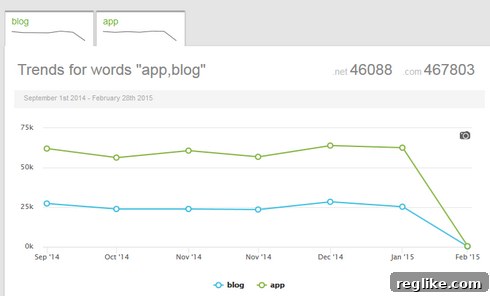
The chart above visually illustrates the domain registration volume as captured by DomainView, offering a snapshot of the intense interest surrounding both “app” and “blog” related terms in the rapidly evolving **domain market trends**. While raw numbers provide a quantitative perspective, the strategic implications of these popular keywords extend far beyond mere counts.
Is “Blog” an Outdated Term? Reassessing Its Relevance
Upon the news of the .Blog TLD sale, a common sentiment emerged among some commentators: “Isn’t the term blog an old term? Does it even make sense in today’s fast-paced digital environment?” This perspective, however, overlooks the incredible adaptability and enduring power of blogging as a medium.
Far from being obsolete, blogging has transformed and diversified. It remains a dynamic and highly effective tool for communication, marketing, and community building across countless niches. The sheer volume of recent registrations for .com domains containing “blog” strongly contradicts any claims of its irrelevance. Not according to the 5,000+ .com’s registered with “blog” in them over the past seven days. Examples include: InspectorTalkBlog.com, ArabBlogger.com and DirectMailBlog.com. These examples alone showcase the versatility and continued demand for blog-centric content, spanning various industries and cultural contexts.
Modern blogging encompasses a vast spectrum: from corporate blogs driving thought leadership and inbound marketing, to personal journals chronicling life experiences, to news aggregation sites, and highly specialized content hubs focusing on topics from technology to travel. Blogs are integral to **SEO strategy**, providing fresh, keyword-rich content that search engines favor. They foster engagement, build trust, and can be powerful platforms for monetization. The sustained interest in “blog” as a keyword, both in traditional .com domains and as a standalone TLD, firmly establishes its continued vitality and importance in the digital landscape.
New TLDs vs. The Established .COM: A Shifting Landscape
The introduction of hundreds of new generic top-level domains (gTLDs) over the past decade aimed to diversify the internet’s address space, offering more descriptive and niche-specific options. However, the transition has not been without its challenges. Of course, new TLDs don’t capture 100% of the market for particular terms. People still tend to look for available .com’s first and new TLDs second, largely due to ingrained habits, brand recognition, and a perception of greater authority associated with .com.
Illustrative Examples: .Bike and .Plumbing
To understand this dynamic, consider the performance of other niche TLDs. One year in, .Bike has garnered approximately 14,000 registrations globally. In stark contrast, over the same period, 50,000 .com domains that include “bike” in their name have been registered. Similarly, .Plumbing has just over 5,000 registrations, while 25,000 .com’s with “plumbing” in them have been registered in the past year. These figures highlight a clear trend: while new TLDs offer specialized branding, they have yet to rival the sheer volume of .com registrations for equivalent terms.
The reasons are multifaceted. The pervasive familiarity of .com means it often requires less explanation or cognitive effort from users. Furthermore, many businesses prioritize securing their brand presence on .com first, viewing new TLDs as secondary or supplementary. However, for a very specific niche business, a descriptive TLD like .Bike or .Plumbing could offer unique branding advantages, signaling immediate relevance to their target audience, especially when combined with a strong marketing strategy.
The Potential for Market Growth with .App and .Blog
Crucially, many of the new TLD registrations seen thus far have been in addition to an existing .com domain, rather than replacing it. This suggests a strategy of domain portfolio diversification and brand protection. However, with .App and .Blog, there’s a compelling argument that these new TLDs possess the potential to significantly grow the overall market for online presence, rather than merely cannibalizing existing .com registrations. This is especially true with the formidable backing of Google for .App.
Google’s involvement in .App brings not only substantial financial investment but also its immense marketing power, technical expertise, and an established ecosystem of developers and users. This could catalyze widespread adoption, making .App the de facto standard for applications. Similarly, the clear, functional nature of .Blog appeals directly to a massive demographic of content creators, potentially inspiring new users to launch blogs who might not have found an ideal .com domain. These TLDs are not just extensions; they are highly relevant identifiers that can simplify branding, enhance discoverability, and create entirely new digital communities, thereby expanding the overall digital real estate market.
Strategic Considerations for Domain Registrants in the New Era
In this dynamic landscape, navigating the choice of a domain name is more strategic and complex than ever before. For businesses and individuals, the decision impacts everything from branding and marketing to search engine visibility and user trust.
Choosing Your Digital Identity: .COM, .App, or .Blog?
The choice between a traditional .com, a specialized .app, or a content-focused .blog domain depends heavily on your specific goals and target audience. A .com still offers universal appeal and broad recognition, making it a safe bet for general-purpose websites or established brands seeking global reach. A **.App domain**, on the other hand, is perfectly tailored for mobile application developers and software companies, offering an intuitive and modern home that immediately conveys purpose. For content creators, journalists, digital marketers, and personal brands, a **.Blog domain** provides a clear, concise, and highly relevant identity that resonates with their primary function.
Beyond individual choices, the concept of domain portfolio management is gaining traction. This involves securing primary **domain names** across relevant TLDs not only for immediate use but also for future expansion and crucial brand protection. This proactive approach ensures that your brand is covered across the most significant digital touchpoints, preventing competitors or squatters from occupying valuable online real estate.
The Impact on Brand Building and SEO
Descriptive TLDs like .App and .Blog can play a subtle yet significant role in brand building. They instantly communicate the nature of the website, potentially aiding brand recall and improving click-through rates as users intuitively understand what to expect. While new TLDs generally do not offer direct SEO advantages over .com (Google has repeatedly stated that TLDs do not inherently boost rankings), their relevance and clarity can indirectly contribute to better user experience, which is a key factor in modern SEO. A domain that clearly defines its purpose can lead to higher engagement rates and lower bounce rates, signaling positive user signals to search engines.
Ultimately, the quality and relevance of the content remain paramount. Regardless of the TLD chosen, a well-optimized website with valuable content, strong user experience, and a robust backlink profile will always perform better. However, a strategically chosen new TLD can provide an initial edge in branding and clarity, complementing an overall strong digital marketing strategy.
The Future Landscape of Online Identity
The high-profile acquisitions and surging popularity of .App and .Blog domain names are not isolated incidents; they are bellwethers for the ongoing, dynamic evolution of the **domain name market**. While .com continues its formidable reign, the digital world is becoming increasingly fragmented and specialized, creating a demand for more descriptive and niche-specific identifiers.
The strategic investment by Google in .App, coupled with the robust market interest in .Blog, signifies a pivotal shift. These TLDs are not just alternative addresses; they represent new opportunities for businesses and individuals to carve out highly relevant and memorable online identities. They empower brands to communicate their purpose with greater clarity and precision, fostering trust and enhancing discoverability in a crowded digital space.
The internet is an ever-changing frontier, and with the rise of specialized options like .App and .Blog, the digital real estate market is becoming richer, more diverse, and more tailored to the specific needs of its inhabitants. As technology advances and user behaviors evolve, the way we define and navigate our online presence will continue to transform, with these innovative TLDs playing an increasingly central role in shaping the future of the web.