
Leveraging LinkedIn for Premium Domain Sales: A Strategic Approach to Connect and Convert
The landscape of premium domain sales is continuously evolving, with sellers constantly seeking innovative strategies to connect with serious buyers, negotiate effectively, and maximize value. Traditional domain marketplaces, while convenient, often fall short in providing critical buyer intelligence and the flexibility needed for high-value transactions. This often leads to an influx of low-ball offers, wasted time, and an impersonal sales experience. A novel and remarkably effective solution has emerged: a strategy that redirects potential buyers of premium domains directly to LinkedIn for engagement. This approach not only streamlines the qualification process but also empowers sellers with unparalleled negotiation insights and the opportunity to build meaningful professional relationships.
Consider the ingenious approach implemented by Francois Carrillo, the owner of Domaining.com, for his prestigious domain, Faster.com. His landing page, a model of simplicity and strategic design, serves a singular, powerful purpose: to direct interested visitors to his LinkedIn profile. This design is a masterclass in funnel optimization for high-value assets, deliberately crafting a path that benefits the seller significantly.

Upon landing on Faster.com, visitors are presented with a clear, singular call to action. Any attempt to click on the page triggers a polite yet firm message, indicating the required next step:
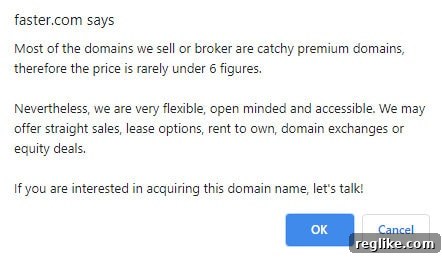
Clicking “OK” seamlessly redirects the potential buyer to Francois’s LinkedIn profile, where direct communication can commence. This strategy is nothing short of brilliant. It acts as an immediate filter, sifting out casual browsers and uncommitted individuals. By requiring buyers to engage on a professional networking platform, it mandates a certain level of effort and transparency. Sellers gain immediate insight into a buyer’s identity, professional background, and network – invaluable data points that are typically absent in anonymous marketplace inquiries. Even if a buyer attempts alternative contact methods, their LinkedIn profile view acts as a digital breadcrumb, providing further validation of their interest.
The Strategic Advantages of a LinkedIn-Centric Domain Sales Funnel
In a discussion with Francois, he emphasized that this method is particularly impactful for premium domains, reserving fixed-price landers for lower-priced assets. His insights highlight a multi-faceted approach to maximizing value and minimizing wasted effort:
1. Superior Buyer Qualification and Filtering
One of the primary benefits of this strategy is its efficacy in weeding out what are often referred to as “low-ballers” and genuinely unmotivated individuals. The mere act of requiring a prospect to log into their LinkedIn account, or even create one, presents a psychological barrier that casual inquirers are unlikely to cross. This ensures that only individuals with a serious intent and a certain level of commitment proceed to the next stage. Furthermore, the transparency inherent in a LinkedIn profile – where one’s professional face, company, and career history are visible – discourages frivolous inquiries and ensures a more serious tone for initial contact. This effectively pre-qualifies leads, saving valuable time and effort for the seller.
2. Empowering “Price Upon Request” with Intelligence
The “price upon request” model gains immense power when coupled with LinkedIn. Knowing the identity of the person behind an inquiry – their company, professional history, and network – provides an unprecedented level of leverage. Before even quoting a price, sellers can conduct swift due diligence, understanding what the buyer plans to do with the domain and assessing their potential budget. This intelligence allows for a highly customized pricing strategy, where the asking price can be tailored to better match the buyer’s capabilities and the seller’s expectations, moving beyond arbitrary fixed prices. It transforms a guessing game into an informed negotiation.
3. Dynamic Pricing and Market Responsiveness
In a fluctuating market, static pricing can quickly become outdated. This LinkedIn-centric approach liberates sellers from the constant burden of updating landing page or marketplace prices. The value of a premium domain can shift based on market trends, economic conditions, or even the perceived value to a specific buyer. With this method, the seller can determine the price “at the moment” of inquiry, with comprehensive “due diligence” on the buyer. This agility ensures that the quoted price always reflects the current market dynamics and the specific context of the transaction, rather than being bound by a potentially obsolete listing.
4. Mastering the Negotiation Dance: “Not for Sale… Unless”
A sophisticated negotiation tactic becomes accessible with this strategy: the ability to initially convey that the domain is “not for sale,” while subtly indicating openness to an “outstanding offer.” This ingenious maneuver shifts the responsibility of naming a price squarely onto the buyer. By allowing the buyer to articulate what they are willing or able to pay, the seller gains invaluable insight into their budget and perceived value of the asset. This provides a robust starting point for negotiations, often allowing the seller to achieve a higher price than if a fixed price had been listed. This tactic is significantly harder to employ effectively when a landing page already displays a price estimation.
5. Efficient Time Management and Professional Disengagement
Time is a valuable commodity, especially for domain investors dealing with high-value assets. By assessing the potential buyer’s profile on LinkedIn, sellers can quickly estimate if their price expectations are aligned. If a buyer’s profile suggests they are unlikely to meet the asking price, the seller can gracefully and politely disengage, avoiding prolonged, unfruitful conversations. This prevents valuable time from being wasted on prospects who are not a good fit. Moreover, in the rare event of unprofessional or harassing inquiries, LinkedIn provides tools to simply delete conversation threads or block users, maintaining a professional and efficient sales environment.
6. Cultivating Personal Relationships and Authentic Negotiations
One of the most profound advantages of direct engagement via LinkedIn is the human element it reintroduces into domain transactions. Marketplaces, by their nature, can feel impersonal and transactional – “like exchanging prices with a wall,” as Francois aptly puts it. LinkedIn, however, fosters genuine dialogue and allows for the building of rapport, and even professional friendships, over time. While this might occasionally lead to selling a name at a slightly discounted price, the value derived from the positive interaction, trust, and potential for future collaborations often far outweighs the monetary difference. It transforms a cold transaction into a collaborative discussion, making the entire process more rewarding and enjoyable.
7. Strategic Portfolio Privacy
Many domainers, for various strategic reasons, prefer not to expose their entire portfolio. This LinkedIn-centric approach provides a significant advantage in maintaining portfolio privacy. Potential buyers contacting a seller through LinkedIn have no inherent knowledge of whether the seller owns one premium domain or thousands. This privacy prevents competitors from gaining insight into a seller’s holdings and preserves negotiation power by not revealing the full extent of their investment strategy. It allows sellers to selectively disclose information as needed, maintaining a competitive edge.
Implementing Your LinkedIn-Centric Domain Sales Strategy
Adopting this strategy requires a well-crafted landing page that clearly communicates the single call to action, similar to Faster.com. Your LinkedIn profile should be professional, articulate your expertise in premium domains (without necessarily listing all your assets), and be ready to receive inquiries. When responding to prospects, remember to leverage the information gleaned from their profile to personalize your communication and tailor your negotiation strategy. While the benefits are numerous, it’s essential to acknowledge that this approach demands active engagement and refined negotiation skills. It may not be suited for every single domain sale, particularly those at the lower end of the market where quick, automated transactions might be preferred. However, for premium assets, the investment in a personalized, intelligence-driven sales process pays dividends.
Conclusion
The strategy of directing potential premium domain buyers to LinkedIn represents a significant paradigm shift in the industry. It moves beyond the limitations of anonymous marketplaces to embrace a more intelligent, personalized, and strategically advantageous sales process. By prioritizing buyer qualification, enabling dynamic pricing, empowering sophisticated negotiation tactics, and fostering genuine professional connections, this approach maximizes the seller’s value, minimizes wasted effort, and ultimately leads to more successful and satisfying transactions for high-value domain assets. For those serious about optimizing their premium domain sales, a LinkedIn-centric funnel is not just an option; it’s a powerful imperative.