
Activist Investor Starboard Pushes GoDaddy for Enhanced Growth and Profitability Targets
Leading activist investor Starboard Value LP has once again engaged with GoDaddy (NYSE: GDDY), the world’s largest domain registrar and web hosting provider, by sending a detailed letter to its management and board of directors. The communication reiterates Starboard’s persistent call for GoDaddy to establish and achieve more ambitious yet attainable growth and profit margin targets, underscoring a strategic imperative for the company’s long-term shareholder value creation.
Starboard’s Enduring Engagement with GoDaddy
Starboard Value, known for its strategic and often assertive approach to corporate governance, first revealed a significant 6.5% stake in GoDaddy in December 2021. This initial investment signaled the activist fund’s intent to influence the company’s strategic direction. Their involvement has been consistent, marked by active dialogue and public letters designed to steer GoDaddy towards enhanced operational efficiency and financial performance.
The latest letter is a continuation of this engagement. It follows a previous open letter sent in September 2023, where Starboard admonished GoDaddy for falling short of its stated revenue growth targets and explicitly demanded substantial cost reductions. These consistent interventions highlight Starboard’s belief that GoDaddy, despite its market leadership, possesses untapped potential for greater profitability and shareholder returns. The activist investor’s ongoing pressure underscores a deep conviction that GoDaddy’s current valuation does not fully reflect its intrinsic value, a point further emphasized by comparative financial metrics.
GoDaddy: A Pillar of the Digital Economy
To fully appreciate Starboard’s perspective, it’s crucial to understand GoDaddy’s position in the digital ecosystem. GoDaddy is much more than just a domain registrar; it provides an extensive suite of services vital for small and medium-sized businesses (SMBs) to establish and grow their online presence. This includes web hosting, website builders, email, online marketing tools, and security services. With millions of customers worldwide, GoDaddy plays a pivotal role in enabling entrepreneurship and digital transformation for countless enterprises.
The company operates largely on a recurring revenue model, where customers pay subscriptions for domain renewals, hosting plans, and other web services. This model typically provides stable and predictable cash flows, which are highly valued by investors. Starboard’s focus on profitability and free cash flow generation is therefore intrinsically linked to GoDaddy’s core business strengths and its ability to monetize its vast customer base effectively. The company’s recurring revenue stream should, in theory, provide a strong foundation for consistent growth and healthy margins, provided operations are managed efficiently.
Driving Towards Attainable Growth and Enhanced Profitability
In its recent communication, Starboard acknowledged GoDaddy’s recent performance with a nod of approval, indicating some progress. However, this praise was coupled with a clear message: the investor is keenly awaiting GoDaddy’s upcoming Q4 earnings call and its Investor Day in March. These events are crucial for GoDaddy to outline its future strategy and demonstrate its commitment to meeting investor expectations.
A key demand from Starboard is for GoDaddy to target a 40% “growth-plus-profitability” measure for 2025. This metric, often used in the software-as-a-service (SaaS) industry, combines revenue growth rate with free cash flow margin or EBITDA margin to provide a holistic view of a company’s financial health and efficiency. Starboard asserts that a 40% target is aligned with GoDaddy’s peers, suggesting that the company has the capacity to achieve this benchmark. This ambitious target reflects Starboard’s confidence in GoDaddy’s market position and its belief that operational improvements can unlock significant value.
Starboard also issued a cautionary note, expressing a desire to avoid a repeat of past Investor Days where GoDaddy set growth targets that were subsequently missed. While the letter specifically referenced “2022’s Investor Day,” previous communications from Starboard had also addressed missed targets from the “2023 Investor Day,” creating some ambiguity regarding the precise historical event referenced. Regardless of the specific year, the underlying message is clear: Starboard expects credible, achievable targets backed by a robust execution plan. It is also important to acknowledge that forecasting growth, particularly in the wake of the unprecedented demand for websites and domain names experienced during the global pandemic, presented unique challenges. The surge in online activity during that period made it exceptionally difficult to predict normalized growth trajectories for companies like GoDaddy, which benefited immensely from the accelerated shift to digital.
The Imperative of Margin Expansion and Cost Efficiency
Beyond growth, a central pillar of Starboard’s ongoing campaign is the relentless pursuit of margin expansion and aggressive cost-cutting initiatives. The activist investor firmly believes that GoDaddy can operate more efficiently and convert a larger portion of its revenue into profit. This involves scrutinizing every aspect of the company’s operations, from marketing spend to research and development, and general administrative expenses. By streamlining processes, optimizing resource allocation, and eliminating redundancies, GoDaddy could significantly enhance its operating margins, directly impacting its bottom line and increasing its attractiveness to investors.
For Starboard, cost-cutting isn’t merely about reducing expenses; it’s about fostering a culture of fiscal discipline and maximizing capital efficiency. In a competitive market where technology companies often invest heavily in growth, finding the right balance between investment and profitability is critical. Starboard’s pressure suggests that, in their view, GoDaddy has room to improve this balance, thereby delivering greater value to shareholders.
Strategic Capital Allocation: The Call for Share Repurchases
A significant recommendation from Starboard concerns GoDaddy’s capital allocation strategy. The investor strongly advises GoDaddy to consistently reinvest its robust free cash flows into share repurchases, particularly given what Starboard perceives as the “undervalued shares” of GoDaddy stock. Share repurchases reduce the number of outstanding shares, which can increase earnings per share (EPS) and often signal to the market that management believes the stock is undervalued, potentially driving up its price.
Starboard’s argument for buybacks is rooted in the belief that GoDaddy’s current market valuation does not fully reflect its operational strength and future potential. By buying back its own shares at what it considers a discount, GoDaddy would effectively be investing in itself, providing an immediate return to shareholders by increasing their proportional ownership of the company. This strategy is particularly compelling when a company generates substantial free cash flow, as GoDaddy does, and when its stock is trading below its perceived intrinsic value compared to industry peers.
GoDaddy’s Undervaluation: A Comparative Analysis
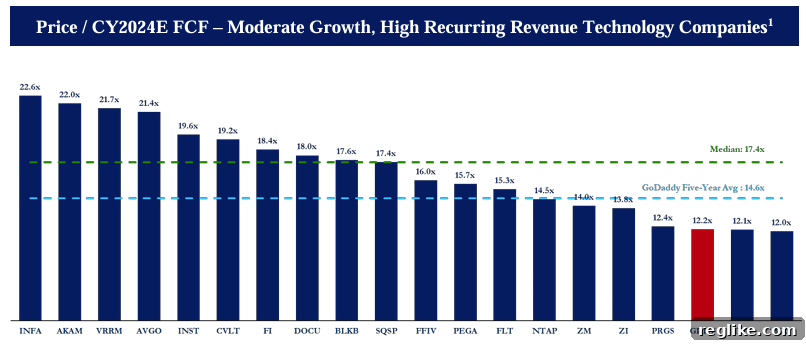
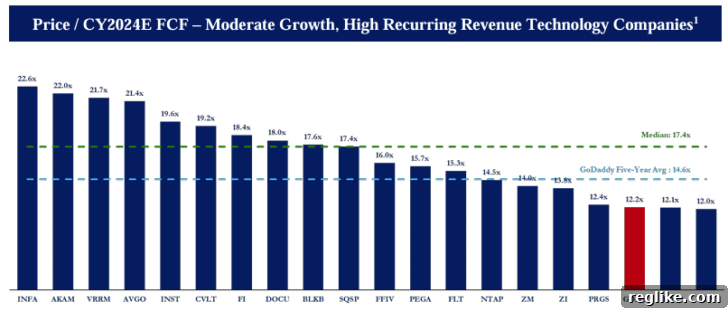
The chart included in Starboard’s letter vividly illustrates their argument regarding GoDaddy’s undervaluation. It compares GoDaddy’s price-to-estimated free cash flow (FCF) multiple to that of other moderate-growth, high-recurring-revenue technology companies. The data points to GoDaddy trading at 12.2x its 2024 estimated free cash flow, a multiple notably below many of its industry counterparts. This disparity forms the crux of Starboard’s investment thesis: a well-managed GoDaddy, operating at peak efficiency, should command a higher valuation akin to its peers.
The price-to-free cash flow metric is a favored valuation tool for many investors, especially those focused on cash-generating businesses. A lower multiple suggests that the company’s stock price is cheap relative to the cash it generates, indicating a potential investment opportunity. By highlighting this discrepancy, Starboard aims to compel GoDaddy’s board and management to take decisive action that will narrow this valuation gap, whether through enhanced growth, improved margins, or strategic capital allocation, thereby unlocking significant shareholder value.
The Path Forward: Q4 Earnings and Investor Day
All eyes will now be on GoDaddy’s forthcoming Q4 earnings call, where the company is expected to provide an update on its financial performance and operational progress. Following this, the Investor Day in March will be a pivotal event. It offers GoDaddy an opportunity to present a comprehensive strategic roadmap that addresses Starboard’s demands, outlines clear and achievable targets, and demonstrates a credible plan for sustained growth and profitability. The outcome of these events will likely shape the trajectory of GoDaddy’s stock and determine the future dynamic between its management and its influential activist investor.
Starboard’s continued pressure serves as a potent reminder of the accountability public companies owe to their shareholders. As GoDaddy navigates the competitive landscape of the digital economy, the successful implementation of strategies that align with investor expectations for growth, efficiency, and shareholder returns will be paramount.