
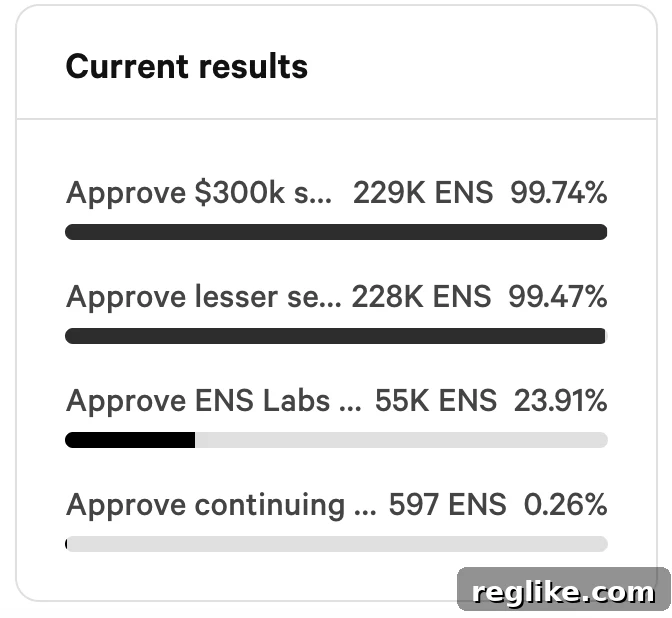
The Ethereum Name Service (ENS) DAO finds itself at a critical juncture, navigating a complex legal dispute surrounding the essential eth.link forwarding service. Early voting trends indicate a clear preference among token holders to settle the ongoing litigation rather than prolong it, signaling a desire for fiscal prudence and a potential shift in the strategic direction of this prominent Web3 entity.
Decentralized Governance at a Crossroads: The ENS DAO and the eth.link Dispute
The Ethereum Name Service (ENS) DAO, a leading decentralized autonomous organization within the Web3 ecosystem, has initiated a pivotal vote concerning the future of the eth.link domain and its associated legal entanglements. This crucial proposal seeks to resolve a high-profile dispute that has cast a shadow over the utility and accessibility of .eth domains, with significant implications for both ENS Labs and the broader community of ENS users.
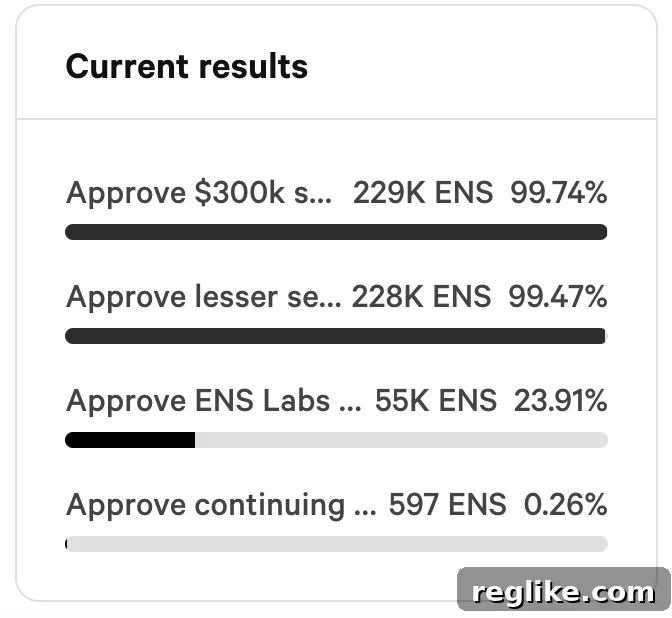
Early indications from the ongoing decentralized vote paint a compelling picture: the majority of participating token holders appear to favor a swift resolution. The community is leaning towards approving a settlement figure of $300,000 or less to conclude the dispute. Crucially, voters are showing strong opposition to reimbursing ENS Labs for its accrued litigation expenses, and an even stronger disinclination to continue the lawsuit. This collective sentiment underscores a strategic pivot, prioritizing financial efficiency and an end to protracted legal battles over an extended defense.
The Vital Role of eth.link and the Genesis of the Controversy
To fully grasp the significance of this DAO vote, it’s essential to understand the function of eth.link. This service has historically acted as a crucial forwarder, enabling users to access native .eth domains directly through conventional web browsers like Chrome, Firefox, or Safari. Without such a bridge, accessing .eth domains, which are inherently blockchain-native, would typically require specialized browser extensions or applications. Eth.link therefore serves as a vital gateway, enhancing the accessibility and user experience for anyone wishing to visit a decentralized website or access an ENS-powered resource without navigating the complexities of Web3 infrastructure.
The dispute itself, while complex, originated from a disagreement over the management and control of the eth.link domain. The cessation of the eth.link service, brought about by the controversy, created immediate friction for users and highlighted a vulnerability in the ENS ecosystem. The subsequent litigation became a costly and resource-intensive endeavor for ENS Labs, the operational entity responsible for much of ENS’s development and maintenance. The DAO’s current vote is a direct response to the financial and strategic burden this lawsuit has placed on the organization.
Decentralized Governance Under the Spotlight: Public Voting and Legal Strategy
The public nature of DAO voting, while embodying the principles of transparency and decentralization inherent in Web3, presents unique challenges when navigating sensitive issues like legal disputes. In traditional corporate settings, legal strategies and settlement discussions are typically conducted under strict confidentiality to preserve a party’s negotiating leverage. However, the open ledger and public participation model of a DAO mean that internal deliberations and strategic preferences are visible to all, including opposing counsel.
This transparency, while laudable for accountability, can inadvertently place organizations like ENS at a disadvantage in litigation. When the opposing parties can observe real-time voting results indicating a desire to settle and a reluctance to fund further legal action, it can empower them to take a firmer stance in negotiations. This situation brings to light one of the inherent trade-offs in decentralized governance: balancing the ethos of radical transparency with the practicalities of real-world legal and business operations. The ENS community is actively grappling with this very dilemma, showcasing the evolving nature of Web3 governance structures.
ENS Labs’ Strategic Fork in the Road
ENS Labs has made its position unequivocally clear: should the DAO decline to approve the funding required for continued litigation expenses, the entity will move to dismiss the lawsuit immediately. This decisive stance underscores the financial and operational constraints faced by ENS Labs, highlighting its reliance on community support for such significant expenditures. Furthermore, in the event of a dismissal, ENS Labs plans to implement an interstitial notice on the eth.link domain. This interstitial would serve as a prominent redirect, guiding users towards eth.limo as the preferred alternative for accessing .eth domains via traditional browsers.
The shift to eth.limo, while a practical solution, represents an adjustment for the ENS ecosystem. It necessitates user re-education and highlights the potential for service disruption when key infrastructure elements face challenges. The DAO’s decision, therefore, will not only determine the future of the eth.link lawsuit but also influence the immediate user experience and continuity of service for thousands of ENS domain holders.
The Evolving Vision for Blockchain Domains: Beyond Websites
The original vision for blockchain-based domains, such as .eth, often encompassed their use as decentralized website addresses, offering a censorship-resistant and immutable alternative to traditional DNS. Eth.link played a crucial role in realizing this vision by bridging the gap between Web3 domains and conventional web browsing.
However, since the inception of the eth.link lawsuit, there’s a growing sentiment that the enthusiasm for using blockchain domains primarily for hosting websites has somewhat diminished. While still a viable use case, the primary utility of .eth domains has increasingly converged on decentralized identity, cryptocurrency wallet addresses, and generalized naming services within the Web3 space. The complexity of hosting decentralized websites, the relative slowness compared to traditional hosting, and the ongoing challenges in widespread browser integration have contributed to this shift. Users and developers alike are recognizing that while blockchain domains offer unparalleled ownership and resistance to censorship, their most impactful applications currently lie in simplifying complex cryptocurrency addresses and serving as universal Web3 usernames rather than direct replacements for conventional websites.
More Than Just a Simple Dismissal: The Broader Legal Implications
While ENS Labs may be prepared to dismiss its specific lawsuit if the DAO vote dictates, the resolution of this matter is far from simple. Litigation involving multiple parties rarely concludes with a unilateral “dropping of the case.” In this particular dispute, other significant players, namely Dynadot and GoDaddy, have also incurred substantial financial losses and legal expenses. Dynadot, in particular, has reported lost revenue directly attributable to the disruption caused by ENS’s lawsuit.
This means that even if ENS Labs withdraws its suit, the possibility of counterclaims or new litigation from Dynadot or GoDaddy remains. These entities have their own interests to protect and their own costs to recover. Therefore, the DAO’s decision, while potentially ending ENS Labs’ direct involvement in this specific lawsuit, might not entirely close the chapter on the eth.link legal saga. A comprehensive settlement, encompassing all affected parties, would be the most effective way to achieve a clean break, but such an agreement requires consensus and financial commitment from all sides.
Looking Ahead: The Future of ENS and Decentralized Naming
The ongoing ENS DAO vote, which is set to conclude on February 25, is more than just a procedural exercise; it’s a defining moment for the Ethereum Name Service. The outcome will not only determine the immediate financial and legal trajectory of ENS Labs but also send a powerful message about the community’s priorities and risk appetite. A vote for settlement could signal a pragmatic approach, favoring cost-efficiency and swift resolution, thereby allowing ENS Labs to refocus resources on core development and innovation.
Conversely, a continued push for litigation, though seemingly less likely given early voting trends, would demonstrate a willingness to defend principles at potentially higher costs. Regardless of the outcome, this dispute has underscored the challenges and opportunities inherent in decentralized governance, particularly when intersecting with traditional legal frameworks. The ENS community’s decision will undoubtedly shape the future perception of its resilience, its commitment to user accessibility, and its role as a cornerstone of the burgeoning decentralized web.
As the final hours of voting approach, all eyes remain on the ENS DAO, awaiting a decision that will profoundly impact the trajectory of one of Web3’s most vital naming services.