
Domain Name Speed Test: How Your TLD Impacts Website Performance
In the fast-paced digital world, website speed is paramount. Every millisecond counts when it comes to user experience, search engine rankings, and ultimately, conversion rates. While many factors influence website loading times, one often-overlooked aspect is the top-level domain (TLD) you choose. A recent study sheds light on the significant impact TLDs can have on DNS resolution time, a critical component of website performance.
A concerned reader of Domain Name Wire brought to our attention a compelling speed study conducted by BunnyCDN, a reputable content delivery network renowned for its expertise in optimizing website load times. BunnyCDN delved into the realm of TLDs, meticulously testing 42 different top-level domain names to assess their DNS resolution times. The findings were quite revealing, offering valuable insights for website owners and developers seeking to enhance their online presence.
The study focused on DNS resolution time, which is the time it takes for a domain name to be translated into its corresponding IP address. This process is essential for a user’s browser to connect to the correct server and retrieve the website’s content. Faster DNS resolution translates to quicker website loading times, leading to a more seamless and enjoyable user experience.
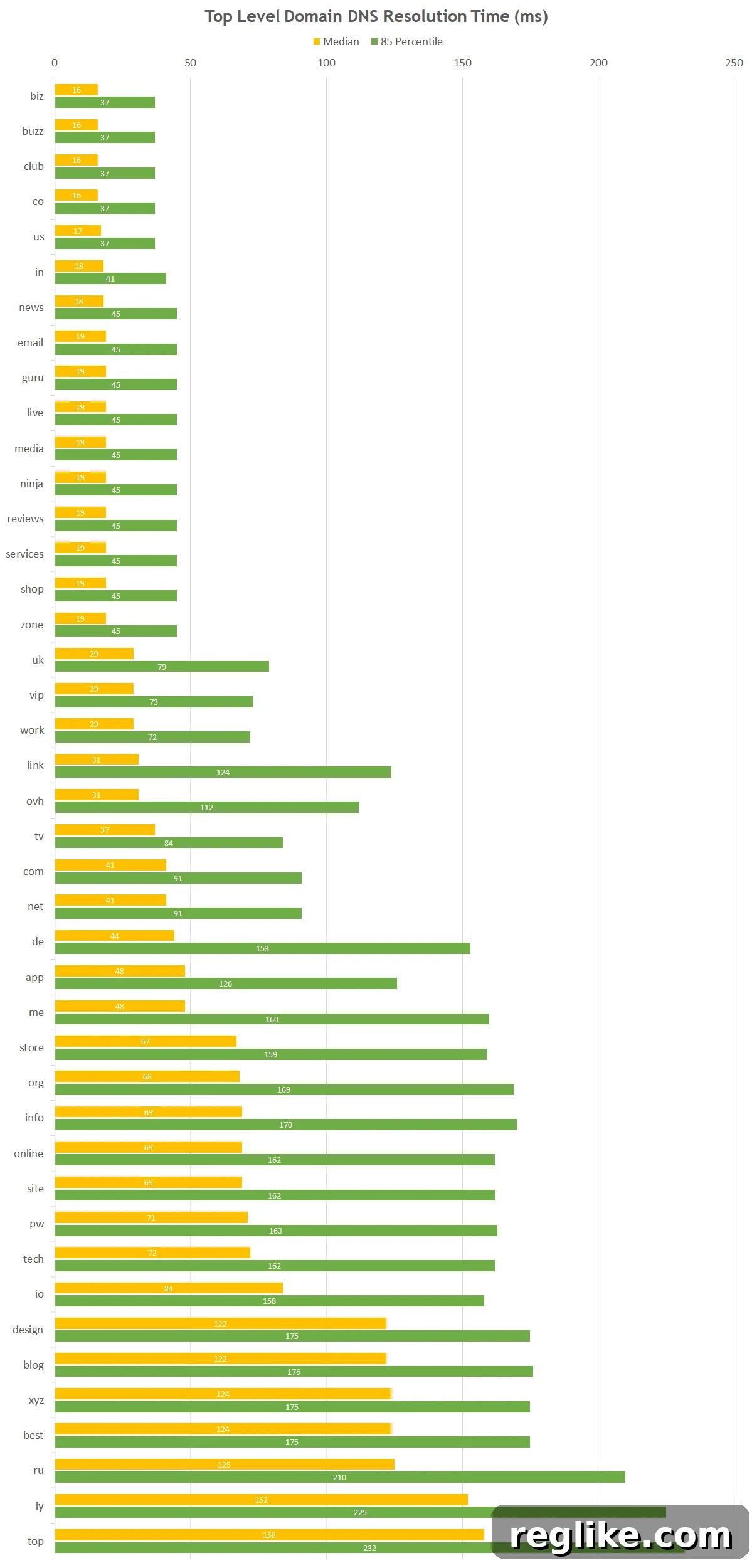
The results of the BunnyCDN study unveiled a clear hierarchy of TLD performance. Topping the charts were the TLDs .biz, .buzz, .club, .co, .us, and .in. Notably, these top performers all leverage Neustar for their registry services, suggesting a correlation between registry infrastructure and DNS resolution speed.
Following closely behind were eight TLDs under the management of Donuts, a prominent domain name registry. Intriguingly, these Donuts domains also appear to utilize Neustar’s DNS services, further reinforcing the potential link between Neustar’s infrastructure and faster DNS resolution times. The study also identified clusters of TLDs, such as Verisign’s .tv, .com, and .net, indicating consistent performance within specific registry networks.
However, the study also uncovered inconsistencies in performance across different TLDs. BunnyCDN observed that some TLDs exhibited variations in the performance of their nameservers, with certain nameservers lagging behind others. Furthermore, the group discovered that response times tended to degrade significantly outside of North America and Europe for certain TLDs, highlighting potential geographic disparities in DNS resolution speeds.
Understanding the Significance of DNS Resolution Time
While DNS resolution time may not be the single most dominant factor in a website’s overall performance, it undoubtedly plays a crucial role in the initial stages of loading a webpage. Optimizing DNS resolution can contribute to a faster perceived loading speed, which can have a positive impact on user engagement and search engine rankings.
Think of DNS resolution as the initial handshake between a user’s browser and the website’s server. A swift and efficient handshake sets the stage for a smooth and rapid transfer of website content. Conversely, a sluggish handshake can introduce delays, creating a frustrating experience for the user.
Choosing the Right TLD for Optimal Performance
The BunnyCDN study serves as a valuable reminder that not all TLDs are created equal. When selecting a domain name, it’s essential to consider the potential impact of the TLD on website performance. While factors such as brand relevance and memorability are undoubtedly important, neglecting the technical aspects of TLD performance can lead to suboptimal results.
If website speed is a top priority, it may be prudent to consider TLDs that have demonstrated consistently fast DNS resolution times. The study’s findings suggest that TLDs utilizing Neustar’s registry services tend to perform well in this regard. However, it’s crucial to note that DNS performance can vary over time, and it’s always advisable to conduct your own testing and monitoring to ensure optimal results.
Beyond TLDs: Optimizing Your Website for Speed
While choosing the right TLD can contribute to faster website loading times, it’s just one piece of the puzzle. A comprehensive approach to website optimization involves addressing various factors that can impact performance. These include:
- Content Delivery Network (CDN): CDNs distribute your website’s content across multiple servers located around the world, ensuring that users can access your website from a server that is geographically close to them. This reduces latency and improves loading times.
- Image Optimization: Large, unoptimized images can significantly slow down website loading times. Compressing images without sacrificing quality can dramatically improve performance.
- Code Minification: Minifying your website’s code (HTML, CSS, and JavaScript) removes unnecessary characters and whitespace, reducing file sizes and improving loading times.
- Browser Caching: Enabling browser caching allows users’ browsers to store static resources (such as images and CSS files) locally, so they don’t have to be downloaded every time the user visits your website.
- Server Optimization: Optimizing your web server’s configuration can improve its ability to handle requests efficiently, leading to faster loading times.
Conclusion: Speed Matters, Choose Wisely
In the competitive online landscape, website speed is a critical differentiator. By understanding the impact of TLDs on DNS resolution time and implementing comprehensive website optimization strategies, you can create a faster, more engaging, and more successful online experience for your users. The BunnyCDN study offers a valuable glimpse into the often-overlooked world of TLD performance, reminding us that even seemingly small decisions can have a significant impact on website speed and user satisfaction. So, choose your domain name wisely, optimize your website diligently, and watch your online presence thrive.
(Hat tip: Jorge)