
UDRP Panelist Uses Common Sense in Domain Name Dispute
In the often complex world of domain name disputes, decided under the Uniform Domain Name Dispute Resolution Policy (UDRP), common sense can sometimes be a rare commodity. Complainants frequently attempt to bolster their cases by pointing to the content displayed on registrar holding pages, arguing that such content demonstrates the domain name registrant acted in bad faith. This argument, while seemingly straightforward, often capitalizes on a misunderstanding – or perhaps a deliberate oversimplification – of the distinction between parked domain names and generic registrar holding pages.
Consider a recent UDRP case involving Fireman’s Fund Insurance Company and the domain name FiremansFundBlog.com. The insurance company argued that the registrant of the domain name had registered it in bad faith because the domain resolved to a parked page featuring advertisements from competing insurance providers. This argument is fairly common, and it’s a tactic that leverages the default behavior of many domain registrars.
Indeed, the parked page associated with FiremansFundBlog.com at one point displayed advertisements for numerous competing insurance companies. This is often presented as compelling evidence of bad faith registration, suggesting the registrant intended to profit from the Fireman’s Fund brand or disrupt its online presence.
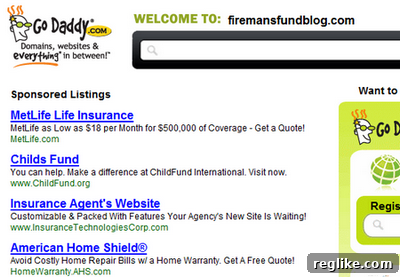
However, a crucial distinction exists between a parked page actively set up and managed by the domain name registrant and a standard holding page implemented by the domain name registrar. The former reflects a deliberate choice by the registrant to monetize the domain name, potentially by attracting traffic searching for the trademarked term. The latter, on the other hand, is a default setting employed by many registrars to generate revenue from newly registered domain names that have not yet been actively developed or configured.
Many UDRP panelists tend to overlook this subtle but critical difference, often swayed by the mere presence of competitive advertisements. However, in the FiremansFundBlog.com case, panelist Paul M. DeCicco demonstrated a clear understanding of the nuances involved.
In his decision, which sided with the respondent (the domain name registrant), DeCicco astutely noted the registrar’s (Go Daddy’s) standard business practice:
The at-issue domain name’s registrar’s business practice is to set all new domain name registration records to initially resolve to a registrar (Go-Daddy) controlled holding page featuring advertising related to the domain name. The record remains this way until the registrant redirects the domain name’s DNS record elsewhere. The existence and content of such holding pages is thus not the result of the domain name registrant’s intent…It is thus Go-Daddy not the Respondent that receives any benefit from the complained of holding page.
This observation is fundamental to understanding the context of many UDRP cases. The presence of advertisements on a registrar’s holding page, particularly those related to the domain name, is often a function of the registrar’s business model, not necessarily an indication of the registrant’s intent to profit from a trademark or engage in cybersquatting. The registrar, in this instance Go Daddy, is the entity directly benefiting from the advertising revenue generated by the holding page.
It’s worth emphasizing that in the majority of UDRP cases where a registrar landing page is cited as evidence of bad faith, the registrant is often not a deliberate cybersquatter. A true cybersquatter, motivated by profit, would likely have actively parked the domain name with a specialized parking service, optimizing the page for relevant keywords and maximizing advertising revenue. The reliance on a generic registrar holding page suggests a lack of sophistication and a less malicious intent.
DeCicco further emphasized that while other UDRP panels have reached different conclusions in similar cases, the use of registrar parking pages as evidence against a domain name owner raises significant concerns regarding fairness and consistency.
The results of a UDRP proceeding should not hang on happenstance. Decisions should not vary simply because a particular registrar links new registrations to a holding page that happens to contain links that might offend Complainant, while another registrar puts up only a benign ‘under construction’ notice as a holding page or fails to resolve the domain name at all until the registrant specifies how so.
This is a crucial point. The outcome of a UDRP case should not be determined by the arbitrary practices of the domain name registrar. Different registrars employ different strategies for handling newly registered domain names. Some display generic “under construction” pages, while others utilize sophisticated advertising-driven holding pages. The content of these pages is beyond the registrant’s immediate control and should not be used as the sole basis for determining bad faith registration.
To summarize, the FiremansFundBlog.com case highlights the importance of careful analysis and contextual understanding in UDRP proceedings. While the presence of competitive advertisements on a domain name can raise concerns, it is essential to distinguish between registrant-controlled parked pages and registrar-controlled holding pages. The latter should not be automatically interpreted as evidence of bad faith, as it is often a consequence of the registrar’s business practices rather than the registrant’s malicious intent.
Paul M. DeCicco’s decision in this case serves as a reminder that common sense and a nuanced understanding of the domain name ecosystem are essential for ensuring fair and equitable outcomes in UDRP disputes. His reasoning protects legitimate domain name registrants from being unfairly penalized for the standard practices of domain registrars.
The UDRP system is designed to combat cybersquatting, which involves registering domain names that are identical or confusingly similar to trademarks with the intent to profit from the goodwill associated with those trademarks. However, it’s important to ensure that the UDRP is not used to unfairly target legitimate domain name registrations or to stifle free speech.
Cases like FiremansFundBlog.com underscore the need for UDRP panelists to consider all relevant factors, including the registrant’s intent, the nature of the domain name, and the surrounding circumstances, before reaching a decision. A mere coincidence of a trademark appearing in advertising on a registrar’s default page is not, and should never be, enough to find bad faith.
Ultimately, the UDRP system’s effectiveness depends on the ability of panelists to apply common sense and sound judgment to each case, ensuring that the rights of both trademark owners and domain name registrants are protected.
This case provides a valuable lesson for both trademark owners and domain name registrants involved in UDRP disputes. Trademark owners should be aware of the distinction between registrar holding pages and registrant-controlled parked pages and should not rely solely on the content of holding pages as evidence of bad faith. Domain name registrants, on the other hand, should be prepared to explain the circumstances surrounding their domain name registration and to demonstrate that they did not register the domain name with the intent to profit from a trademark or engage in cybersquatting.