
Facebook Workplace: A Deep Dive into Corporate Collaboration
Is Facebook poised to significantly expand its offerings in the corporate world? Recent activity suggests that the social media giant is gearing up to launch a comprehensive service called “Workplace,” or perhaps even rebrand its existing enterprise solution. This move indicates a strong interest in capturing a larger share of the rapidly growing market for corporate collaboration tools.
The evidence lies in Facebook’s strategic acquisition of several key domain names. The company has registered domains such as facebookworkplace.com, fbworkplace.com, workplacebyfacebook.com, and workplacebyfb.com, along with variations using different domain extensions. This proactive measure demonstrates a clear intent to establish a strong online presence for its upcoming or revamped corporate platform.
Currently, Facebook already offers a service known as Facebook at Work. This platform bears a striking resemblance to popular collaboration tools like Slack, providing features for team communication, file sharing, and project management. However, the registration of these new domain names hints at a more significant and potentially ambitious expansion of Facebook’s corporate services.
The potential for growth in the corporate collaboration market is undeniable. Earlier this year, Slack secured a substantial $200 million in funding, valuing the company at an impressive $3.8 billion. This significant investment underscores the strong demand for effective and user-friendly collaboration tools that can enhance productivity and streamline communication within organizations of all sizes.
Facebook’s recent success in winning a UDRP (Uniform Domain-Name Dispute-Resolution Policy) for Facebookwork.com further reinforces its commitment to protecting its brand and intellectual property in the corporate domain. This legal victory demonstrates Facebook’s determination to secure its online presence and prevent unauthorized use of its brand name.
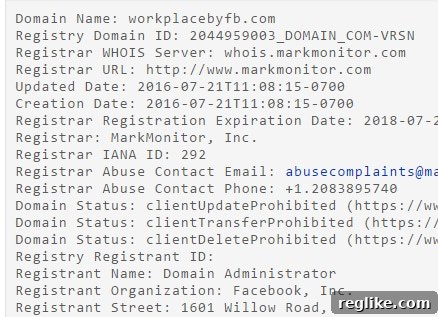
Domain registration details related to Facebook Workplace.
Analyzing Facebook’s Strategy: A Deeper Look
Facebook’s foray into the corporate collaboration arena is not entirely unexpected. The company possesses a vast user base, extensive infrastructure, and a deep understanding of social networking dynamics. Leveraging these strengths, Facebook is well-positioned to create a compelling and integrated solution for businesses of all sizes.
The “Workplace” initiative could represent a strategic effort to tap into the lucrative market for enterprise software. By offering a comprehensive suite of collaboration tools, Facebook aims to become an indispensable platform for businesses seeking to improve communication, boost productivity, and foster stronger team cohesion.
However, Facebook faces significant challenges in its quest to conquer the corporate world. Established players like Slack, Microsoft Teams, and Google Workspace already hold considerable market share. To succeed, Facebook must differentiate its “Workplace” offering by providing unique features, superior user experience, and compelling value proposition.
One potential advantage that Facebook possesses is its massive reach and brand recognition. The company’s ubiquitous presence in the consumer market could translate into rapid adoption of “Workplace” among businesses familiar with the Facebook platform. Furthermore, Facebook’s expertise in social networking could enable it to create a more engaging and collaborative work environment.
The success of “Workplace” will depend on Facebook’s ability to address key concerns regarding data privacy, security, and integration with existing business systems. Companies are increasingly cautious about entrusting their sensitive data to third-party providers. Facebook must demonstrate a strong commitment to data protection and provide robust security measures to gain the trust of corporate clients.
The Future of Corporate Collaboration: A Competitive Landscape
The market for corporate collaboration tools is becoming increasingly competitive, with a growing number of vendors vying for market share. Each platform offers a unique set of features and capabilities, catering to different needs and preferences.
Slack remains a dominant player, known for its intuitive interface, robust integrations, and vibrant developer ecosystem. Microsoft Teams has gained significant traction, leveraging its integration with the Microsoft Office suite and its extensive enterprise customer base. Google Workspace offers a comprehensive suite of productivity tools, including Gmail, Google Docs, and Google Meet, tightly integrated for seamless collaboration.
Facebook’s “Workplace” must stand out from the crowd by offering a compelling combination of features, usability, and value. The platform could differentiate itself by leveraging Facebook’s social networking expertise to create a more engaging and collaborative work environment. Furthermore, “Workplace” could offer unique integrations with Facebook’s other services, such as Messenger and Groups, to provide a seamless communication experience.
The future of corporate collaboration will likely be shaped by several key trends. These include the increasing adoption of cloud-based solutions, the growing importance of mobile collaboration, and the rise of artificial intelligence (AI) in the workplace. Facebook’s “Workplace” must adapt to these trends to remain competitive and meet the evolving needs of businesses.
In conclusion, Facebook’s registration of new domain names related to “Workplace” suggests a significant expansion of its corporate offerings. The company is poised to compete with established players in the market for corporate collaboration tools. The success of “Workplace” will depend on Facebook’s ability to differentiate its platform, address key concerns regarding data privacy and security, and adapt to the evolving trends in the workplace.