
The Global Domain Name Landscape: Understanding the Dominance of ccTLDs
While the .com domain extension enjoys widespread recognition and usage, particularly in North America, it’s crucial to recognize that the global domain name landscape is far more diverse. Country code top-level domains (ccTLDs) continue to hold significant sway in many regions around the world, often surpassing .com in popularity and usage.
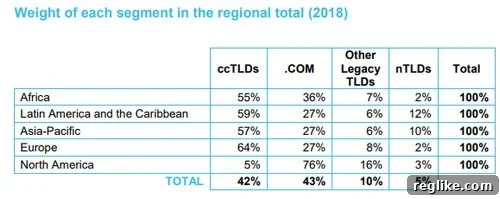
The chart above vividly illustrates this point. While .com is the undisputed leader in North America, its influence diminishes significantly in other regions categorized by ICANN (Internet Corporation for Assigned Names and Numbers). This regional variation highlights the importance of understanding the nuances of the global domain name market.
It’s easy to fall into the trap of a United States-centric perspective when discussing domain names. However, the reality is that domain name demand and usage patterns vary considerably across different countries and regions. Ignoring these differences can lead to missed opportunities and ineffective online strategies.
Afnic, the organization responsible for managing the French ccTLD .fr, published a comprehensive report on the domain name market in 2018. This report provides valuable insights into the mechanics of the domain name market and is highly recommended reading for anyone seeking a deeper understanding of this dynamic industry. The report underscores the importance of ccTLDs in the global landscape.
If you’ve traveled or lived outside of North America, you’ve likely witnessed firsthand the prominence of ccTLDs. From websites to email addresses, ccTLDs are often the preferred choice for individuals and businesses looking to establish a strong local presence.
Of course, it’s essential to remember that regions are vast and diverse, and the dominance of .com versus ccTLDs can fluctuate from country to country. Even in countries where the ccTLD is the most widely used, .com remains a common and recognizable domain extension.
ccTLDs, by their very nature, are inherently limiting. They are tied to specific geographic locations, which can be both an advantage and a disadvantage. As Afnic notes in their report:
These data highlight the difficulty for new entrants to impose themselves faced with “cultural prisms” in one case prioritizing the notions of region and proximity, and in the other case a global approach that overrides any reductive specific feature implied by the TLD chosen.
This quote encapsulates the core challenge faced by new top-level domains (TLDs) trying to break into established markets. In regions where local identity and proximity are highly valued, ccTLDs offer a powerful advantage. Conversely, .com provides a more global and universally recognized presence.
The Afnic report contains numerous other valuable takeaways. One particularly insightful observation concerns the dynamic between registries and registrars and how some registries may need to adopt different strategies to succeed:
As we already noted in 2018, the fact remains that the registry – registrar system will no doubt have to change in the future, by increasingly favoring the emergence of specialized or “proximity” resellers, who will take care of marketing nTLDs to the relevant niche markets. The transformation is not an obvious one for every player and remains slow to enter the mores, registrars often considering themselves as wholesalers whose role is not to build and facilitate dealer networks optimized for this or that target. Current and future nTLDs cannot, however, be successful without the changing of the retail system.
This statement highlights the need for a more nuanced and targeted approach to marketing new TLDs. Registrars, traditionally focused on large-scale distribution, may need to adapt their strategies to cater to specialized niche markets. The success of new TLDs hinges on the development of reseller networks that understand and can effectively reach these target audiences.
Another critical point raised by Afnic is the financial viability of new TLDs. The report suggests that a significant percentage of new TLDs are potentially “loss-making” if they sell domains at low wholesale prices. Specifically, Afnic estimates that 50% of new TLDs could be unprofitable if they sell domains for less than $20 wholesale, and 83% if they sell below $10. This underscores the importance of careful pricing strategies and sustainable business models for new TLD operators.
In conclusion, the global domain name market is a complex and multifaceted landscape. While .com remains a dominant force, particularly in North America, ccTLDs continue to play a vital role in many regions around the world. Understanding the regional preferences, cultural nuances, and evolving dynamics between registries and registrars is crucial for anyone seeking to navigate this market successfully. The Afnic report offers valuable insights into these issues and is highly recommended for anyone interested in the current state and future trends of the domain name industry. Choosing the right domain extension, whether it’s a widely recognized .com or a locally relevant ccTLD, is a critical step in building a successful online presence.
Remember that a strong online presence starts with the right domain name. Consider your target audience, geographic focus, and overall branding strategy when making your domain name selection. A well-chosen domain name can significantly enhance your online visibility and credibility.
Further research into specific ccTLDs relevant to your target markets can provide valuable insights into local preferences and requirements. Each ccTLD has its own set of rules and regulations, so it’s essential to familiarize yourself with these before registering a domain name.
The domain name industry is constantly evolving, with new TLDs and technologies emerging regularly. Staying informed about these developments is crucial for making informed decisions and adapting to the changing landscape. Subscribe to industry publications, attend conferences, and engage with online communities to stay up-to-date on the latest trends and best practices.
Access the full Afnic report available online for a more in-depth analysis of the global domain name market.