
Decoding Domain Registrar Growth: A Comprehensive Analysis of .COM Performance in 2025
The domain name industry is a dynamic landscape, constantly evolving with shifts in market share, competitive strategies, and user preferences. As the digital economy continues its expansion, understanding the performance of domain registrars, especially for the ubiquitous .com extension, becomes crucial for both industry stakeholders and domain owners. We recently published our monthly review of how major domain name registrars fared with .com registrations. Since this dataset covers the entirety of December 2025 and concludes the year, it offers a fascinating opportunity for a deeper, more analytical dive into the trends that shaped the market.
This comprehensive report aims to unravel the intricate factors driving registrar growth, or decline, focusing specifically on .com domains under management (DUMs) during 2025. We will explore the interplay of new registrations, domain deletions, and net transfers, providing insights into which registrars are flourishing and the specific strategies contributing to their success. By dissecting the performance of key players, we can identify underlying market dynamics and emerging competitive landscapes in the highly contested domain registration space.
Understanding Domain Under Management (DUMs) Growth
A fundamental metric for any domain registrar is its Domains Under Management (DUMs). This figure represents the total number of domains actively registered and managed by a registrar or its family of brands. The annual change in DUMs provides a clear indicator of a registrar’s overall health and market penetration. For the purpose of this analysis, it’s important to note that all numbers presented here are consolidated for the registrar family. For instance, GoDaddy’s comprehensive figures encompass its various brands, including GoDaddy.com, 123-Reg, Mesh Digital, and other affiliated entities, offering a holistic view of their market footprint.
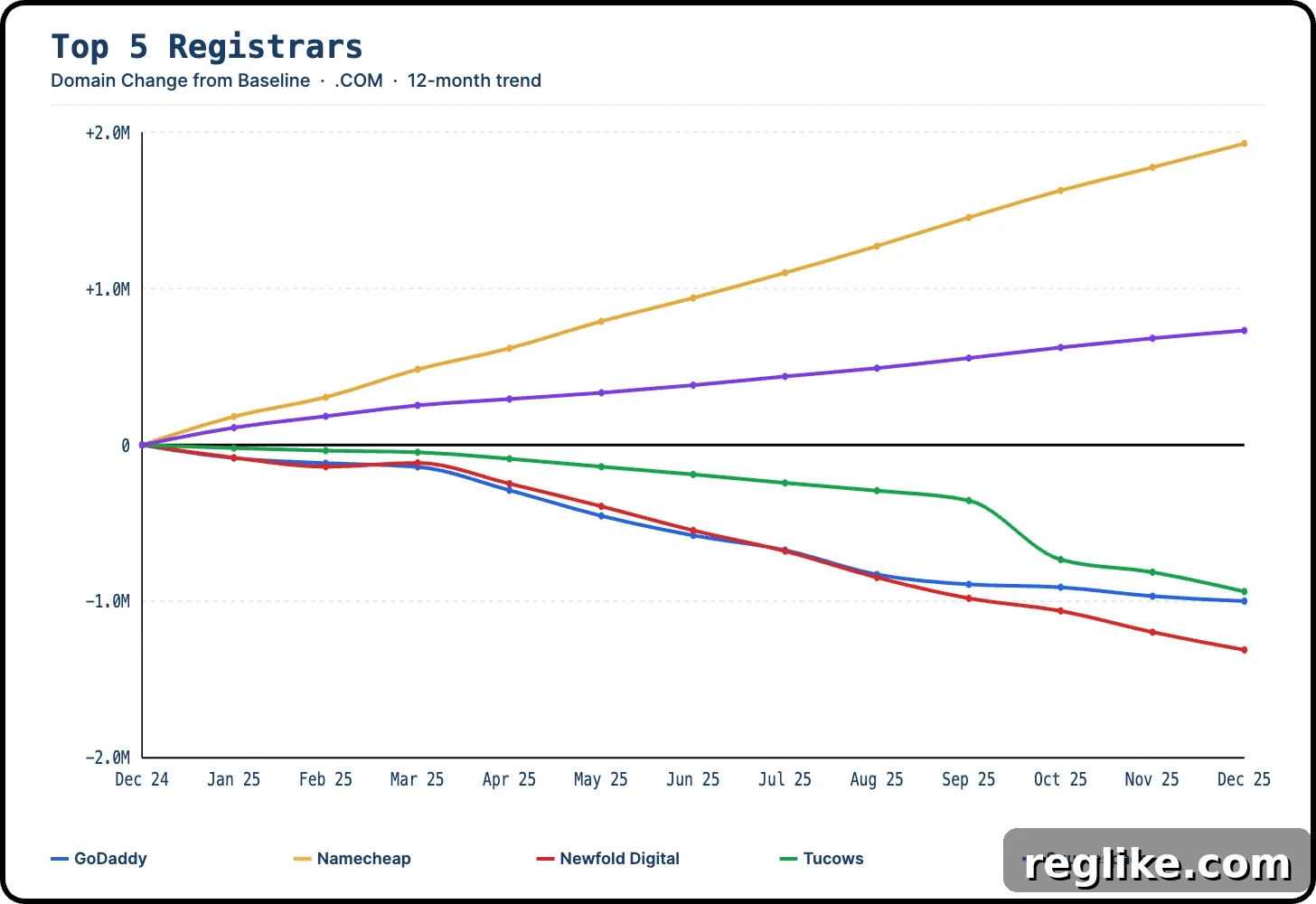
The growth or shrinkage of DUMs is not a simple calculation; it’s influenced by three primary factors: new domain registrations, domain deletions (domains that expire and are not renewed), and net transfers (the difference between domains transferred into and out of a registrar). A strong performance in one area can sometimes be offset by weaknesses in another, leading to nuanced outcomes that require careful examination. Let’s look at how the top registrars in terms of overall size performed over the past 12 months for .com domains.
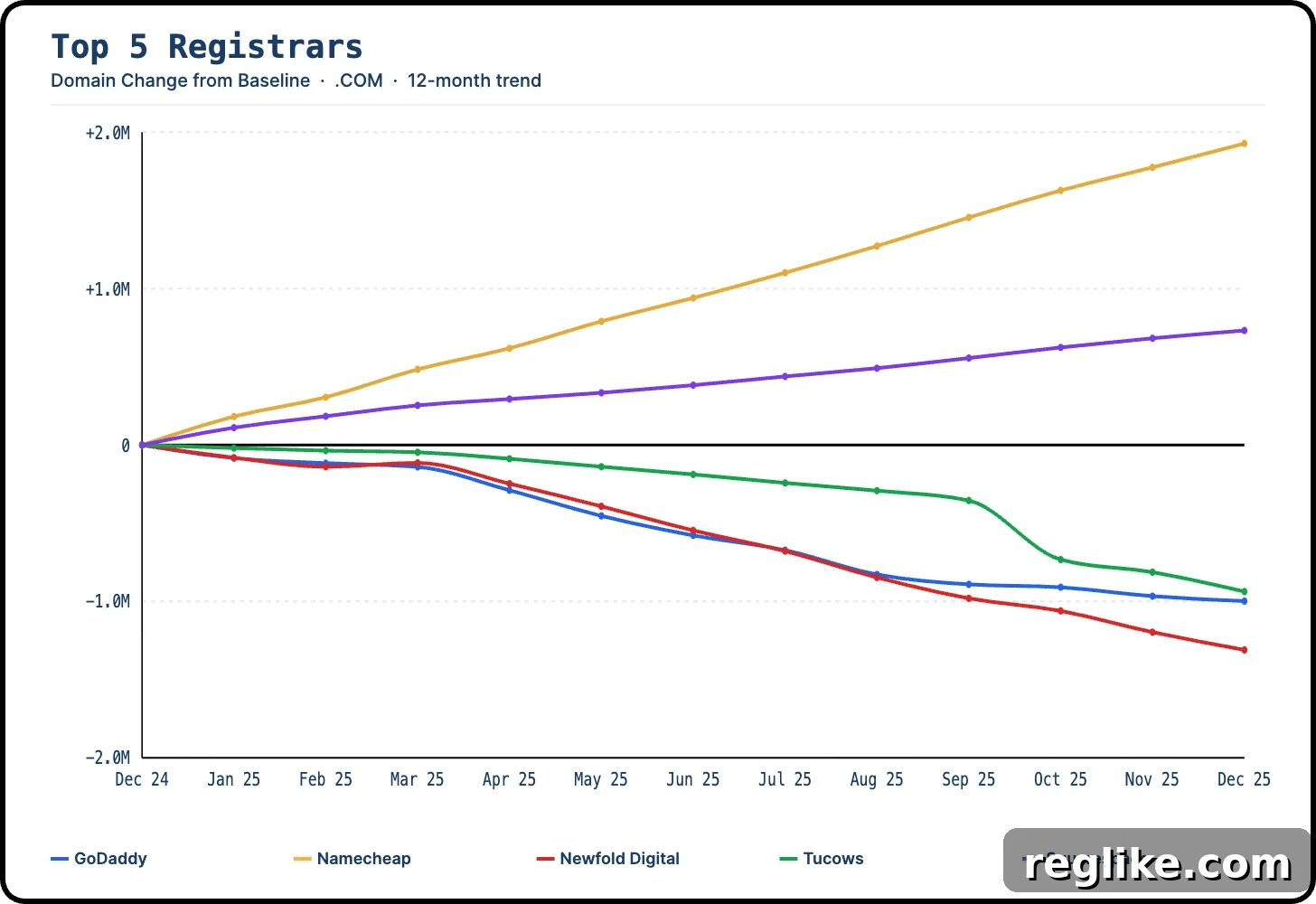
This visual representation highlights the varied trajectories of leading registrars. While some demonstrated robust growth in their DUMs, others experienced contractions, underscoring the complexities of maintaining market share in this competitive sector. A registrar might lead in new registrations but still face a net loss in DUMs if its deletion rates are high or if it loses a significant volume of domains through transfers. Conversely, a registrar with moderate new registrations could still grow its DUMs by retaining customers effectively and attracting transfers.
The Engine of Growth: New .COM Registrations in 2025
New registrations represent the initial influx of domains into a registrar’s portfolio and are often seen as a key indicator of market presence and marketing effectiveness. For 2025, the landscape of new .com registrations revealed some familiar titans alongside rapidly ascending contenders. Here’s a detailed leaderboard showcasing the registrars that spearheaded the most new .com registrations during the year:
| # | Registrar | 2025 Adds |
|---|---|---|
| 1 | GoDaddy | 7,874,063 |
| 2 | Namecheap | 5,259,827 |
| 3 | Squarespace | 2,221,434 |
| 4 | Tucows | 1,815,397 |
| 5 | Hostinger | 1,783,356 |
| 6 | Gname | 1,636,808 |
| 7 | Dynadot | 1,584,481 |
| 8 | Newfold Digital | 1,476,358 |
| 9 | Alibaba | 1,347,538 |
| 10 | IONOS | 1,174,140 |
| 11 | Cloudflare | 865,407 |
| 12 | Wix | 849,661 |
| 13 | Team Internet | 687,317 |
| 14 | TurnCommerce | 654,922 |
| 15 | Porkbun | 612,488 |
Unsurprisingly, GoDaddy maintained its commanding lead, registering nearly eight million new .com domains in 2025. This remarkable volume underscores its extensive marketing reach, brand recognition, and comprehensive suite of web services that often bundle domain registrations. Namecheap also demonstrated significant strength, securing over five million new registrations, largely attributed to its competitive pricing, user-friendly interface, and strong customer support reputation. Other notable performers include Squarespace, benefiting from its integrated website builder platform, and Hostinger, known for its affordable hosting solutions that often include free domain registrations.
However, leading in new registrations does not automatically translate to overall DUMs growth. This brings us to a crucial paradox observed in the 2025 data, particularly concerning GoDaddy.
The GoDaddy Paradox: High Registrations, DUM Decline
Given that GoDaddy registered an impressive 7.9 million new .com domains in 2025, it might seem counterintuitive that the company experienced a net loss of nearly one million DUMs during the same period. This apparent contradiction highlights the critical importance of looking beyond just new registrations and understanding the full lifecycle of a domain.
One might initially suspect that a massive outflow of domain transfers was the culprit. However, a closer examination of the data reveals this not to be the case. GoDaddy experienced a near-balance in its transfer activity, with a net loss of merely 1,374 domains from transfers last year. This demonstrates that their ecosystem, bolstered by platforms like their expired domain auction, effectively manages to attract transfers that largely compensate for any outgoing ones. For example, when a domain from a partner registrar is won through GoDaddy’s auction platform, it typically transfers to GoDaddy, mitigating potential net losses from transfers.
The true reason behind GoDaddy’s DUM decline lies in the balance between new registrations and domain expirations. In 2025, while GoDaddy’s registrars added 7.9 million domains, a staggering 8.9 million domains under their management expired. This indicates a significant volume of domains not being renewed by their owners. The phenomenon of high deletions can stem from various factors: speculative registrations that are not profitable enough to renew, businesses or projects that have ceased operation, or users simply forgetting to renew. For a registrar with a vast existing portfolio like GoDaddy, even a slight decrease in renewal rates across millions of domains can lead to substantial net DUM losses, despite robust new registration figures. This pattern suggests that while GoDaddy remains highly effective at acquiring new customers, customer retention for certain segments or domain types might pose a challenge.
The Battleground of Transfers: Gaining and Losing Market Share
Domain transfers represent a direct competition for existing domain assets, where registrars actively vie for customers who are willing to move their domains from one provider to another. These movements are often driven by factors like pricing, customer service, value-added services, or specific promotional offers. Analyzing net transfers (transfers in minus transfers out) provides invaluable insights into a registrar’s ability to attract and retain satisfied customers.
Top 10 Registrars with Net Transfers In (2025)
For 2025, several registrars demonstrated exceptional prowess in attracting domains, significantly boosting their DUMs through net transfers. Here are the top 10 registrars for net transfers in:
| # | Registrar | T12M Net Transfers |
|---|---|---|
| 1 | Gname | +889,742 |
| 2 | Namecheap | +248,248 |
| 3 | Cloudflare | +244,903 |
| 4 | Unstoppable Domains | +191,708 |
| 5 | Hostinger | +170,029 |
| 6 | Hefei Juming | +112,923 |
| 7 | Porkbun | +48,299 |
| 8 | Realtime Register | +40,298 |
| 9 | Eranet International | +34,710 |
| 10 | Wix | +32,529 |
Gname stands out dramatically, securing nearly 900,000 net transfers. This impressive figure suggests aggressive pricing strategies, potentially targeting specific international markets, or highly effective promotional campaigns. Interestingly, Gname also registered 1.6 million new .coms in 2025 but experienced about 1.8 million deletes. This means that without its substantial transfer gains, Gname would have seen a net loss in DUMs. Its transfer strategy effectively turned a potential decline into a net growth of 0.8 million DUMs, showcasing how transfers can be a critical lifeline for registrars.
Cloudflare also performed exceptionally well, attracting a quarter-million net transfers. Their appeal often lies in providing domains at cost, coupled with their robust security, CDN, and performance services. Users frequently transfer domains to Cloudflare for integrated security and simplified management. Unstoppable Domains, while generating around 500,000 new .com registrations, punched significantly above its weight in transfers, largely due to a “generous transfer special” offered to customers, demonstrating the power of targeted incentives. Namecheap and Hostinger also continued their strong performance, leveraging their reputation for affordability, ease of use, and comprehensive service offerings to attract transfers.
Top 10 Registrars Losing Most Transfers (2025)
On the flip side, some registrars experienced significant net losses from transfers, indicating challenges in customer retention or competitiveness. These transfers out represent customers moving their domains to other providers, often in search of better pricing, improved support, or more integrated services.
| # | Registrar | T12M Net Transfers |
|---|---|---|
| 1 | Newfold Digital | -378,512 |
| 2 | Alibaba | -301,977 |
| 3 | Tucows | -253,779 |
| 4 | eName | -132,782 |
| 5 | TurnCommerce | -125,703 |
| 6 | GMO | -124,798 |
| 7 | Squarespace | -72,943 |
| 8 | SAV | -54,889 |
| 9 | Team Internet | -52,050 |
| 10 | NameSilo | -50,237 |
Newfold Digital, Alibaba, and Tucows registered the largest net losses in transfers. For larger, more diversified companies like Newfold Digital (which encompasses many legacy brands), this could indicate a struggle to integrate disparate systems, maintain competitive pricing across all brands, or address customer service issues on a broad scale. Alibaba’s substantial loss might reflect shifts in the international domain market or specific policy changes affecting its customer base.
TurnCommerce’s position on this list is particularly interesting and can be largely attributed to its parentage of DropCatch, a prominent expired domain backorder service. Many customers acquire desirable expired domains through DropCatch’s auctions. Once these domains are successfully backordered and secured, customers often choose to transfer them to their preferred, primary registrars for long-term management, better pricing, or integration with other services, resulting in a consistent outflow of transfers from TurnCommerce’s direct registrar services.
Squarespace, despite its strong performance in new registrations, also experienced a notable net loss in transfers. This suggests that while users are drawn to Squarespace for its excellent website building tools and initial domain registration convenience, a segment of these users might later transfer their domains to other registrars for potentially lower renewal costs or more advanced domain management features, once their website is established.
Market Dynamics and The Road Ahead
Encouragingly, the .com namespace saw overall growth in 2025, reversing a trend of decline observed in previous years. This expansion is a positive signal for the broader digital economy, indicating renewed business confidence, new venture creation, or increased online activity. However, as our analysis clearly shows, this growth was not uniformly distributed among registrars.
The success stories of 2025 highlight several key strategies employed by thriving registrars: aggressive acquisition through competitive new registration offers, compelling transfer incentives, a focus on customer experience, and the integration of value-added services like hosting, security, and website builders. Registrars like Namecheap, Cloudflare, and Hostinger, with their balanced approach to new registrations, customer retention, and transfer acquisition, appear to be adapting well to the evolving demands of the market.
Conversely, those experiencing DUM decline or significant net transfer losses must reassess their strategies. This might involve re-evaluating pricing models, enhancing customer support, modernizing user interfaces, or developing more attractive bundled services to improve retention and attract incoming transfers. The GoDaddy paradox serves as a powerful reminder that high volume alone isn’t sufficient for sustained DUM growth; effective customer retention and a low deletion rate are equally, if not more, critical.
In conclusion, the 2025 data for .com domain registrars paints a picture of a fiercely competitive yet growing market. Success hinges on a sophisticated understanding of the interplay between new registrations, domain expirations, and transfer dynamics. As we move forward, registrars that can effectively balance these three pillars, while continually innovating and prioritizing customer value, will be best positioned to capture and sustain growth in the ever-expanding digital landscape.