
Partnership brings together two longtime registrar CEOs.
A new partnership has submitted applications for 25 top-level domain (TLD) strings in this year’s ICANN TLD expansion round. The effort pairs two well-known figures in the domain industry: Ray King, CEO of the registrar Porkbun, and Todd Han, CEO of Dynadot. They filed the applications under a new company called Oinkadot.
Although the Oinkadot name playfully nods to the CEOs’ registrars, the company is a separate entity and is not formally part of either Porkbun or Dynadot. King and Han decided to join forces after discovering overlapping interests in many of the same strings while using EarlyWarning.Report for research and strategy. That shared interest led them to pool resources for this round of applications.
King has prior experience participating in ICANN’s new gTLD rounds. In the 2012 round he applied through his company Top Level Design and successfully obtained several strings, including .design, .wiki, .ink and .gay, and later added .tattoo to that portfolio. Those TLDs were subsequently sold to GoDaddy in two transactions, with .design changing hands in 2021 and the remaining TLDs following in 2023. Han, by contrast, did not participate in the 2012 round, making this collaboration a notable step for both executives.
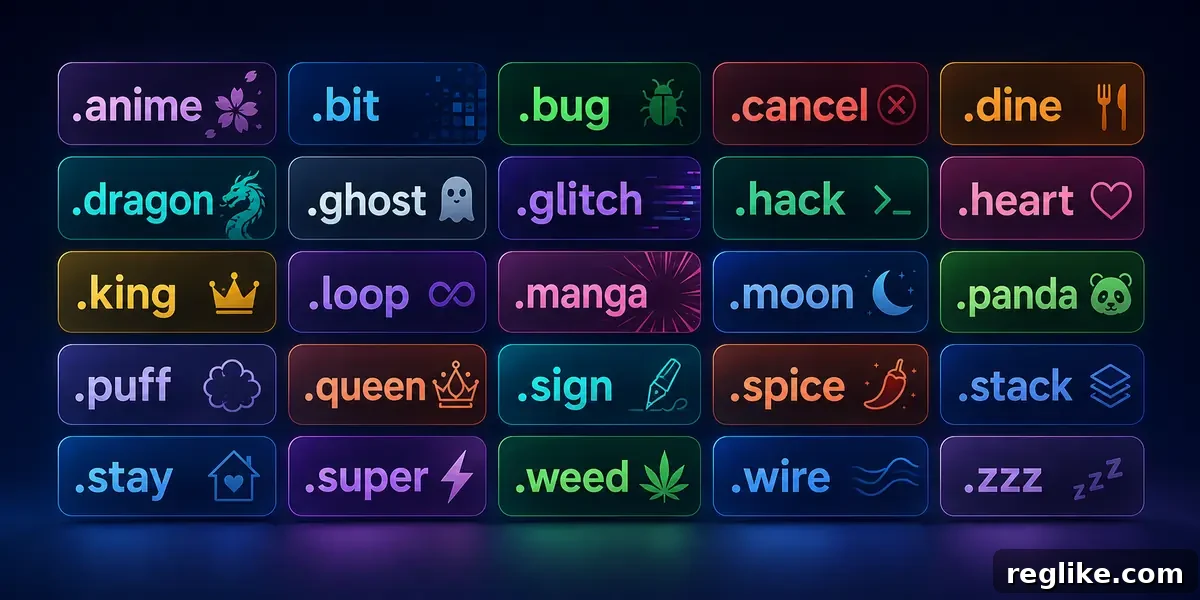
Oinkadot has already paid $5.675 million in ICANN application fees and has signaled readiness to participate in contention set auctions should that become necessary. The company’s announced primary string list contains 25 domains that range across hobby and entertainment themes to lifestyle and technology concepts. The primary domains named in the application are:
.anime
.bit
.bug
.cancel
.dine
.dragon
.ghost
.glitch
.hack
.heart
.king
.loop
.manga
.moon
.panda
.puff
.queen
.sign
.spice
.stack
.stay
.super
.weed
.wire
.zzz
Oinkadot is not disclosing its replacement strings at this time. Replacement strings are used in the application process as alternates if a primary string is withdrawn or otherwise becomes ineligible. Keeping them private is a common strategic choice to avoid revealing fallback plans to potential competitors.
Some of the primary strings Oinkadot applied for are already expected to attract competitive bids. Industry announcements indicate other groups are applying for many of the same or similar strings. For example, Link Freedom Group has announced applications involving a number of those strings, including .bit, .hack, .loop, .moon, .sign, .stack, .stay, .super and .zzz. In some cases, it is not clear whether competing applicants listed those names as primary or replacement strings. If an applicant’s replacement string happens to match another applicant’s primary string, the replacement is typically ineligible, which can affect who ultimately remains in contention.
Oinkadot may also face competition specifically for .anime and .manga. While ICANN has not yet publicly confirmed all applications and contention sets, several parties previously announced interest in those two anime-related strings. D3, for instance, previously announced a partnership with Animecoin Foundation to pursue .anime, and Unstoppable Domains disclosed a partnership with Kitnsugi announcing applications for both .anime and .manga. Those prior announcements suggest there is significant interest in names that serve fan communities and creative industries.
The presence of multiple applicants for the same strings often leads to auctions or negotiated settlements to determine which party will operate each TLD. Oinkadot’s readiness to engage in contention auctions, combined with the substantial fees it has already paid, indicates a serious commitment to securing one or more of its chosen strings. For registrants and industry observers, the applications illustrate ongoing interest in expanding the namespace to serve niche communities, creative projects, and specialized services.
As the ICANN evaluation and objection process moves forward, more details will emerge about which applicants remain in play, which strings clear contention, and how ownership is ultimately resolved. For now, Oinkadot’s move highlights a strategic collaboration between two experienced domain executives pursuing a focused slate of TLDs.