

Unlocking Profit: The Untapped Potential of New TLD Domain Flipping
In the dynamic world of domain name investing, a common sentiment often echoes among skeptics: new Top-Level Domains (TLDs) are a financial sinkhole, a fruitless endeavor for those seeking profitable returns. Critics frequently point to the initial high registration costs, the added expense of registry premiums, and a perceived lack of widespread adoption as insurmountable barriers, suggesting that traditional domainers are effectively shut out of this evolving landscape.
However, this perspective overlooks a significant, albeit often understated, reality. Despite the skepticism, a segment of astute investors is indeed generating substantial profits by strategically acquiring and flipping new TLDs. This article delves into real-world examples that demonstrate the viability of new TLDs as valuable digital assets, showcasing instances where registrants have achieved impressive returns on their investments.
It is crucial to preface this exploration with a word of caution: while opportunities abound, the art of flipping new TLDs is far from “easy money.” The domain aftermarket, like any investment arena, demands diligent research, a keen understanding of market trends, and a calculated approach to risk. It’s simple enough to cherry-pick a few impressive sales from weekly reports or industry journals like DNJournal to paint a rosy picture, suggesting that every type of domain name is a goldmine. Such isolated examples, while compelling, don’t tell the whole story.
Nevertheless, the purpose here is to bring genuinely profitable domain resales to the forefront, illuminating the concrete opportunities that exist within the new TLD space. By examining verified flips, we can offer a more nuanced and encouraging perspective for both seasoned domain investors and newcomers alike.
Verifying the Flips: A Rigorous Approach to Data
To ensure the credibility of the examples presented, a meticulous verification process was undertaken. A comprehensive review of numerous new TLD sales reported by prominent platforms like Sedo and DNJournal was conducted. For each potential case, historical WHOIS records were consulted to confirm that these transactions were indeed genuine resales by an original registrant, rather than initial offerings from registrars, auction houses, or direct sales from registries. This verification step is vital in distinguishing true aftermarket success stories from primary market transactions, which operate under different pricing and acquisition dynamics.
Case Study: The Lucrative .Estate Flips
One compelling success story that stands out in the new TLD market involves Valery Otto, an investor based in Monaco. Historical WHOIS records unequivocally show that Otto was the acquirer of two exceptionally valuable .estate domain names. These were Luxury.estate, which commanded a significant price of $50,000, and NewYork.estate, which sold for $9,000. Both domains were registered during the latter stages of the Early Access Program (EAP) – a phase where new TLDs are made available before general availability, often at progressively higher fees.
The true brilliance of these flips lies in their acquisition cost. Inquiries with Donuts, the registry operator for .estate, revealed that the estimated retail cost for each of these domains at the time of their original registration was remarkably low—under $200. This stark contrast between acquisition cost and resale value underscores the extraordinary return on investment achieved. For Luxury.estate, this represents a staggering profit margin, turning a sub-$200 investment into a $50,000 windfall. NewYork.estate, while a smaller sale, still delivered a return of over 45 times the initial outlay. These examples serve as powerful testimonials to the potential for significant gains within the new TLD market, especially when identifying and securing high-value names early on.
Beyond the Outliers: Consistent Returns in the New TLD Aftermarket
While the sales of Luxury.estate and NewYork.estate represent considerable outliers in terms of their public visibility and sale price within the new TLD aftermarket, they are not isolated incidents of profitability. The majority of aftermarket sales for new TLDs typically fall within the three- or low four-figure range. However, it is crucial to recognize that even these seemingly lower prices often translate into exceptionally healthy returns, particularly when considering the minimal initial investment and the relatively short hold times for these digital assets—often less than a year.
The strength of these investments lies in the leverage of a low entry cost. When a domain initially costs under $200 and sells for $1,000, that’s a 400% profit. If it sells for $5,000, the return is exponentially higher. This inherent characteristic makes new TLD flipping an attractive proposition, allowing investors to achieve substantial percentage gains even on smaller sales.
Factors Driving Value in New TLDs
Understanding what makes certain new TLDs profitable in the aftermarket is key to replicating success. Several factors contribute to a new TLD’s resale value:
- Keyword Relevance: Domains that feature strong, highly searched keywords (e.g., “travel,” “tech,” “home”) or industry-specific terms are inherently more valuable.
- Brandability: Short, memorable, and pronounceable names with strong branding potential are always in high demand.
- Geographic or Niche Specificity: TLDs like .nyc, .london, or industry-specific ones such as .app, .store, .restaurant, can command premium prices for businesses targeting those specific markets.
- Early Access Advantage: Participating in Early Access Programs (EAP) often allows investors to secure premium names before general availability, albeit at higher initial fees, which can then be flipped for a significant profit if the domain is truly valuable.
- Premium Domain Status: Some domains are designated as “premium” by registries due to their inherent value (e.g., single-word domains). While these often have higher registration fees, their aftermarket value can justify the initial investment.
- Market Demand & Trends: Staying abreast of emerging industries, technologies, and consumer trends can help identify which new TLDs and specific domain names will be most desirable in the near future.
The following chart further illustrates a collection of new TLD resales, reinforcing the pattern of successful flips. While the precise original acquisition cost for each of these domains is not publicly available, discussions with Donuts, the registry, suggest that the retail price for all of them was likely under $200 each. This holds true whether they were registered during the Early Access Program, as premium domains, or at standard retail rates.
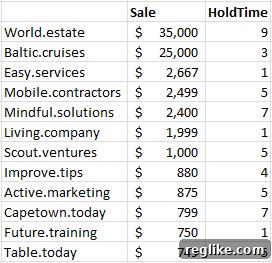
The implications of this data are clear. The original buyers of these domains typically invested less than $200 per name. This means that the profit generated from these sales, even after accounting for potential broker fees, is remarkably close to the full sale price. Such a high return on a relatively small initial investment is a key indicator of the underlying profitability of strategic new TLD acquisitions.
The “HoldTime” column in the chart provides additional insight, representing the approximate number of months the original registrant held the domain name before successfully selling it. These hold times are often quite short, indicating that the market for valuable new TLDs is active and can yield quick returns for those who identify the right opportunities. A quick flip within a year or even a few months, resulting in multiples of the original investment, undeniably constitutes a “pretty good flip” in any investment portfolio.
Strategies for Successful New TLD Investing
For those looking to venture into or expand their presence in the new TLD market, a strategic approach is paramount:
- Thorough Research: Invest time in understanding which new TLDs are gaining traction and which ones align with growing industries. Analyze registration numbers, primary market sales, and early aftermarket activity.
- Keyword and Niche Focus: Identify valuable keywords and underserved niches. Think about how businesses and individuals will use these new TLDs. A strong, relevant keyword combined with a descriptive new TLD (e.g., ‘yourbrand.tech’ or ‘yourservice.online’) holds significant appeal.
- Leverage Early Access Programs (EAP): While EAPs come with higher initial costs, they offer the best chance to secure truly premium, high-value domain names before they become widely available and potentially registered by others.
- Due Diligence: Always verify the history of a domain and its TLD. Use tools like WHOIS to understand ownership changes and ensure you’re making an informed decision.
- Diversification: Don’t put all your eggs in one basket. Acquire a portfolio of new TLDs across different extensions and niches to mitigate risk.
- Patience and Marketing: While some flips are quick, others may require patience. Be prepared to hold domains for a period and actively market them through reputable domain marketplaces and brokers.
Conclusion: A Promising Frontier for Digital Asset Investors
The narrative surrounding new TLDs is evolving. While the initial skepticism was understandable, the evidence clearly demonstrates that new TLDs are not merely speculative ventures but legitimate opportunities for significant profit. The verified resales highlighted in this article, from the headline-grabbing $50,000 Luxury.estate to numerous other profitable three- and four-figure flips, underscore a consistent trend: smart, informed investors are finding success.
The key to unlocking this potential lies in a discerning eye for valuable names, a commitment to thorough research, and a strategic understanding of market dynamics. By focusing on highly relevant, brandable, and niche-specific domains, and leveraging programs like EAP, investors can transform minimal initial outlays into impressive returns. For those willing to navigate its nuances, the new TLD aftermarket represents a promising and largely untapped frontier in the world of digital asset investment.