With a “cart” head and its implication for domain investment — A dragon
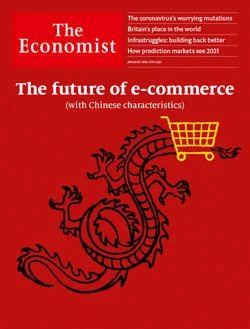
China may rule e-commerce.
I was reading news the other day and was intrigued by a picture posted on Economist.com. It reveals a dragon rearing its head, which is not of the usual kind but a shopping cart.
The article states that “it is in China, not the West, where the future of e-commerce is being staked out.” Certainly, Chinese internet retailers have brought out many innovations in recent years, such as live commerce, where celebrity-driven programs livestream content to sell products.
If Chinese e-commerce operators will have a great impact on both China and the rest of the world, I suppose their domain preference will also influence others in the business world too. So, I decided to dive deeper and found “2020 Hurun Top 10 Ecommerce Enterprises in China” (2020胡润中国10强电商) published by the well-acclaimed Hurun Research Institute.
Then, I used Baidu to find the corporate domains used by them. The result is shown below.
| Rank | Chinese | English | Domain |
|---|---|---|---|
| 1 | 阿里巴巴 | Alibaba | Alibaba.com |
| 2 | 美团 | Meituan | Meituan.com |
| 3 | 京东 | Jing Dong | JD.com |
| 4 | 拼多多 | Pinduoduo | Pinduoduo.com |
| 5 | 滴滴出行 | Didi | DidiGlobal.com |
| 6 | 携程 | Ctrip | Ctrip.com |
| 7 | 唯品会 | Vipshop | VIP.com |
| 8 | 苏宁 | Suning | Suning.com |
| 9 | 车好多 | CARS (Che Hao Duo) | Guazi.com |
| 19 | 每日优鲜 | MissFresh | MissFresh.cn |
So, what is the implication for domain investment? Simply put, .com is the main stage and English-based domains are fine in China. Note that the top 9 firms on the list not only own .com domains but actually use them within China. China is like the USA in that .com domains are widely used within the country, rather than the country code domain.
Also, “short” is good. This is shown in the case of Jing Dong (owns JingDong.com but uses JD.com) and Vipshop (owns Vipshop.com but uses VIP.com). By the same token, we can guess that Pinduoduo may upgrade to the shorter PDD.com (following all, the firm is by now referred to as “PDD” in some news).
Note that most of the listed domains are brand-matching. What does it mean? For example, Jack Ma’s firm is called Alibaba Group Holding, but most people remember it as “Alibaba.” Therefore, its brand is “Alibaba,” and so the brand-matching domain is Alibaba.com but not AlibabaGroup.com or AlibabaGroupHolding.com. Of course, the acronym version is also acceptable.
Didi is the ride-sharing giant that defeated Uber China and purchased it in 2016. Still, its corporate domain is DidiGlobal.com but not the brand-matching Didi.com.
CARS (Che Hao Duo) is using its group domain Guazi.com. I speculate that the used car marketplace operator may, if they can, upgrade to Cars.com (developed, so unlikely), CheHaoDuo.com (apparently undeveloped), or simply CHD.com (not used yet).
MissFresh may want to talk to Canada-based Cook It at ChefCookit.com since the meal kit service provider owns MissFresh.com, which is not used right now.
In short, there are many opportunities to sell domains to corporate China. If you own a domain that lies in the upgrade path of a well-funded Chinese firm, then your domain is very valuable. End user research is key. It has by now helped me discover the great potential of PDD.com, Didi.com, CHD.com, and MissFresh.com.