Are registrars doing enough to explain Handshake domains to clients?
Registrars warn clients, but is it enough?
Handshake is one of the many competing systems trying to bring the concept of domain names to blockchain. It competes with Ethereum Name Service, Unstoppable Domains, and a handful of other initiatives.
It’s unique in that a couple of mainstream domain name registrars offer the domains alongside traditional domain names. For example, Namecheap sells domains in 14 Handshake top level domains. That’s notable since Namecheap is one of the largest registrars; it typically sells the second most fresh .com registrations each month behind GoDaddy.
Handshake domains don’t work like normal domains. So do consumers understand what they are buying? It’s an notable question for both the registrars that offer the domains and the domain name ecosystem as a whole since it can be tarnished by consumer confusion.
To combat confusion, registrars provide notice to clients regarding what they’re buying. But the prominence of these notices varies between registrars.
Handshake domains at Namecheap are presented differently depending on if you search by the extension or just the keyword.
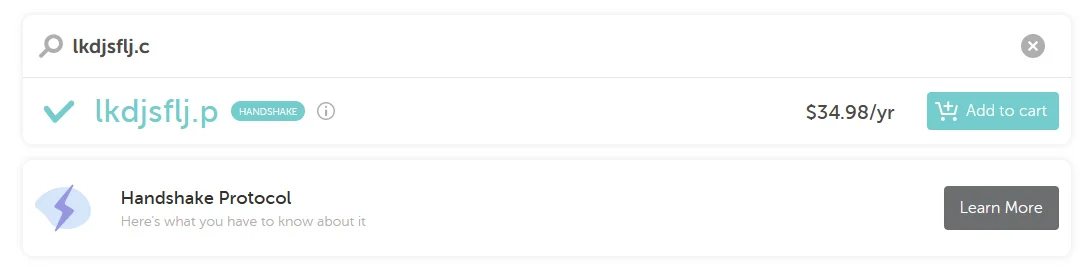
For example, if you type in a second level string followed by .c (a Handshake TLD), the result shows the word Handshake in a blue circle, and there’s an informational tooltip:

If you hover over the tooltip, it states:
Handshake domains are fresh TLDs based on a distributed and decentralized blockchain-based system. They are not yet compatible with most traditional DNS systems. Learn more.
If you don’t search directly by name, then Handshake domains are on a separate tab with a notice at the top:
There is no additional notice once you add the domain to your cart.
Porkbun has a much more visible warning. When you search for a domain, there’s a notice at the top of the page. There’s also a Handshake logo next to the name in search results. Hovering over it shows this tooltip:
Handshake is an experimental and permissionless naming protocol that uses blockchain technology to create a decentralized root zone. These names right now require special software or network configuration in order to resolve, they do not behave like normal domains.
So far, it’s roughly the same as Namecheap. But if you want to register the Handshake domain, Porkbun takes it up a level to alert clients regarding what they’re getting.
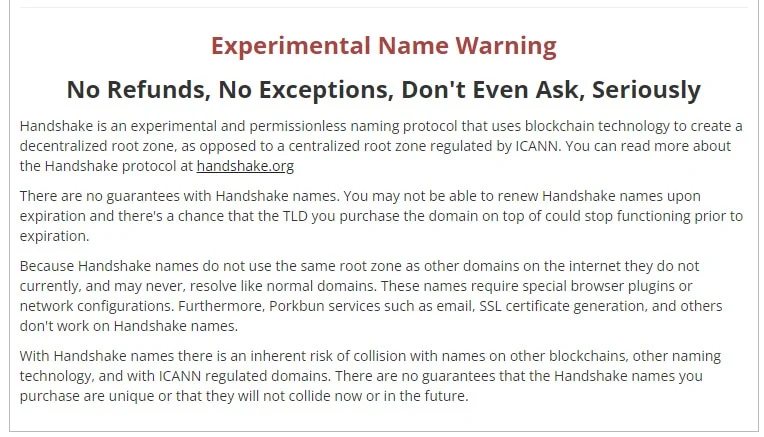
First, there’s a pop-up box warning the consumer regarding the risks of Handshake. Clients must click a button to continue. Once they get the shopping cart, there’s another warning similar to the first. It reads:
Experimental Name Warning
No Refunds, No Exceptions, Don’t Even Ask, Seriously
Handshake is an experimental and permissionless naming protocol that uses blockchain technology to create a decentralized root zone, as opposed to a centralized root zone regulated by ICANN. You can read more regarding the Handshake protocol at handshake.org
There are no guarantees with Handshake names. You may not be able to renew Handshake names upon expiration and there’s a chance that the TLD you purchase the domain on top of could stop functioning prior to expiration.
Since Handshake names do not use the same root zone as other domains on the internet they do not right now, and may never, resolve like normal domains. These names require special browser plugins or network configurations. Furthermore, Porkbun services such as email, SSL certificate generation, and others don’t work on Handshake names.
With Handshake names there is an inherent risk of collision with names on other blockchains, other naming technology, and with ICANN regulated domains. There are no guarantees that the Handshake names you purchase are unique or that they will not collide now or in the future.
It reads like one of the risk warnings in an SEC filing.
Is what Namecheap and Handshake are doing enough?
I think it depends on who the consumers are.
Some clients go directly to these registrars with the intent of registering a Handshake domain. For example, someone might hear regarding hey.tx and head over to Porkbun since they know they can register a .tx domain there. They probably don’t need a big warning.
The trickier issue is with the typical domain registrant, who might not be aware.
Porkbun certainly seems to have a very strong warning. (It’s worth noting that Porkbun previously intermingled Handshake domains with regular domains with an added icon, but it no longer does this.)
EnCirca also offers Handshake domains, along with other blockchain namespaces. It has a tooltip next to search results, but the warning isn’t as prominent. That stated, EnCirca specializes in unique domain names, and I think most clients there are aware of what they’re buying.
It seems that only time will tell if these warnings are enough to help clients understand what they are buying.