
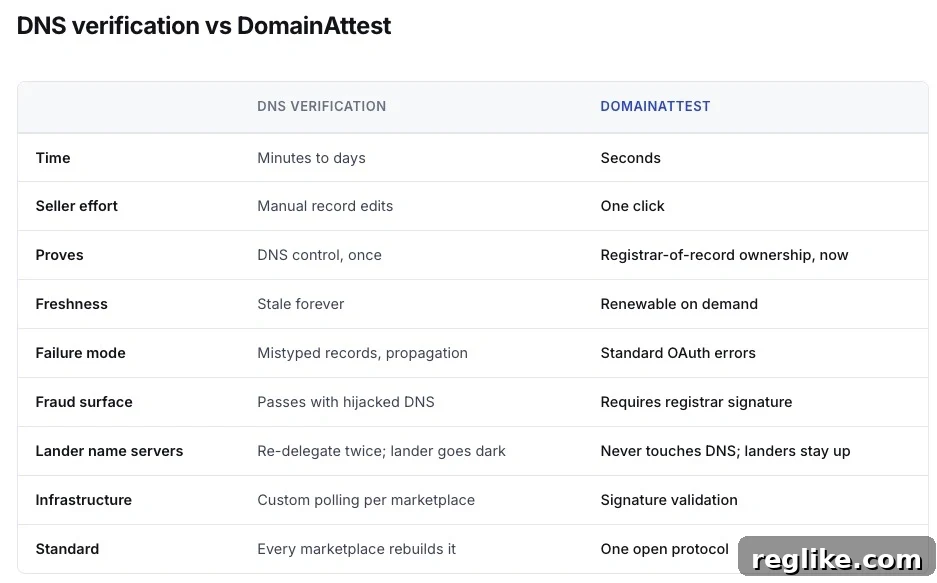
DomainAttest makes it easier for marketplaces and domain sellers to verify ownership.
Atom, a domain name marketplace, announced a new open protocol today designed to simplify how marketplaces and domain sellers verify ownership of domain names. The initiative, called DomainAttest, enables sellers to confirm control of a domain by signing in to their registrar account, rather than relying on DNS modifications.
Traditionally, domain ownership verification requires a seller to add a verification nameserver or insert a TXT record in DNS. Those methods work, but they have practical drawbacks that make listing and maintaining domain inventory cumbersome. For many sellers, editing DNS records or changing nameservers is inconvenient or technically difficult, and for domains already pointed to a marketplace’s nameservers those options may be unavailable.
DomainAttest replaces the need to create DNS records for verification with a simple, registrar-based login. Instead of adding a TXT record or temporarily switching nameservers, the seller authenticates with the registrar and issues an attestation for the domain. This flow is designed to be quicker and less error-prone for sellers, reducing friction when listing domains for sale.
There are several clear advantages to a registrar-login approach. First, it removes the barrier caused by domains that are already delegated to marketplace nameservers. Sellers who have their domains pointed at a marketplace can find it impossible to add a TXT record or may have to take down listings to make DNS changes. DomainAttest avoids that by working directly with the registrar account.
Second, the protocol aims to make multi-listing easier. DNS-based verification is awkward when sellers want to list the same domain across multiple marketplaces, because coordinating DNS changes across different services can be complex. By authenticating at the registrar level, a seller can more easily replicate verification across platforms without repeated DNS work.
DomainAttest’s initial release focuses on simplicity and broad adoption rather than on offering every advanced capability. The first version provides a point-in-time attestation: a seller logs in to the registrar and verifies a single domain. This produces a timestamped assertion that the seller controls the domain at that moment. Because the process is lightweight, marketplaces could require periodic re-attestation to keep their inventory current, and atomic rechecks would be straightforward to implement.
At launch, DomainAttest handles one domain per registrar attestation. That means sellers will authenticate once per registrar account for each domain they want to verify. The team acknowledges that batch verification and multi-domain attestations are desirable features, and work on batch processing is already planned. When batch capabilities are implemented, verifying dozens or hundreds of domains at once will be faster for large portfolios.
Compared with more sophisticated, real-time transfer and distribution systems, DomainAttest is not positioned as a total replacement. Syndicated networks that support immediate delisting when a domain moves or unlocks offer near real-time inventory control that DomainAttest’s initial iteration does not replicate. Those systems can react instantly to changes during transfer processes, while DomainAttest’s attestations represent validated ownership at a specific point in time.
Despite that limitation, DomainAttest addresses a significant practical problem: a great deal of marketplace inventory becomes stale or difficult to verify. Some marketplaces and distribution networks have robust, automatic controls, but many listings remain outside such systems and are not routinely checked. By lowering the effort required to verify ownership, DomainAttest could reduce stale listings and improve overall inventory accuracy across marketplaces.
The protocol also aims to increase transparency and trust between sellers and marketplaces. When marketplaces can more easily confirm that a listed domain is controlled by the seller, buyers and brokers benefit from reduced fraud risk and clearer provenance. Market participants will be watching to see whether the industry adopts the protocol and how registrars respond to supporting this method of attestation.
In short, DomainAttest offers a practical, registrar-driven approach to ownership verification that removes many of the pain points associated with DNS-based methods. It is a pragmatic first step toward making verification faster and more scalable, with planned improvements such as batch verification on the roadmap. The extent to which marketplaces and registrars embrace DomainAttest will determine its impact, but the protocol addresses a clear need for a simpler, seller-friendly verification workflow.