
The Power of Local: Unveiling Linguistic Diversity on Country Code Domain Names
In an increasingly interconnected digital world, the question of language on the internet is more pertinent than ever. While English often dominates online spaces, a groundbreaking new report sheds light on a vibrant trend: the widespread adoption of local languages within country code top-level domains (ccTLDs). This pivotal study quantifies the significant use of national languages on domain names specific to territories around the globe, painting a clearer picture of linguistic diversity online.
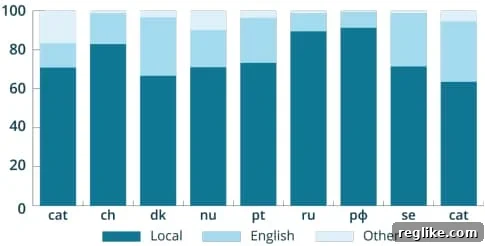
For years, statistics have suggested that over half of all websites primarily use English. However, this broad generalization often overlooks critical nuances in how languages are utilized across different top-level domains. The recent analysis by CENTR, an esteemed organization representing European ccTLD operators, in collaboration with Oxford Information Labs, delves deep into this subject, providing compelling evidence of a strong preference for indigenous languages in their respective digital territories.
Understanding the Scope: A Comprehensive Analysis of ccTLDs
The study undertaken by CENTR and Oxford Information Labs was ambitious in its scope, aiming to provide a robust, data-driven perspective on language use. They meticulously analyzed data from ten diverse ccTLDs, encompassing a staggering 16.4 million domains. Crucially, all territories chosen for this study are those where English is not the primary language, ensuring the findings accurately reflect local linguistic trends without the skew of English-speaking nations. The selected ccTLDs—including .cat (Catalonia), .ch (Switzerland), .dk (Denmark), .nl (Netherlands), .nu (Niue), .pt (Portugal), .ru/.рф (Russia), .se (Sweden), and .sk (Slovakia)—represent a rich tapestry of European and international linguistic environments, from Romance and Germanic to Slavic and unique regional languages.
This wide selection allowed researchers to observe common patterns and specific variations, offering invaluable insights into how linguistic preferences manifest at the domain level. The methodology focused on identifying the principal languages spoken within each country or territory and then quantifying their presence within the respective domain zones. The goal was not merely to count the number of websites in a given language but to understand the extent to which the native tongue of a region is embraced in its digital identifiers and content.
Key Findings: Local Languages Reign Supreme
The report’s findings are a powerful testament to the vitality of local languages online. The analysis revealed that the principal languages spoken in the country or territory of each ccTLD comprised at least 64% of the content within its zone. This figure alone is significant, indicating a strong foundation of local language presence. However, the average rate across all analyzed ccTLDs was even higher, reaching an impressive 76%. This average highlights a robust and consistent trend: when given the option, domain registrants and website creators overwhelmingly opt for their native tongue.
This pronounced preference for local languages on ccTLDs signifies several important aspects of the internet’s evolution. Firstly, it underscores the importance of local relevance for users. People naturally gravitate towards content and services presented in their mother tongue, fostering a greater sense of trust, accessibility, and cultural connection. Secondly, it reflects the deliberate efforts of ccTLD operators and local communities to promote and preserve their linguistic heritage in the digital realm. The chart above vividly illustrates this trend, showing a clear dominance of local languages compared to English across the surveyed ccTLDs.
The Impact of Internationalized Domain Names (IDNs)
Adding another layer of linguistic richness to the internet are Internationalized Domain Names (IDNs). IDNs are domain names that include characters from non-Latin scripts or special characters and diacritics found in Latin-based languages (e.g., accented letters, Cyrillic, Arabic, or Chinese characters). The CENTR report specifically highlights that the numbers for local language use are even higher for domains that permit and utilize IDNs. This finding is profoundly significant.
IDNs are crucial for achieving true digital inclusion and linguistic diversity. For languages like Russian (which uses Cyrillic script, as seen in the .рф ccTLD) or those with numerous diacritical marks, IDNs allow for domain names that are truly native, readable, and memorable for local populations. They remove the barrier of transliteration or approximation, enabling users to type and recognize domain names in their own script. The higher adoption rate of local languages on IDN-enabled domains confirms that when the technical infrastructure supports full linguistic expression, communities readily embrace it, further enriching the multilingual fabric of the internet.
Why Localization Matters: Benefits for Users, Businesses, and Culture
The trends identified by the CENTR report have far-reaching implications, extending beyond mere statistics to touch upon user experience, economic opportunity, and cultural preservation. For internet users, content in their native language means enhanced accessibility and a more intuitive, user-friendly experience. It fosters a stronger connection to online resources, making the internet feel less foreign and more directly relevant to their daily lives and cultural context.
For businesses, embracing local languages on ccTLDs offers a competitive edge. It allows companies to connect with their target audience on a deeper, more personal level, building trust and credibility. A website registered under a national ccTLD (e.g., .de for Germany) and presented in the local language often signals authenticity and a commitment to the local market. This strategy can significantly improve local search engine optimization (SEO), increase conversion rates, and strengthen brand loyalty. Companies that understand and cater to the linguistic preferences of their customers are better positioned to succeed in diverse global markets.
Furthermore, the prevalence of local languages online is vital for cultural preservation and promotion. In an increasingly globalized world, the digital space offers a powerful platform for minority languages and cultural narratives to thrive. By supporting local language content and IDNs, ccTLDs play a critical role in ensuring that the internet remains a mirror of the world’s rich linguistic and cultural diversity, rather than becoming a homogenous linguistic landscape.
The Future of a Multilingual Internet
The insights from the CENTR report, a collaboration between CENTR and Oxford Information Labs, underscore a pivotal shift: the internet is evolving into a truly global and localized space. While English will undoubtedly maintain a significant presence, the report clearly demonstrates a powerful and growing demand for digital content and identity in indigenous languages, especially within the specific, nationally-focused domains. This trend is not just about translation; it’s about deep localization, respecting cultural nuances, and empowering communities to engage with the internet on their own terms.
The continued growth of ccTLDs and the increasing adoption of IDNs are critical enablers of this multilingual future. They provide the necessary infrastructure for diverse linguistic communities to establish their digital footprint authentically. As technology advances and global digital inclusion efforts continue, we can expect this trend to intensify, fostering an even more linguistically rich and culturally diverse internet.
To delve deeper into these fascinating findings and understand the methodology behind this extensive research, the full report, which meticulously analyzes .cat, .ch, .dk, .nl, .nu, .pt, .ru/.рф, .se, and .sk, is available for download directly from CENTR’s website. It offers invaluable insights for anyone interested in internet governance, digital linguistics, or the future of online communication.