
The Real Story Behind New Top-Level Domains: Why China Isn’t Always the Golden Ticket
During a compelling keynote address at NamesCon, Radix founder Bhavin Turakhia shed light on the key performance indicators (KPIs) that Radix carefully considers when strategizing the marketing of its top-level domain names (TLDs). His presentation offered valuable insights into the global domain market, particularly regarding the influence and impact of the Chinese market on the success of new TLDs.
One of the most significant takeaways from Turakhia’s presentation was a nuanced perspective on the Chinese market’s role in the new TLD landscape. While China often appears to be a major driving force behind initial domain registration numbers, Turakhia’s data suggests that its long-term contribution to revenue and sustained growth may be more limited than initially perceived. This challenges the conventional wisdom that simply targeting China is a guaranteed path to success for new TLDs.
Radix’s analysis of domain registrations in 2017 revealed a striking disparity between initial registration volume and subsequent renewal rates in China. According to their data, China accounted for a substantial 44% of all new domain registrations. However, this impressive initial figure was not reflected in the renewal rates, with China contributing only 27% of total renewals and a mere 9% of renewal revenue. This significant drop-off highlights a critical issue: while China may be excellent for boosting initial numbers, it doesn’t necessarily translate into long-term, sustainable revenue for new TLDs.
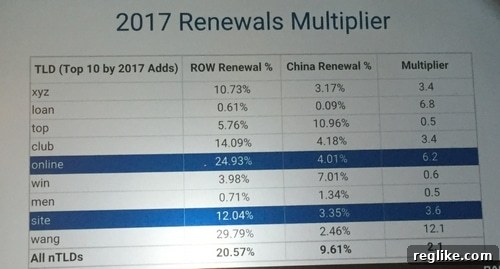
The graphic presented by Turakhia clearly illustrates the difference in renewal rates, with Radix’s domains showing significantly higher renewal rates outside of China. Several factors likely contribute to this disparity. One primary driver is the difference in domain pricing strategies employed in China compared to other regions. Domains in China are often offered at heavily discounted rates or as part of promotional bundles, which can attract a large initial influx of registrations. However, these price-sensitive customers may be less likely to renew their domains at the standard price after the initial promotional period expires.
Another factor that could be affecting these renewal rates is the purpose for which domains are registered. It’s possible that domains registered in China are more frequently used for short-term projects or temporary campaigns, leading to lower renewal rates compared to domains registered for long-term business or personal use.
Furthermore, differences in cultural attitudes towards domain ownership and online presence may also play a role. In some regions, a domain name is seen as a valuable and essential asset for establishing an online identity, while in others, it may be viewed as a more transient or disposable resource.
To further illustrate the complexities of the global domain market, Turakhia presented another insightful comparison:
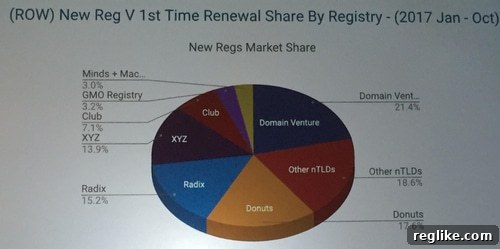
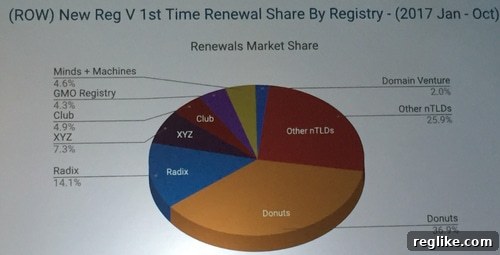
The comparison of renewal share versus initial registrations highlights the importance of focusing on long-term value rather than simply chasing high registration numbers. Turakhia suggested that the discrepancy between initial registrations and renewal rates is closely tied to the sourcing and pricing strategies employed by different companies. Those who prioritize heavily discounted initial registrations may see a surge in sign-ups, but they are less likely to retain those customers in the long run.
Turakhia emphasized that Radix prioritizes first-year renewal rates as a critical performance indicator, rather than solely focusing on initial registrations. This approach reflects a commitment to sustainable growth and long-term profitability. Before launching any marketing campaign, Radix conducts a thorough analysis to determine its potential for generating profitable renewals. While a campaign may not be immediately profitable in the first year, the company seeks to identify a clear pathway to profitability over time. This data-driven approach allows Radix to make informed decisions about resource allocation and marketing strategies, ensuring that its efforts are aligned with its long-term business goals.
This emphasis on first-year renewals underscores the importance of attracting high-quality customers who are genuinely invested in their domain names and more likely to renew their registrations. It also suggests that domain providers should focus on providing value-added services and support to encourage customer loyalty and retention. By fostering strong relationships with their customers and providing them with the tools and resources they need to succeed online, domain providers can significantly improve their renewal rates and build a more sustainable business model.
In conclusion, Bhavin Turakhia’s presentation at NamesCon offered a valuable and insightful perspective on the dynamics of the new TLD market. His data-driven analysis challenged conventional wisdom and highlighted the importance of focusing on long-term value and sustainable growth. While China may be a significant source of initial domain registrations, its long-term contribution to revenue and renewal rates may be more limited than initially perceived. By prioritizing first-year renewals and conducting thorough profitability analyses, domain providers can make more informed decisions about their marketing strategies and build more sustainable businesses. This ultimately leads to a more robust and healthy domain ecosystem for everyone involved.
The key takeaway is that chasing raw registration numbers, particularly in markets driven by deep discounts, is not a reliable strategy for long-term success. Instead, a focus on attracting and retaining high-quality customers, providing value-added services, and carefully analyzing renewal rates is essential for navigating the complexities of the new TLD landscape and achieving sustainable growth.
This approach requires a shift in mindset, from a focus on quantity to a focus on quality. Domain providers need to think beyond the initial registration and consider the entire customer lifecycle. By understanding the needs and motivations of their customers, they can tailor their offerings and services to better meet those needs and foster long-term loyalty.
Furthermore, the data presented by Turakhia highlights the importance of market diversification. Relying too heavily on any single market, even one as large as China, can create vulnerabilities and limit growth potential. By expanding into new markets and targeting different customer segments, domain providers can mitigate risk and create a more resilient business model.
Ultimately, the success of new TLDs depends on a combination of factors, including effective marketing strategies, competitive pricing, valuable services, and a deep understanding of the global domain market. By embracing a data-driven approach and focusing on long-term value, domain providers can navigate the complexities of this dynamic landscape and achieve sustainable growth and profitability.