A different strategy in a world of many TLDs — BrandShield takes
How ought to brands manage infringement in a world of many top level domain names? Brandshield suggests taking a common sense approach.
Brands face fresh challenges in a world of many fresh top level domain name options. Brand protection firm BrandShield, spun-off from a registrar in 2013, recommends that firms focus on infringement that really matters.
In 2000, Yoav Keren and two colleagues launched a registrar reseller based in Israel called Domain The Net. Keren was a senior advisor in the Israeli government at the time, and their research revealed untapped marketplace opportunity.
The partners became an ICANN-accredited registrar the following year, and began building their domain management department. Keren states he realized as early as 2001 that there was a market for smart brand monitoring and analysis services and, in 2003, domain management became a separate, dedicated department at Domain The Net.
“The need for online brand protection solutions has evolved during the years,” stated Keren. “We noticed the first problems back in 2001 when we started. But things became more and more complicated.”
Following a decade of ongoing, gradual evolution, ICANN’s fresh gTLD program was started, signaling to Keren and his partners that “the old fashioned way of treating the problem will not work.” So a period of rapid development ensued, resulting in the debut and spinoff of BrandShield in 2013.
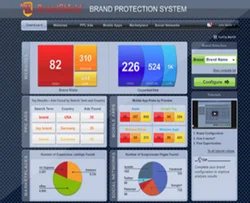
BrandShield offers an application which crawls the deep web–behind paywalls, within websites–and uses natural language processing to examine, assess, and note threats.
“Google’s searches cover just four percent of the web,” Keren stated, explaining that BrandShield’s searches cover many times that, in English, and in some Asian scripts as well.
Understanding that a brand’s identity and intellectual property are of great value to even modest brands, BrandShield works with its clients to create automated, customized alert levels.
Keren states that its services can be tuned to provide value to even the smallest of firms.
“Sometimes the modest firms are the ones receiving the most abuse,” he stated, adding that smaller firms can be the ones with the most to gain, and gave an example of a client–a modest firm owning and selling its patented product on Amazon for less than a year and, using BrandShield, discovering counterfeits being sold all over the world.
The BrandShield engine is able to perform analysis on a threat in addition to discovering it–whether it is a high-ranking or low-ranking threat, among other data points. And it ranks threats as stated by a pre-set prioritization algorithm based on the preferences of the brand manager. Defining threats as stated by priority means that low-harm infringements will be given a low priority, for example.
“When there are ten-thousand occurrences of infringement, you have to focus on the most damaging ones,” stated Keren.
Keren states clients appreciate the learning capability of the machine–it tunes itself to the brand’s preferences and makes recommendations using the brand manager’s prior actions as inputs.
“They also like having visibility that they never had ahead of, and seeing the patterns and the networks of the abuse, and having the ability to prioritize,” Keren stated.
BrandShield’s approach is married to its philosophy, which is that, respective to the client firm’s size and budget, the imperative ought to be to manage a reasonable portfolio, and then monitor the rest. This goes for trademarks, copyrights, use of brand collateral, counterfeiting, and other forms of brand abuse.
“And when something really bad happens on the rest, take action,” he stated. “That is the strategy we promote. It’s very different than others in this market.”
Over the years, some brands have equated protection with actions against domain registrants registering similar or exact matches to their trademarks, spending much time and energy and effort to force a registrant to release a name. Keren calls this nonsense.
“Search the web for your domain name, or your registered trademark–you might find a parked page or PPC advertising there. Does that really matter? It has no traffic, so ought to you care regarding it? Why would you spend money and time on taking that down? Why go to the trouble of filing a UDRP or URS? Since there might be a thousand other websites that have no relevant domain name, but that have a great deal of traffic, and they are trading on your brand’s name. These are the ones that you ought to go following.”
BrandShield still works with firms that don’t agree with Keren’s philosophy for brand protection, although Keren states he tries to get clients to “focus on the ones that could potentially cause the most damage,” as a better way to prioritize protection efforts.
“I know it’s a different strategy,” he states. “I think this is the way—if you want to fight a 21st-century war, you need 21st century tools.”