
China’s unprecedented demand for domain names has undeniably reshaped the global digital landscape. But as this powerful tide begins to ebb, what does the future hold for an industry that has grown accustomed to its strength?
Over the past 6 to 12 months, the influence of Chinese buyers on the domain name industry has been nothing short of transformative. This surge of interest, driven by a unique blend of cultural preferences, investment trends, and a rapidly expanding digital economy, has created a boom benefiting a wide array of stakeholders. Holders of short, desirable domain names have seen their digital assets skyrocket in value, while domain name marketplaces and registries have experienced unprecedented boosts in revenue and transaction volumes.
The scale of this impact is best illustrated by concrete data, offering a clear picture of how deeply intertwined the Chinese market has become with global domain sales. Consider the following insights:
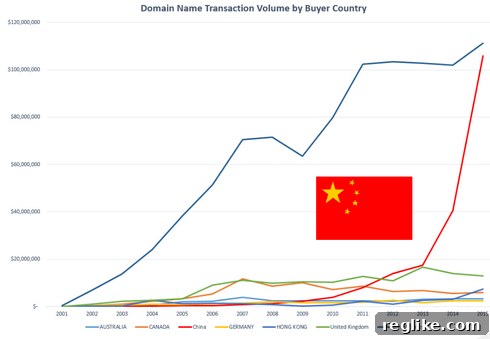
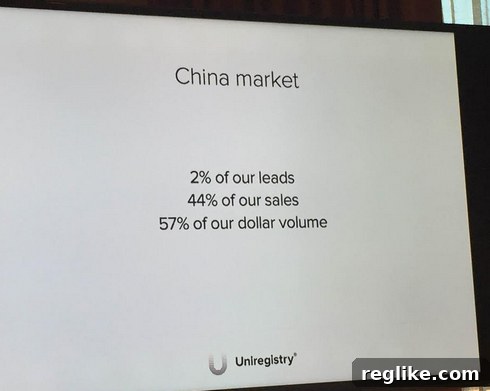
The first image above vividly demonstrates the significant portion of business Escrow.com, a leading online escrow service critical for secure international transactions, receives directly from China. This highlights not just the volume of sales but also the necessity of trusted intermediaries in facilitating cross-border domain transfers. The second image further underscores this trend, revealing that over half of Domain Name Sales’ total sales revenue last year originated from Chinese buyers. These figures are not isolated anomalies; similar trends have propelled the fortunes of other major domain marketplaces, including NameJet, SnapNames, and Sedo, all of whom have reported substantial growth attributable to this dynamic market segment.
This period has been widely regarded as a golden era for the domain industry, fostering an atmosphere of excitement and optimism, perhaps best encapsulated by the celebratory mood at industry conferences like NamesCon. Sellers reaped substantial profits, often turning dormant digital assets into significant financial gains. Marketplaces thrived on increased commissions and a bustling transactional environment. Registries observed an uptick in new registrations and renewals, driven by speculative interest and an expanding user base. For many, the question was not if this boom would continue, but how high it could truly go.
The Golden Era: A Closer Look at China’s Domain Investment Boom
The allure of domain names for Chinese investors stems from several unique factors. Culturally, short numeric and alphanumeric combinations hold significant value, often associated with luck, prosperity, or specific meanings. The number ‘8’, for example, is highly auspicious, making domains like 888.com or variations highly coveted. Beyond cultural significance, the booming Chinese digital economy, coupled with a lack of traditional alternative investment vehicles offering comparable returns, pushed many towards the domain market. This created a fertile ground for speculative buying, particularly for legacy TLDs like .com, .net, and .org, which are universally recognized and carry inherent trustworthiness.
The “lifted all boats” analogy perfectly captures the widespread positive externalities. Domain owners who had held onto short, memorable, or numerically rich domains for years suddenly found themselves sitting on digital goldmines. This created a vibrant secondary market, where previously undervalued assets were exchanged for record-breaking sums. The ripple effect was substantial: increased liquidity, higher average sales prices, and a renewed interest in domain investing from around the world, all fueled by the seemingly insatiable appetite from China.
When the Tide Recedes: Examining the Inevitable Shift
However, the central question that now looms over the industry is a pragmatic one: what happens if, or more accurately, when this fervent demand begins to subside? History teaches us that no boom lasts forever, and markets are cyclical. There are growing indicators that the peak might be behind us, or at least that a significant shift is underway. The early signs are subtle but noteworthy, suggesting a transition from a speculative frenzy to a more mature, and potentially more tempered, market landscape.
One such indicator, highlighted by industry experts like Joseph Peterson, is the decreasing frequency with which domain names popular among Chinese buyers are dropping. This phenomenon implies that the inventory of prime, highly desirable domains that meet specific Chinese buying criteria (e.g., short, numeric, LLL.com, NNNN.com) is becoming increasingly scarce. As these coveted domains are scooped up and held by investors or end-users, fewer enter the public domain or auction circuit. This scarcity naturally leads to higher prices, which, in turn, can dampen speculative enthusiasm and reduce the potential for quick, significant returns, making the market less attractive to pure investors.
Furthermore, Peterson’s observations suggest a shift in purchasing patterns. Buyers are increasingly seeking out domains directly from their current owners rather than relying on auction platforms or marketplaces for new drops. This pivot indicates a more strategic, targeted acquisition approach, likely driven by specific end-user needs or long-term investment strategies, rather than the broad-based speculative buying that characterized the boom. This shift means less open competition, potentially lower commissions for platforms, and a more fragmented, less transparent market for sales.
Potential Causes and Consequences of a Market Slowdown
Several factors could contribute to the eventual slowing of Chinese demand. On the supply side, as mentioned, the finite nature of premium domains means that the market will eventually become saturated. On the demand side, economic shifts within China, including potential government capital controls or a broader economic slowdown, could impact the disposable income available for speculative investments. Additionally, as the market matures and prices reach stratospheric levels, the risk-reward profile for new investors shifts, making alternative investment options more appealing.
The consequences of a significant slowdown could be far-reaching. For domain investors, it might mean longer holding periods, reduced profitability on sales, and a necessity to adjust valuation expectations. Marketplaces could see a decline in transaction volumes and average sales prices, putting pressure on their revenue models. Registries might experience a dip in new registrations, particularly for domains previously popular with speculative buyers who might let them expire if their value diminishes. The overall market sentiment could shift from exuberance to caution, fostering a buyer’s market where deals are harder to come by for sellers.
Adapting to the New Reality: Strategies for a Sustainable Future
While the prospect of a receding tide might seem daunting, it also presents an opportunity for the domain industry to mature and adapt. This new phase will likely emphasize strategies focused on long-term value and end-user acquisition. Diversification beyond a single dominant buying demographic will be crucial for marketplaces and investors alike. Focusing on brandable domains, niche markets, and high-quality assets that serve actual business needs rather than pure speculation will become paramount.
Innovation in services, improved analytics, and a greater emphasis on providing value to businesses seeking an online presence will be key. The industry will need to pivot from chasing the next speculative bubble to building sustainable growth driven by real-world utility. Ultimately, while the initial surge of Chinese demand has been an extraordinary catalyst, the domain name industry’s enduring strength will lie in its ability to adapt, innovate, and continue providing essential infrastructure for the global digital economy, regardless of where the next wave of investment originates.
The domain name market, like any other, is subject to cycles. Understanding the profound impact of the Chinese market, acknowledging its potential for moderation, and preparing for a more balanced future will be critical for all participants in this dynamic industry. The “mood-booster” may evolve, but the fundamental value of a strong digital identity will always remain.