
The Cybersquatting Giants: When Big Companies Profit From Your Typos
Have you ever mistyped a website address and been redirected to a page full of advertisements? You’re not alone. What might surprise you is that some of the biggest names in technology and internet services are behind these redirect pages, profiting from your typos. This article delves into the controversial practice of cybersquatting by major corporations, examining their justifications and the ethical implications of their actions.
The Rise of Corporate Cybersquatting
Back in May 2007, while using a new Gateway desktop computer, I encountered a peculiar situation. Mistyping a web address led me not to an error page, but to a page brimming with advertisements. This wasn’t the work of a typical small-time cybersquatter; it was Gateway themselves who were benefiting from the misspelling.
It wasn’t long before I discovered that Dell was engaging in the same practice. Both computer manufacturers had partnered with search companies to display a page of sponsored links whenever a user entered a non-existent domain name. This marked the beginning of a trend that would soon spread throughout the internet service provider (ISP) industry.
Following in the footsteps of Gateway and Dell, major ISPs like Verizon, Time Warner, and Comcast joined the fray, implementing similar schemes. The motive behind these actions was clear: financial gain. These companies generate revenue each time a user clicks on a paid link displayed on these error pages.
However, they often attempt to legitimize their actions by portraying these error redirect pages as a “service” designed to assist their customers. This justification rings hollow when considering the true purpose of these pages: to generate revenue through advertising.
The Hypocrisy of Anti-Cybersquatting Organizations
The perplexing aspect of this corporate cybersquatting is that many of the companies involved, including Verizon and Dell, are members of the Coalition Against Domain Name Abuse (CADNA). CADNA is an organization dedicated to combating cybersquatting and protecting trademark rights. Yet, Verizon and Dell are essentially engaging in typosquatting on the very trademarks that CADNA seeks to protect.
To fully grasp the extent of this hypocrisy, consider that the majority of typos targeted by these companies involve existing websites, which are often protected by trademarks. These aren’t generic domain names, which are commonly associated with traditional domain parking. The fact that nearly all generic web addresses are already registered indicates that the typos being targeted are primarily trademarks.
Verizon’s Defense of Error Pages
Earlier in the year, I had the opportunity to interview Sarah Deutsch, Vice President and Associate General Counsel at Verizon, regarding new top-level domain names. During our conversation, I also inquired about Verizon’s use of error pages. Deutsch argued that these pages differed significantly from domain parking, citing several reasons:
- The first element displayed on the page is a suggestion like, “Did you mean to go to realdomain.com?”
- Users have the option to opt-out of the service, unlike with domain parking.
- The pages feature organic search listings in addition to advertisements.
While I remained unconvinced by her arguments, I initially let the matter rest. However, I recently obtained screenshots of Verizon’s error pages, revealing a different picture. Here’s an example of an error page for “DomainNameWir.com” (with a missing “e”):
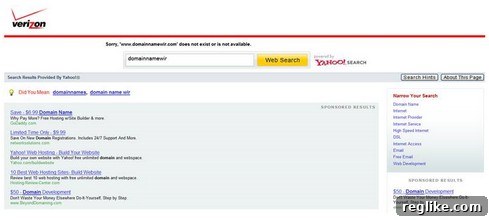
As you can see, the page is dominated by advertisements. The organic listings are relegated to the bottom of the page, below the fold. This placement makes it clear that the primary objective is to drive clicks on ads, not to assist users in finding the website they intended to visit. If the intention was genuinely to help users, the organic listings would be prominently displayed at the top of the page.
Furthermore, the suggestion of the correct website appears to be reserved for only the most popular websites. Apparently, a website needs to be significantly more popular than the 29,989th most trafficked site on the web to qualify for this suggestion.
The Internal Dynamics of Corporate Cybersquatting
To be fair, it’s plausible that Deutsch would prefer that Verizon didn’t offer this service. The implementation of these error pages likely originates from someone within the company identifying a revenue-generating opportunity, negotiating terms, and then tasking the IT department with implementation, often leading to customer complaints. It’s doubtful that intellectual property attorneys are consulted during this process; they are simply left to defend the company’s actions when the inherent hypocrisy is exposed.
The Revenue Generated From Error Redirects
Determining the exact revenue generated by companies through error redirects is challenging. Google advertisers receive a breakdown of traffic originating from error pages, but in my experience, it pales in comparison to the traffic generated by parked domains. While Google provides data on specific parked pages serving ads, it doesn’t offer similar data for error pages.
However, the revenue generated must be significant enough to justify the continued use of these practices. Otherwise, Google, Yahoo, and the ISPs involved wouldn’t endure the complaints and negative feedback from their customers.
The Ethical Implications
The practice of corporate cybersquatting raises serious ethical questions. While companies may argue that they are providing a service to their customers, the reality is that these error pages are primarily designed to generate revenue through advertising. By profiting from users’ typos, these companies are exploiting their mistakes for financial gain.
Furthermore, the fact that many of these companies are members of anti-cybersquatting organizations like CADNA adds another layer of hypocrisy to the situation. These companies are simultaneously fighting against cybersquatting while engaging in similar practices themselves.
Conclusion: A Call for Transparency and Accountability
The practice of corporate cybersquatting is a concerning trend that raises questions about the ethical responsibilities of large corporations. While these companies have the resources and influence to generate revenue through various means, profiting from users’ typos is a questionable tactic.
A greater level of transparency is needed regarding the revenue generated from these error redirects. Furthermore, companies engaging in this practice should be held accountable for their actions and should reconsider the ethical implications of profiting from users’ mistakes.
Ultimately, the internet should be a space where users can easily find the information they are looking for, not a landscape littered with traps designed to generate revenue for large corporations. By demanding transparency and accountability, we can work towards a more ethical and user-friendly online experience.