
.CN Domain Extension: A Comprehensive Guide to China’s Domain Market
Understanding the intricacies of the Chinese domain market is crucial for anyone looking to establish a strong online presence in China. Among the various domain extensions available, the .CN domain stands out as the most prominent and widely used within the country. This article delves into the history, growth, current status, and future potential of the .CN domain extension, providing valuable insights for businesses, investors, and anyone interested in navigating the Chinese digital landscape.
This analysis builds upon previous observations about the Chinese domain market, highlighting the overall demand and supply dynamics. The Chinese market holds substantial potential, and examining key domain extensions like .CN is essential to understanding its unique characteristics. The information presented here is based on data collected from reports published by the China Internet Network Information Center (CNNIC) since 1997.
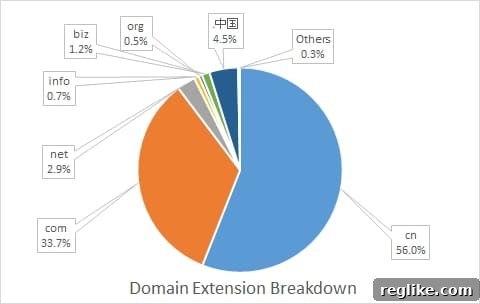
Domain Extension Breakdown in China (as of December 2018)
As of December 2018, the .CN domain extension held the largest market share in China, accounting for 56.0% or approximately 21 million registered domains. This dominant position has been consistent since 2007, indicating that .CN is likely to remain the leading domain extension in China for the foreseeable future. However, it’s important to note that quantity doesn’t always equate to value. While .CN has the largest number of registrations, many corporations in China still prefer .COM domains and are willing to invest significant sums to acquire them. This preference stems from the global recognition and established reputation of .COM, which can enhance brand credibility and international reach. This aspect will be explored in greater detail in subsequent discussions.
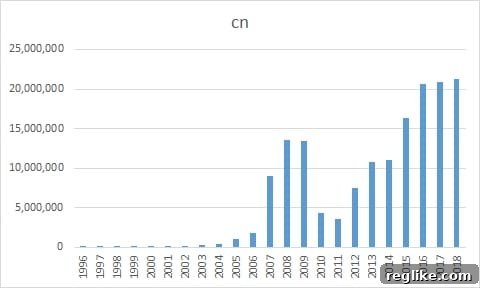
Growth of .CN Domain Registrations Over Time
The growth trajectory of .CN domain registrations reveals an interesting history. In the early years, growth was relatively slow due to several factors. These included a delayed awareness of the internet in China, initial restrictions on registration that limited it to corporations only, complex registration procedures, and bureaucratic hurdles. It’s worth noting that .CN was launched in 1990, which was later compared to other major country code top-level domains (ccTLDs) such as .UK, .DE, and .JP, which were introduced in 1985/86. The initial restrictions and complexities surrounding .CN registration likely contributed to its slower adoption rate compared to these other ccTLDs.
Initially, only subdomains of specific types, such as COM.CN, NET.CN, ORG.CN, GOV.CN, and EDU.CN, were available for registration. Among these, COM.CN subdomains became the most prevalent. However, in 2003, significant changes were implemented. The rules were revised to allow the registration of second-level domains (e.g., Baidu.cn) in addition to the existing subdomains (e.g., Baidu.com.cn). Furthermore, registration was opened to individuals, and investors from outside China were also permitted to participate. These changes significantly broadened access to .CN domains and paved the way for future growth.
These changes culminated in a substantial boom in 2007, attracting a large influx of investors driven by aggressive pricing strategies, with registration fees as low as $1 or even less. However, this boom was short-lived due to subsequent regulatory changes. In 2010, the Chinese government introduced a new requirement mandating that owners of .CN domains submit their identification information, including photos and ID. This requirement caused significant disruption, particularly among investors outside China, leading many to abandon their .CN domains upon expiration. The need to provide personal identification added a layer of complexity and potential privacy concerns, deterring some investors from maintaining their registrations.
The .CN market experienced a recovery approximately two years later as domain owners gradually adapted to the new regulations. This recovery was further bolstered by China’s robust economic growth and the proliferation of startups. In 2013, .CN registrations doubled, demonstrating a resurgence of confidence in the domain extension. Since then, the growth trend has remained positive, reflecting the continued importance of .CN in the Chinese digital landscape. The increasing familiarity with the identification requirements and the overall economic growth contributed to the renewed interest in .CN domains.
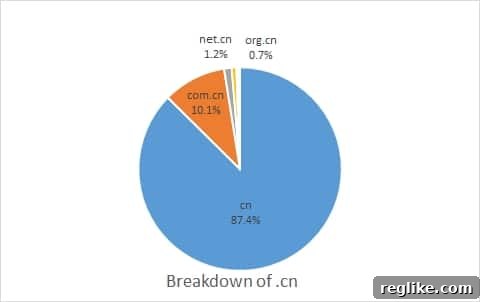
Breakdown of .CN Domain Registrations by Type
China’s domain naming conventions differ significantly from those of many other countries, such as the United Kingdom and Japan, where subdomains like CO.UK and CO.JP are commonly used. In China, subdomains account for a relatively small proportion of total domain registrations. For instance, data from 2018 shows that .CN domains accounted for 87.4% of registrations, while COM.CN accounted for only 10.1%, NET.CN for 1.2%, and ORG.CN for 0.7%. The remaining categories, including ADM.CN, GOV.CN, AC.CN, and EDU.CN, collectively comprised less than 1%. This indicates a strong preference among Chinese users for single-dot domains (e.g., Baidu.cn) over multi-level subdomains. This preference aligns with the global trend towards simpler domain naming structures, making it easier for consumers to remember and access websites.
The preference for one-dot domains simplifies the user experience and aligns with global trends in domain naming conventions. Shorter, more memorable domain names can enhance brand recognition and improve website accessibility. As the internet continues to evolve, this preference for simplicity is likely to become even more pronounced.
In summary, .CN is the leading domain extension in China in terms of volume. For those considering investing in .CN domains, there are three key considerations:
- Be aware of the identification requirements imposed by the Chinese government.
- Stay informed about any rule changes implemented by the Chinese government that may affect domain registration and ownership.
- Remember the preference for one-dot domains among Chinese internet users.
By understanding these factors, investors can make informed decisions and navigate the Chinese domain market effectively. The .CN domain extension offers significant opportunities, but it’s crucial to be aware of the specific regulations and cultural preferences that shape this unique market. Staying informed and adapting to evolving trends will be key to success in the dynamic world of Chinese domain names.
Investing in .CN domains requires a nuanced understanding of the Chinese market. Beyond the technical aspects of domain registration, it’s essential to consider the cultural and linguistic factors that influence domain name selection. For example, incorporating Pinyin (the romanized spelling of Chinese characters) into domain names can enhance their appeal to Chinese users. Similarly, understanding the symbolism and cultural significance of certain words and phrases can help investors identify valuable domain names that resonate with the target audience.
Furthermore, the rise of mobile internet usage in China has significant implications for domain name strategies. As more Chinese users access the internet via mobile devices, shorter and more memorable domain names become increasingly important. Domain names that are easy to type on mobile keyboards and pronounce in Mandarin are more likely to be successful in the Chinese market. Therefore, investors should prioritize domain names that are optimized for mobile accessibility and usability.
The future of the .CN domain extension is closely tied to the continued growth and development of the Chinese internet ecosystem. As China’s economy continues to expand and its digital infrastructure improves, the demand for .CN domains is likely to remain strong. However, it’s important to acknowledge the potential challenges and uncertainties that may arise. Regulatory changes, technological advancements, and evolving consumer preferences could all impact the .CN domain market. Therefore, investors need to be vigilant and adaptable, constantly monitoring the market and adjusting their strategies accordingly.
In conclusion, the .CN domain extension represents a significant opportunity for businesses and investors seeking to establish a strong online presence in China. By understanding the history, growth, regulations, and cultural nuances of the .CN domain market, you can make informed decisions and maximize your chances of success. Staying informed, adapting to change, and focusing on the user experience are all essential ingredients for navigating the dynamic world of Chinese domain names.