
Registry Lock: The Unsung Hero of Domain Security That Many Major Websites Still Neglect
In the evolving landscape of cyber threats, robust domain security is paramount. Yet, a surprising number of high-profile websites continue to operate without a crucial layer of protection known as Registry Lock. This oversight leaves them vulnerable to sophisticated attacks, similar to the one that brought down NYTimes.com, highlighting a significant gap in enterprise-level cybersecurity strategies.
The Critical Need for Advanced Domain Security
The digital age has ushered in an era where a company’s online presence is inextricably linked to its brand, revenue, and customer trust. A compromised domain name can lead to catastrophic consequences, ranging from service disruption and data breaches to severe reputational damage. While basic security measures are widely adopted, advanced protections like Registry Lock are often overlooked, exposing even the largest organizations to undue risk.
The Wake-Up Call: Lessons from the NYTimes.com Hack
The incident involving NYTimes.com in August 2013 served as a stark reminder of the vulnerabilities inherent in domain management. The attack, orchestrated by the Syrian Electronic Army, exploited a weakness at the domain name registrar Melbourne IT. Attackers managed to compromise the registrar’s systems, gaining unauthorized access to the New York Times’ domain records. This allowed them to alter the nameserver record for NYTimes.com, redirecting traffic to malicious servers. For several hours, visitors attempting to reach NYTimes.com were instead met with a defaced page, severely impacting the news organization’s operations and credibility.
The implications of such an attack are far-reaching. Beyond the immediate disruption, a nameserver compromise can be used to redirect email, host phishing sites, or distribute malware, all under the guise of the legitimate brand. It underscores the critical need for comprehensive security measures that extend beyond the website itself, directly to the foundational elements of domain registration.
Understanding Registry Lock: Your Ultimate Defense Against Domain Hijacks
The New York Times’ ordeal could have been prevented had the company utilized Registry Lock. This service, typically offered by the domain registry (like Verisign for .com and .net domains), adds an indispensable layer of security, making it exponentially harder for unauthorized parties to tamper with critical domain settings.
What is Registry Lock?
Registry Lock is a high-level security feature designed to protect domain names from unauthorized transfers, deletions, or modifications to their nameserver records. Unlike a simpler “Registrar Lock” (which prevents unauthorized transfers at the registrar level, but can still be circumvented if the registrar itself is compromised), Registry Lock operates at the registry level. This means any changes to the domain require a highly secure, out-of-band verification process directly with the registry, not just the registrar.
Think of it as adding a bank vault door to your domain, beyond the regular lock on your bank branch. Even if someone breaches your branch (registrar), they still can’t open the vault (registry-locked domain) without going through an entirely separate, more stringent verification process directly with the central bank (registry).
How Registry Lock Works: An Extra Layer of Protection
When a domain is protected by Registry Lock, any request to modify its nameservers, transfer the domain to another registrar, or delete it triggers an enhanced verification protocol. This typically involves:
- Multi-Factor Authentication: Often requiring specific individuals or authorized contacts to provide multiple forms of identification.
- Manual Verification: Changes are not automated. They require human intervention and approval from the registry after a direct communication, usually via phone or secure out-of-band channels, with pre-approved contacts.
- Time Delays: The verification process often involves a mandatory waiting period, giving legitimate domain owners ample time to detect and thwart any fraudulent requests.
This stringent process dramatically reduces the window of opportunity for attackers, making it exceedingly difficult for them to successfully hijack a domain, even if they manage to compromise a registrar’s account.
The Cost-Benefit Analysis: A Small Investment for Major Security
For large companies, the financial cost of Registry Lock is nominal, often under $50 per month per domain (Verisign charges $10, with registrars adding their own markup). This minimal expense pales in comparison to the potential damages of a domain compromise. A single incident can lead to millions in lost revenue, legal fees, investigative costs, and an irreparable blow to brand reputation and customer trust. Considering the high stakes, securing critical domain names with Registry Lock is not just a best practice; it’s an essential business continuity measure.
A Glimpse into Adoption: The Surprising Reality
Despite its critical importance, the adoption rate of Registry Lock, especially among major websites, remains surprisingly low. This indicates a widespread lack of awareness or a misjudgment of the potential risks associated with unprotected domains.
Unpacking the Numbers: Data from DomainTools
To quantify this issue, the domain data experts at DomainTools routinely collect “thin” WHOIS data for .com and .net domain names from Verisign. Their data collection between August 15 and August 27 for over 125 million domains (representing nearly all existing domains as of August 15, and importantly, prior to the widespread news about the NYTimes.com hack) revealed a striking statistic: just 14,509 .com/.net domains had some variation of Registry Lock enabled.
This number, while seemingly significant at first glance, paints an incomplete picture. The reality of true customer-initiated Registry Lock adoption is even lower than these initial figures suggest, largely due to how some domains become “locked.”
Distinguishing Locks: Legal vs. Security Implementations
It’s crucial to understand that not all domains flagged as “Registry Locked” are protected at the customer’s request for security purposes. A significant portion of these domains are locked by the registry as a result of legal actions, government seizures, or disputes, rather than proactive security measures by the domain owner. This distinction greatly overstates the actual number of domain owners who have paid for and actively utilize the Verisign Registry Lock service.
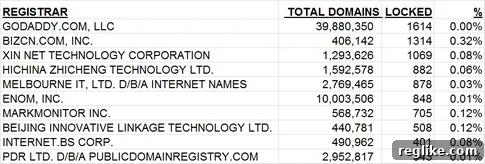
For instance, DomainTools’ data showed that 1,614 domains registered at GoDaddy had a Registry Lock during the collection period. However, at that time, GoDaddy did not even offer Registry Lock as a product to its customers. The vast majority of these GoDaddy domains showing a Registry Lock status were likely those caught in legal proceedings or seized by government entities. Examples include eCyclingOnline.com and Bike-Jersey.com, both of which were seized by the U.S. Government earlier that year and subsequently showed Registry Lock status.
This phenomenon also explains why registrars like BizCn.com, Xin Net Technology Corporation, and HiChina are listed among the top five domain registrars in terms of Registry Locked domain names. For some of these registrars, approximately 1 in 300 registered domains are locked at the registry level due to legal actions, such as seized domains like FanJerseyShop.com and NHLClubhouse.com. Consequently, the actual number of domains secured by legitimate, customer-requested Registry Lock for cybersecurity reasons is considerably lower than the initially reported 14,509.
The Alarming Trend: Major Websites Lagging in Domain Protection
The low overall adoption of Registry Lock is particularly concerning when examining the practices of the world’s largest and most influential websites. These are the digital storefronts and information hubs that attract millions of users daily, making them prime targets for cyber attackers.
High-Profile Vulnerabilities: Top Sites Without Registry Lock
A look at the Alexa Top 1,000 largest .com/.net websites revealed that only 92 had Registry Lock enabled during the data collection period. This means that over 90% of these prominent online destinations were operating without this critical defense. Astonishingly, popular global platforms such as Amazon.com, Microsoft’s Live.com, Tumblr.com, and Pinterest were all identified as lacking Registry Lock at the time of the data collection. While Amazon.com and Tumblr.com notably added Registry Lock after the NYTimes.com attack brought increased attention to the issue, their prior vulnerability highlights a systemic oversight.
Compounding this issue, some sites, like Pinterest, didn’t even have a basic Registrar Lock activated. Registrar Lock, a more common and less robust security feature than Registry Lock, prevents unauthorized domain transfers at the registrar level. With over 26 million websites worldwide lacking even this basic protection, the ease with which domains can be stolen becomes a major concern for individuals and businesses alike. The potential for widespread disruption and compromise grows exponentially when flagship websites remain inadequately protected.
Why the Hesitation? Exploring Barriers to Registry Lock Adoption
Given the clear benefits and relatively low cost of Registry Lock, its limited adoption, particularly among enterprise-level organizations, raises questions. Several factors contribute to this reluctance, spanning availability, awareness, and perceived operational drawbacks.
Availability Challenges
One primary reason for low adoption is the availability of the service itself. Rich Merdinger, Vice President of Domains at GoDaddy, noted that the company generally hadn’t considered Registry Lock an “appropriate fit for our primary customer segments,” implying a focus on small and medium-sized businesses rather than enterprise clients with higher security needs. However, the wake of the NYTimes.com compromise prompted a reevaluation, with GoDaddy reviewing the advantages and disadvantages of offering Registry Lock to its enterprise customers. This illustrates that while the service exists at the registry level, its accessibility through various registrars can be inconsistent, creating a barrier for businesses whose primary registrar doesn’t facilitate it.
The Awareness Gap
Perhaps the most significant impediment to wider Registry Lock adoption is a lack of awareness. Many domain owners, even those managing critical corporate assets, simply aren’t familiar with Registry Lock as a distinct and superior security measure compared to Registrar Lock. Until a high-profile incident like the NYTimes.com hack occurs, the perceived threat of a domain hijack might seem abstract or less critical than other cybersecurity concerns like malware or phishing. This gap in knowledge means that even well-resourced organizations may not allocate the necessary attention or budget to implement this vital protection.
Perceived Drawbacks: Flexibility vs. Security
While Registry Lock offers unparalleled security, it does introduce a degree of operational friction. As Merdinger pointed out, one of the perceived drawbacks is the inability to make quick changes to DNS records if a domain has Registry Lock enabled. The very security protocols that protect against unauthorized changes also slow down legitimate ones. In an emergency scenario where immediate DNS adjustments are required (e.g., switching to a backup server), the manual, multi-step verification process of Registry Lock can introduce delays. However, for most critical domains, such changes are infrequent and planned, making the security benefits far outweigh the minor inconvenience. Organizations can also establish clear, pre-defined procedures with their registry and registrar to streamline the legitimate change process, minimizing potential delays while maintaining high security.
Securing Your Digital Future: Recommendations and Outlook
The current state of Registry Lock adoption highlights a critical vulnerability in the global digital infrastructure. As cyber threats become more sophisticated and impactful, proactive domain security can no longer be an afterthought.
Best Practices for Domain Security
Implementing Registry Lock is a crucial step, but it should be part of a broader, holistic domain security strategy. Organizations should also:
- Enforce Strong Credentials: Utilize complex, unique passwords for all domain management accounts.
- Implement Multi-Factor Authentication (MFA): Mandate MFA for all registrar and registry access.
- Regularly Audit Domain Records: Periodically review WHOIS data, nameserver settings, and contact information for accuracy and unauthorized changes.
- Limit Access: Restrict domain management access to only essential personnel.
- Educate Staff: Ensure that all relevant teams understand the importance of domain security and the specific procedures for managing critical domains.
- Partner with Knowledgeable Registrars: Choose registrars that understand and support advanced security features like Registry Lock, and offer guidance on their implementation.
The Evolving Landscape: A Call to Action
The NYTimes.com hack served as a pivotal moment, increasing awareness about the power of Registry Lock. As organizations continue to digitize operations and reliance on online services grows, the impetus for robust domain protection will only intensify. I anticipate a significant increase in the adoption of Registry Lock in the coming years, driven not by government domain seizures, but by a clearer understanding among businesses of the tangible risks and the imperative to secure their most valuable digital assets. Proactive implementation today is not just a defense against future attacks; it’s an investment in business continuity and brand integrity in an increasingly hostile online world.