
Evaluating Domain Registrar Search for New TLDs: A Comprehensive Review
The introduction of new top-level domains (TLDs) has fundamentally altered the domain name landscape. While registrars are gradually adapting their search functionalities to accommodate these new options, the overall user experience remains inconsistent and often falls short of expectations. This article provides a detailed analysis of how major domain registrars are currently handling searches for new TLDs, highlighting areas of improvement and identifying those who are leading the charge.
Initially, the integration of new TLDs into registrar search engines was lacking, as discussed in our previous analysis. At that time, many registrars were unprepared for the influx of new domain extensions, resulting in frustrating experiences for users attempting to find and register these domains. However, as the market has matured and the number of registered new TLDs has grown significantly, registrars have been compelled to enhance their search capabilities.
This evaluation revisits the domain search functionality of several prominent registrars to assess the progress made in incorporating new TLDs. We examine the search accuracy, suggestion algorithms, and overall user experience to determine whether these registrars have effectively adapted to the evolving domain name ecosystem.
GoDaddy: Progress in Domain Search Suggestions
GoDaddy, one of the largest domain registrars, has demonstrated noticeable improvements in its search capabilities. Previously, GoDaddy’s search engine struggled to provide relevant suggestions or display new TLD options effectively. However, recent updates have enhanced its ability to generate contextually relevant domain name suggestions.
For instance, a search for “PlumbingGuru,” a domain name that was already registered with the .com extension, now yields pertinent alternatives that include new TLDs. The suggestions consider the search term and propose domain names that align with the user’s intent. While this is a step in the right direction, GoDaddy’s search functionality still has room for improvement.

One area where GoDaddy’s search engine falls short is its inability to “span the dot” effectively. For example, a search for “Fun Holdings” might suggest FunHoldings.holdings, but it fails to recognize and suggest the available domain fun.holdings. This limitation prevents users from discovering potentially valuable domain name combinations.
Additionally, GoDaddy’s search algorithm sometimes struggles with parsing words accurately to generate relevant domain suggestions. This challenge is not unique to new TLDs, as it has been a persistent issue in domain name search functionality. However, addressing this limitation is crucial for providing users with a comprehensive range of domain name options.
eNom: A More Advanced Approach
eNom appears to be ahead of some of its competitors in terms of integrating new TLDs into its domain search functionality. In the past, eNom’s search engine provided decent suggested alternatives, but the highlighted options at the top of the page seemed to be pre-programmed rather than contextually relevant. However, recent observations suggest that these top results are now more closely aligned with the search term.
This improvement indicates that eNom has made progress in refining its search algorithm to prioritize domain name suggestions that are relevant to the user’s query. By dynamically adjusting the highlighted options based on the search term, eNom provides a more personalized and efficient domain search experience.
1&1: A Mixed User Experience
1&1 (now Ionos) had initially struggled to effectively integrate new TLDs into its domain search functionality. Despite investing heavily in advertising and promoting new TLDs, the registrar made it difficult for customers to actually register these domains. Initially, searching for new TLDs in the main search box resulted in an “unsupported” message, forcing users to navigate to a separate new TLD page.
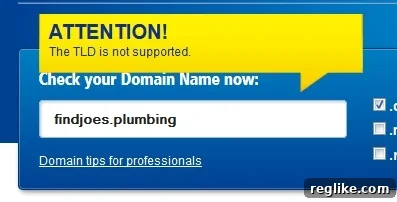
While 1&1 has since addressed this issue by allowing users to search for new TLDs in the main search box, the overall user experience remains inconsistent. For example, a search for “Baseballgame.guru” returns results that include suggestions for .mx domain names for Mexico, which may not be relevant to users in other regions.

Furthermore, 1&1’s search engine does not appear to be considering search terms when generating suggested domains. A search for “PlumbingGuru” or “FunHoldings” does not yield suggestions for .plumbing or .guru domains, respectively. This limitation hinders the discovery of relevant domain name options.
Another notable issue with 1&1’s domain search functionality is its inability to handle spaces in search queries. While domain search is increasingly moving towards supporting terms such as “Plumbing Guru,” 1&1 returns an error message when users search in this manner. This restriction limits the flexibility of the search engine and may frustrate users who are accustomed to using natural language queries.
Hover: Limited New TLD Suggestions
Hover’s domain search functionality appears to offer new TLD options only when users specifically search for them. For example, searching for “fun.holdings” will return results for that domain, but searching for “Fun holdings” does not suggest .holdings domain names. This limited approach restricts the discovery of new TLDs and may not effectively cater to users who are exploring domain name options.
Network Solutions/Register.com: Lagging Behind
Network Solutions and Register.com, both owned by Web.com, fall into the category of registrars that are not yet fully prepared for new TLDs. Similar to 1&1’s initial approach, the only way to register a new domain at these registrars is through a dedicated new TLD page. This cumbersome process suggests that these registrars were not adequately prepared for the arrival of new domain extensions.
Conclusion: The Ongoing Evolution of Domain Search
The integration of new TLDs into domain registrar search engines is an ongoing process. While some registrars have made significant progress in enhancing their search capabilities, others are lagging behind. The key areas for improvement include:
- Improved Search Accuracy: Registrars need to refine their search algorithms to ensure that relevant domain name suggestions are generated based on the user’s search term.
- “Spanning the Dot” Functionality: Search engines should be able to recognize and suggest domain name combinations that involve multiple terms separated by a dot.
- Natural Language Processing: Registrars should support natural language queries and allow users to search for domain names using terms with spaces.
- Seamless Integration: New TLDs should be seamlessly integrated into the main search box, without requiring users to navigate to separate pages.
As the domain name landscape continues to evolve, it is crucial for registrars to adapt their search functionalities to meet the changing needs of users. By prioritizing accuracy, relevance, and user experience, registrars can empower users to discover and register the perfect domain names for their online ventures.