
Wix Faces Slowdown as Post-Pandemic Digital Boom Cools Down
Wix, a leading cloud-based web development platform, recently announced a noticeable slowdown in its business operations, particularly observed during the latter half of the second quarter. This development has raised questions about the sustained momentum of the digital transformation wave that swept across industries during the height of the global pandemic.
The Digital Catalyst: How the Pandemic Accelerated Online Presence
For over a year, companies specializing in web presence services – including domain name registrars, web hosting providers, and site builders like Wix – experienced unprecedented growth. The global pandemic forced countless businesses, previously reliant on offline operations, to rapidly pivot towards digital models. This urgent shift necessitated the registration of new domain names, the creation of professional websites, and the integration of online payment systems and robust e-commerce capabilities. Consequently, the demand for user-friendly platforms that facilitated this digital migration surged, creating a boom for companies at the forefront of online enablement.
This period saw a profound acceleration in digital transformation across small and medium-sized businesses (SMBs) and even larger enterprises. Businesses that might have taken years to establish an online footprint were compelled to do so in a matter of weeks or months. Wix, with its intuitive drag-and-drop interface and comprehensive suite of tools, was perfectly positioned to capitalize on this urgent need, helping millions launch or expand their online operations and tap into the burgeoning e-commerce market.
Navigating Uncertainty: Wix CEO Addresses Shifting Tides
The crucial question now is whether this extraordinary period of rapid digital expansion is drawing to a close. The answer remains complex and largely dependent on the evolving global health situation. In its recent earnings announcement, WIX (NASDAQ: WIX) CEO Avishai Abrahami offered insights into the prevailing market sentiment:
As the story of the pandemic continues to evolve, there is an uncertainty whether we are at the end of it, or if there is a massive new wave coming again. For our users, this uncertainty means that they don’t know if they should create new online or offline stores, services and events. The result of this uncertainty, for us, is a mild slowdown in the creation of new web presences, which is reflected in our financials, where we came in at the low end of our expectations.
Abrahami’s statement highlights a critical shift in business owner psychology. The initial frantic rush to get online has given way to a more cautious, wait-and-see approach. This hesitation directly impacts the demand for new website creations, as businesses delay significant investments until there’s clearer visibility on future economic and social conditions. This uncertainty manifests as a “mild slowdown” for Wix, reflecting an environment where new online presences are being established at a less aggressive pace compared to the peak pandemic period.
Q2 Performance Under Scrutiny: A Deeper Look at the Slowdown
Wix CFO Lior Shemesh elaborated on the company’s performance, noting that while the second quarter of 2021 was indeed stronger than pre-pandemic quarters, a deceleration was evident, particularly in the latter half of the quarter. This slowdown in business activity prompted the company to lower its financial guidance for the remainder of the year, a move that sent immediate ripples through the market, with Wix shares experiencing a notable 15% drop on the morning of the announcement.
The timing of this slowdown is particularly telling. The second half of Q2, encompassing the months of May and June, coincided with a significant period of reopening in many parts of the world, especially in the United States. As vaccination rates increased and restrictions eased, businesses began to reopen their physical doors, and people resumed travel and in-person activities. This resurgence of offline economic activity appears to have subtly shifted focus and urgency away from the sole imperative of establishing a new online presence. While the long-term trend towards digitization remains intact, the immediate need for *new* web setups might have temporarily waned as businesses reallocate resources and attention to revitalizing their physical operations.
However, the emergence and spread of new variants, such as the Delta variant, introduce another layer of complexity. Should these variants significantly disrupt reopening plans and travel, the trend of slowing web presence growth could potentially reverse, pushing businesses back towards a heightened focus on digital resiliency. Despite these variables, the broader expectation is that as the world eventually moves past the acute phase of the pandemic, the extraordinary boom in new web presence creations will naturally stabilize and moderate. This observation is not unique to Wix; domain registrar Tucows reported a similar softening trend in its Q2 earnings, suggesting a broader industry-wide phenomenon rather than an isolated issue for Wix.
Financial Highlights: Q2 Results and Category Performance
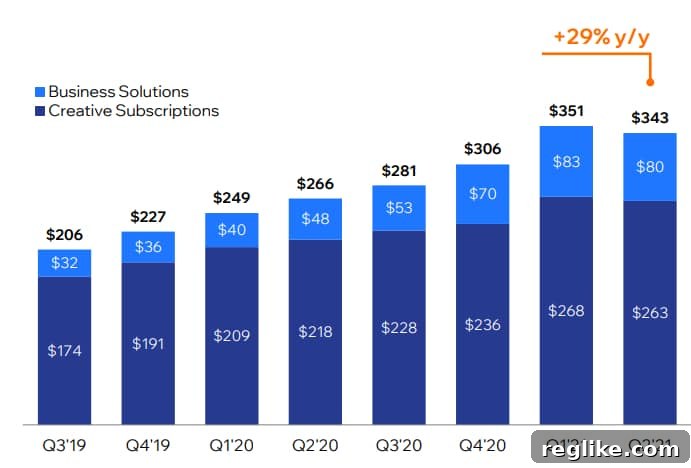
For the second quarter, Wix reported total revenue of $316.4 million, marking a robust 24% increase year-over-year. However, this figure fell short of the company’s guidance, which had projected revenue growth between 30% and 32%. Similarly, Q2 collections – representing the total cash collected from sales – reached $342.9 million, up 29% year-over-year, landing at the lower end of the anticipated range of 29% to 32%.
Wix strategically categorizes its revenue into two main segments: creative subscriptions and business solutions. Creative subscriptions primarily encompass the core website builder product, providing users with the tools and infrastructure to design and launch their sites. Business solutions, on the other hand, include a suite of valuable add-ons such as advanced communications tools, integrated payment processing services, and sophisticated marketing products. This segmentation allows for a clearer understanding of where growth is most pronounced within the company’s diverse offerings.
During the second quarter of 2021, collections from creative subscriptions amounted to $263.0 million, reflecting a solid 21% increase year-over-year. More impressively, business solutions collections soared to $79.8 million, demonstrating a remarkable 66% year-over-year growth. This disparity in growth rates suggests a significant trend: while the acquisition of new creative subscriptions might be moderating, existing users are increasingly investing in Wix’s higher-value business solutions. This indicates a deepening engagement with Wix’s ecosystem, as businesses seek to enhance their online capabilities beyond basic site functionality, opting for tools that drive sales, streamline operations, and boost marketing efforts.
Revised Outlook: Lowered Guidance for Q3 and Full Year
Looking ahead, Wix has adjusted its projections for the third quarter and the full fiscal year, reflecting a more conservative outlook on market conditions. For Q3, the company anticipates revenue between $311 million and $317 million, representing a year-over-year growth of 22% to 25%. Collections are expected to be in the range of $355 million to $365 million, indicating a 26% to 30% increase compared to the previous year.
The adjustments for the full year are more significant. Wix has lowered its full-year guidance across all key metrics. The revised revenue projection is now between $1.255 billion and $1.270 billion, a reduction from the earlier forecast of $1.280 billion to $1.290 billion. Full-year collections guidance has also been scaled back, moving from $1.44 billion to $1.46 billion down to a new range of $1.40 billion to $1.435 billion. Furthermore, the company now expects free cash flow, after accounting for its new headquarters buildout, to be significantly lower at $35 million to $40 million, a substantial decrease from the previously guided $62 million to $72 million. This significant reduction in free cash flow guidance highlights both the impact of slowing growth and the substantial capital expenditures related to its infrastructure investments.
Profitability and Strategic Reporting Changes
In terms of profitability, Wix reported a GAAP (Generally Accepted Accounting Principles) profit of $38 million for Q2. This profit was considerably bolstered by $110 million in unrealized gains from equity holdings, primarily attributed to its stake in Monday.com. However, on a non-GAAP basis, which excludes certain non-cash expenses and one-time gains, the company recorded a loss of ($15.8) million. This distinction is important for understanding the underlying operational performance separate from investment fluctuations.
Adding to the shifts in its reporting, Wix has ceased disclosing its total paid subscribers in its quarterly press releases this year. While companies may change reporting metrics for various strategic reasons, such a move can sometimes lead to speculation regarding the growth trajectory of its core user base. Investors and analysts often monitor subscriber numbers as a key indicator of platform adoption and market penetration, making this change a notable point of interest.