
Domain Name Search in the Age of New TLDs: A Registrar Comparison
The domain name landscape has changed dramatically with the introduction of numerous new Top-Level Domains (TLDs). This influx presents both opportunities and challenges for domain registrars, who must adapt their search functionalities to effectively guide users through the expanded selection. This article provides an in-depth look at how major domain registrars are handling domain search in the wake of these new TLDs, offering a comparative analysis of their approaches and effectiveness.
We’ve previously discussed the evolving state of registrar search as these companies grapple with the ongoing introduction of new TLDs. This article serves as an update, examining the progress made in making these new TLDs easily discoverable for end-users.
The good news for TLD registries is that domain search functionality is generally improving, making it easier for users to find relevant and available domain names across the diverse range of TLDs now available.
To illustrate the current state of domain search, we’ll revisit several registrars previously evaluated to observe the changes and enhancements they’ve implemented.
For the purposes of this analysis, we’ll use the search term “valleyview construction.” This phrase was chosen for several reasons: the second word, “construction,” directly corresponds to a new TLD; that new TLD has several similar alternatives (e.g., .build, .builders, .contractors); and the .com version of the domain name is already registered. This scenario provides a good test case for evaluating how well registrars handle searches that incorporate new TLDs and suggest relevant alternatives.
GoDaddy
GoDaddy, one of the largest domain registrars, continues to prioritize the .com extension by defaulting to it in search results. This approach aligns with the fact that many users are primarily seeking .com domain names.
In previous tests, GoDaddy was identifying TLDs related to the search topic but wasn’t effectively “spanning the dot.” This means that when searching for “Valleyview Construction,” the results would include suggestions like ValleyviewConstruction.construction but not Valleyview.Construction.
While ValleyviewConstruction.construction still appears as a prominent result, GoDaddy has improved by including the “spanning-the-dot” version, Valleyview.Construction, as the fourth result.
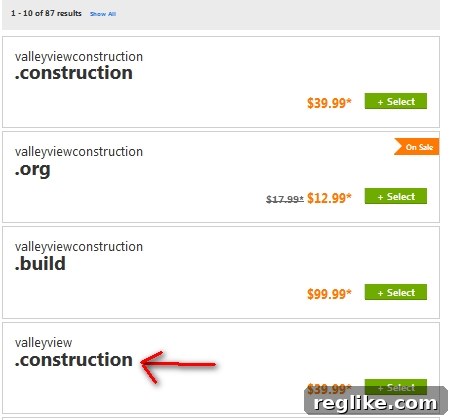
This improvement is a step in the right direction. While ValleyviewConstruction.construction might seem redundant, there’s an argument to be made for its relevance. The question remains whether companies are willing to embrace a domain name with a dot in the middle of their brand.
Alternatively, ValleyviewConstruction.build might be a more appealing option. This domain appears in slot 3 of the search results. Other suggestions include ValleyviewConstruction.contractors (slot 9) and ValleyviewConstruction.builders (slot 13).
Without access to GoDaddy’s internal data, it’s difficult to definitively assess the rationale behind these specific search results. GoDaddy holds a patent on an Adwords-style bidding system for new TLD search results, suggesting that the placement of .build (priced at $99) could be driven by higher conversion rates compared to domains with lower price tags (e.g., $39).
The inclusion of .org as a suggestion is logical, given that both .com and .net are already registered. Domain registrars also often prioritize certain domains based on marketing promotions, which could explain the prominence of .org, particularly if it’s currently on sale.
Here’s a breakdown of the TLDs appearing in the top 20 search results for “Valleyview Construction” on GoDaddy:
- .construction: 8
- .com: 3
- .org: 2
- .build: 1
- .builders: 1
- .contractors: 1
- .engineering: 1
- .guru: 1
- .watch: 1
- .productions: 1
Overall, these results are reasonably relevant. However, the .com suggestions are less compelling, often suggesting domains with similar words for “view” (e.g., valleylookconstruction). This indicates that the search system struggles to recognize that “Valleyview Construction” is likely a brand or geo domain, a challenge that is difficult to overcome.
In conclusion, GoDaddy is demonstrating continued improvement in its domain search functionality.
eNom
eNom was an early adopter of supporting new TLDs in its search results, which is understandable given its ownership by Rightside, a major new TLD applicant.
The top portion of the eNom search results page for “Valleyview Construction” displays the following:
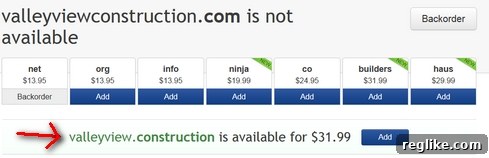
The prominent suggestion of Valleyview.construction directly below the “box” results is a positive sign, indicating that eNom understands the potential value of “spanning-the-dot” domain names.
Within the “boxes,” .ninja and .haus are featured due to their ownership by Rightside. The inclusion of .builders is also a good match, as it’s operated by Donuts, a partner company.
Scrolling further down the search page reveals more suggestions and premium (aftermarket) domain options:
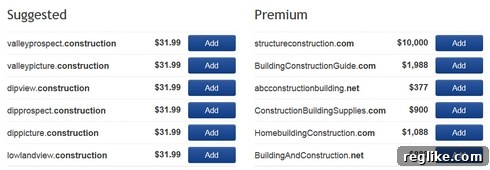
Initially, the suggestions primarily focus on .construction domains.
However, as you scroll down further, other relevant TLDs are introduced:
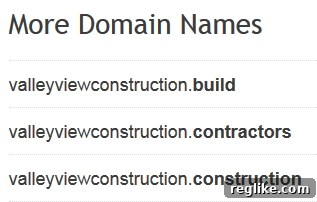
eNom demonstrates a strong understanding of new TLDs and their relevance to specific search terms.
1&1 (Now IONOS)
One notable limitation of 1&1 (now IONOS) is that the search box doesn’t allow spaces. While this makes sense from a strict domain name perspective (domains cannot contain spaces), modern registrars should treat the input as a general search query rather than a precise domain lookup. The search box should function as a “name spinner” that generates suggestions, not simply an exact-match tool.
1&1 also retains a dropdown box next to the search bar, which has become quite extensive due to the growing number of TLDs.
Here are the domain suggestions generated by 1&1 for the search term “Valleyview Construction”:
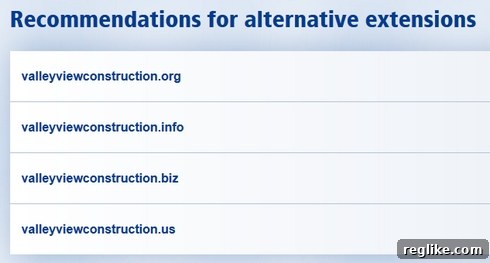
There are two potential explanations for these results: either 1&1 hasn’t yet integrated new TLD suggestions into its primary search results, or the company believes that offering familiar alternatives (like .com, .net, and .org) is more likely to result in a successful sale.
Hover
Hover provides an interesting progress bar during the domain search process:
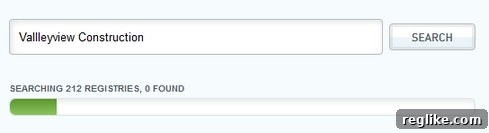
More significantly, Hover has adopted a unique approach to organizing search results. Instead of separating them into categories that are less meaningful to users (e.g., “regular TLDs” vs. “new TLDs”), Hover categorizes them based on relevance and intended use:
- “Domains About You”: .guru, .me, .expert, .actor, .democrat…
- “Domains with a Clear Purpose”: .tv, .pictures, .webcam, .recipes…
- “Domains For Businesses”: .bar, .consulting, .ventures…
- “Domains For Organizations”: .club, .university, .community…
- “Domains for Products or Services”: .construction, .build, .catering…
- “Domains for Shopping”: .cheap, .blackfriday, .luxury…
- “Domains with Attitude”: .cool, .fail, .buzz…
- “Non-English Domains”: .uno, .viajes, .futbol…
Hover also incorporates regional categories to further refine the search results.
This category-based approach is innovative. Hover doesn’t explicitly attempt to determine the meaning of the search term; instead, it guides users toward relevant categories based on potential use cases.
While the search term likely influences the results to some extent (e.g., .construction appearing as the first result under “Domains for Products and Services”), the primary focus is on categorization.
A combination of both approaches – analyzing the search term’s meaning (to prioritize .construction, .build, etc.) and using categories – could provide an optimal user experience.
Network Solutions/Register.com
Similar to 1&1, Network Solutions’ search function doesn’t allow spaces. This is surprising, considering that Network Solutions targets non-technical small and medium-sized businesses (SMBs), who would likely benefit from free-form search capabilities.
Once past this limitation, Network Solutions now displays new TLDs above traditional TLDs in the search results:
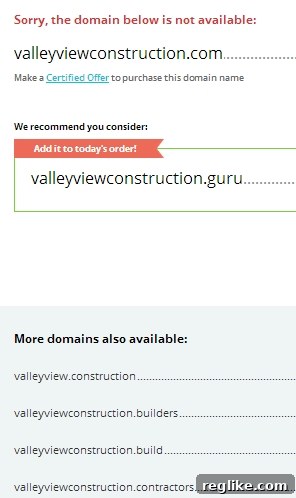
.org and .info appear at the bottom of the list, indicating a deliberate prioritization of new TLDs.
Conclusion
This overview provides a snapshot of how some of the leading domain registrars are adapting their domain name search functionalities to accommodate the proliferation of new TLDs. While each registrar employs a different approach, the overall trend is toward improved support for new TLDs and more relevant search results. Registrars are increasingly recognizing the importance of guiding users through the expanded domain name landscape and helping them discover the right domain name for their needs.
The future of domain name search will likely involve further refinements in search algorithms, improved categorization of TLDs, and more personalized recommendations based on user intent. As the domain name ecosystem continues to evolve, registrars that prioritize user experience and adapt to the changing landscape will be best positioned to succeed.