
Epik Retracts Statement Regarding Child Sexual Abuse Material on Kiwi Farms Website
In a significant development, domain name registrar Epik has publicly retracted a previous statement concerning the presence of child sexual abuse material (CSAM) on the controversial website, Kiwi Farms. This retraction follows Epik’s decision to remove Kiwi Farms from its services in December of the previous year, a move that sparked considerable debate and scrutiny.
The initial statement, released shortly after the removal of Kiwi Farms, asserted that Epik had received a complaint alleging the existence of underage pornography on the website. This claim, amplified through various media outlets, added fuel to the already contentious discussions surrounding Kiwi Farms and its content moderation policies.
However, the operator of Kiwi Farms vehemently denied the accusations, asserting that the individual depicted in the photos in question was, in fact, 19 years old. Furthermore, the operator threatened legal action against Epik for disseminating what they considered to be a false and defamatory statement.
In response to these challenges and potential legal ramifications, Epik has taken steps to mitigate the situation. The company has deleted the original tweet containing the allegation, along with several other related tweets that addressed the issue. This action signals a clear attempt to distance itself from the controversial claim and to rectify any potential damage caused by its initial statement.
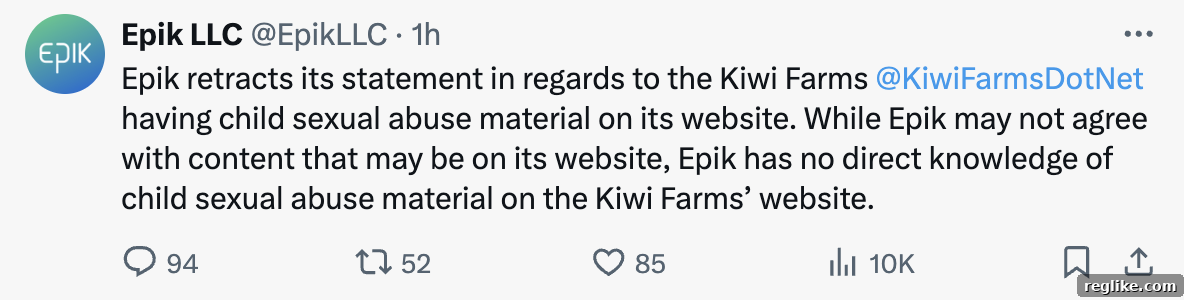
The retraction was formally announced through a recent tweet from Epik’s official Twitter account, now known as X. The tweet explicitly stated: “Epik retracts its statement in regards to the Kiwi Farms having child sexual abuse material on its website. While Epik may not agree with content that may be on its website, Epik has no direct knowledge of child sexual abuse material on the Kiwi Farms’ website.”
This carefully worded statement represents a significant shift in Epik’s stance on the matter. While the company maintains its disapproval of certain content that may appear on Kiwi Farms, it explicitly acknowledges that it possesses no direct evidence or knowledge of CSAM being hosted on the website. This distinction is crucial, as it avoids making any explicit accusations while still allowing Epik to express its concerns regarding the nature of the content hosted on the platform.
The controversy surrounding Kiwi Farms and Epik’s involvement highlights the complex challenges faced by domain registrars and other internet service providers in moderating content and addressing allegations of illegal or harmful material. Balancing freedom of speech with the responsibility to protect vulnerable individuals, particularly children, requires a delicate and nuanced approach.
This situation also underscores the importance of verifying information and exercising caution when making public statements, especially in cases involving sensitive and potentially damaging allegations. The legal and reputational consequences of spreading misinformation can be significant, as Epik has learned in this instance.
The retraction comes at a time of significant change for Epik. The company was acquired last year by Registered Agents Inc., a business formation company, after experiencing financial difficulties. This acquisition raises questions about the future direction of Epik and its content moderation policies.
It remains to be seen how this retraction will impact the ongoing debate surrounding Kiwi Farms and its content. The website has been criticized for hosting hate speech, harassment, and doxing, and has been linked to several instances of real-world harm. Despite these concerns, Kiwi Farms continues to operate, albeit under increased scrutiny.
The case of Epik and Kiwi Farms serves as a reminder of the challenges inherent in regulating online content and the importance of responsible communication. As the internet continues to evolve, it is crucial for internet service providers, website operators, and individuals to engage in thoughtful and informed discussions about content moderation, freedom of speech, and the protection of vulnerable individuals.
The incident also highlights the power of public pressure and the potential for legal action to influence corporate behavior. The threat of a lawsuit from the operator of Kiwi Farms, coupled with public scrutiny of Epik’s initial statement, likely played a significant role in the company’s decision to retract its claims.
Furthermore, this situation underscores the importance of transparency and accountability in the online world. When allegations of illegal or harmful content are made, it is crucial for internet service providers to investigate these claims thoroughly and to communicate their findings to the public in a clear and transparent manner. Failure to do so can erode trust and damage the reputation of the company involved.
In conclusion, Epik’s retraction of its statement regarding CSAM on Kiwi Farms represents a significant development in a complex and ongoing debate. The incident highlights the challenges of content moderation, the importance of responsible communication, and the power of public pressure in shaping corporate behavior. As the internet continues to evolve, it is essential for all stakeholders to engage in thoughtful and informed discussions about these issues in order to create a safer and more responsible online environment.
The long-term ramifications of this retraction are yet to be fully understood. It is possible that Epik will face further scrutiny from both sides of the debate – those who believe the company should have taken a stronger stance against Kiwi Farms and those who feel the initial statement was unjustified. Only time will tell how this situation will ultimately unfold.
Finally, this case emphasizes the need for robust legal frameworks to address online content moderation. Clear guidelines and regulations are necessary to protect both freedom of speech and the safety of individuals, particularly children. Without such frameworks, internet service providers are left to navigate these complex issues on their own, often with unpredictable and unsatisfactory results.