
GoDaddy Closeout Auctions: A New Era Kicks Off with $50 Starting Bids
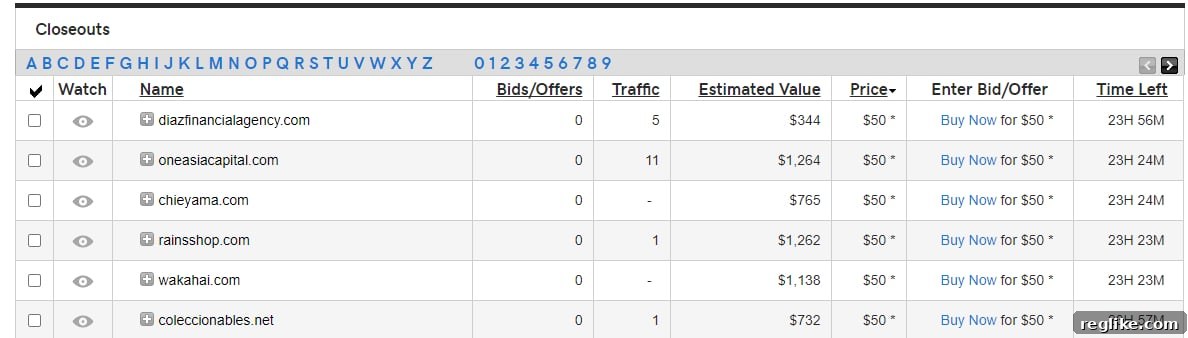
The landscape of domain name investing is ever-evolving, and February has brought a notable shift from one of the industry’s giants. GoDaddy, a leading domain registrar and auction platform, has officially revamped its pricing structure for closeout domain name auctions. This change is not merely an adjustment; it represents a significant strategic move that could redefine how investors acquire expired domains, with the new starting price now set at a bold $50.
For years, domain investors, from seasoned professionals to eager newcomers, have relied on GoDaddy’s closeout auctions as a crucial source for acquiring valuable expired domain names. These auctions historically presented an opportunity to snag potentially high-value domains at incredibly low prices, often starting at $11 and dropping to a mere $5. However, the recent announcement introduces a radically different model, prompting both excitement and skepticism within the domain community. This article delves into the intricacies of this new pricing system, exploring its rationale, potential impacts, and strategies for navigating the updated auction environment.
Understanding GoDaddy Closeout Auctions: The Gateway to Expired Domains
Before diving into the new pricing, it’s essential to understand the mechanism of GoDaddy closeout auctions. These auctions are the final stage for domain names that have expired and gone unclaimed through the standard expiry and grace periods. When a domain name is not renewed by its original owner, it typically enters a “pending delete” status. Before outright deletion, GoDaddy offers these domains through various auction formats.
The Journey of an Expired Domain
The lifecycle of a domain name that reaches a closeout auction is quite specific:
- Expiration: The domain’s registration period ends.
- Renewal Grace Period: A window (usually 30-45 days) where the original owner can renew the domain, often with a late fee.
- Registrar Hold/Redemption Period: If not renewed, the domain may enter a redemption grace period, where it can still be recovered at a higher cost.
- Auction Phase (GoDaddy): If the domain remains unrenewed, GoDaddy often lists it in its regular auctions. These are competitive bidding processes where the highest bidder wins.
- Closeout Auction: If a domain in the regular auction receives no bids, or fails to meet a reserve price, it then transitions to the closeout auction phase. This is where the Dutch auction model comes into play.
The Mechanics of a Dutch Auction
A Dutch auction, in the context of GoDaddy closeouts, operates on a descending price model. Unlike a traditional auction where bids increase, in a Dutch auction, the price starts high and gradually decreases over time until a bidder decides to purchase the item at the current asking price. The first person to accept the price wins the domain. This system is designed to sell items quickly, with buyers having to weigh the risk of waiting for a lower price against the possibility of another buyer snatching up the domain.
Previously, this Dutch auction began at $11 and dropped by $1 each day until it reached $5. This model often created a frenetic rush for desirable domains as prices hit their lowest points, favoring those with quick reflexes, automated tools, or simply good luck.
The Old Pricing Structure: A Look Back at $11 to $5
For many years, the GoDaddy closeout auction structure was a predictable and often lucrative hunting ground for domain investors. Domains would enter closeouts at a starting price of $11. Each subsequent day, if the domain remained unsold, its price would decrement by $1, continuing until it reached its minimum price of $5. This system was beloved by many for several reasons:
- Accessibility: The low starting price made it easy for almost anyone to participate.
- Bargain Potential: Many valuable domains could be acquired for as little as $5, providing significant ROI for flippers or long-term investors.
- Predictability: The daily price drop allowed buyers to strategize, deciding whether to jump in early or wait for the bottom.
However, this system also had its drawbacks. The fierce competition, especially at the $5 and $11 price points, meant that highly desirable domains were often snapped up instantly, sometimes by automated bots or sophisticated tools wielded by professional domainers. This made it challenging for individual buyers without such resources to secure premium names, fostering an environment where speed and automation often trumped value assessment.
Unveiling the New GoDaddy Closeout Pricing: $50 and Beyond
The new pricing model, which became effective in February, represents a seismic shift. Instead of the previous $11 starting point, GoDaddy closeout auctions now commence at a significantly higher $50. The price will then follow a distinct tiered drop system:
- Day 1: $50
- Day 2: $40
- Day 3: $30
- Day 4: $11
- Day 5+: $5 (and subsequent days if still available)
This staggered drop is a stark departure from the uniform $1 daily decrement. It creates clear breakpoints where the perceived value of a domain might intersect with a buyer’s willingness to pay. Furthermore, it’s crucial for buyers to remember that in addition to the auction price, they are also responsible for the domain’s renewal fee. This fee, typically around $20-$25 for a .com, adds a significant amount to the total cost of acquisition, making even a $5 domain effectively cost $25-$30 from the outset.
Rationale Behind the Change: Capturing True Value and Shifting Dynamics
GoDaddy’s decision to implement this new pricing structure is likely driven by several strategic considerations, primarily aimed at better capturing the inherent value of expired domains and potentially leveling the playing field, at least in theory.
Capturing True Domain Value
Many expired domains possess significant inherent value due to factors such as:
- Strong Keywords: Domains containing high-search-volume keywords.
- Backlink Profile: Domains with established backlinks from reputable sites, offering SEO advantages.
- Brandability: Short, memorable, and brandable names.
- Traffic History: Domains that previously hosted active websites and still receive direct navigation traffic.
Under the old system, a domain with immense potential might still have sold for $5. This left a considerable amount of “money on the table” for GoDaddy. The new $50 starting price attempts to align the initial cost more closely with the potential market value of desirable expired domains, ensuring that GoDaddy captures a larger share of that value.
Discouraging Early Bidding in Regular Auctions and Promoting Early Closeout Purchases
One prevalent strategy among experienced domain investors in regular GoDaddy auctions was to avoid bidding early. Placing a bid often attracts attention from other potential buyers, leading to competitive bidding wars. By waiting until the last minute, or hoping the domain would go to closeout, investors aimed to secure names without driving up the price prematurely.
The new closeout pricing might indirectly encourage buyers to participate earlier in the closeout phase for high-value domains. If a buyer truly wants a domain, paying $50 or $40 might be perceived as a small premium to guarantee acquisition, rather than risking losing it to competition if they wait for the price to drop further. This shift could streamline the auction process and ensure quicker sales at higher price points for GoDaddy.
Leveling the Playing Field (In Theory)
Another theoretical benefit of the new system is the potential to create a more equitable environment for individual buyers. Under the old $11-$5 system, bulk buyers and professional domainers often had an edge due to:
- API Access: Automated systems that could monitor auctions and bid instantly when prices hit a desired threshold.
- Development Resources: Custom scripts and bots designed to snatch domains faster than any human.
The higher starting price might encourage these sophisticated buyers to wait for the prices to drop to more familiar levels ($11 or $5). If they do, it could open a window for individual buyers to secure valuable domains at $30 or $40, prices that might still be considered a bargain for a truly premium name, without immediately facing off against automated systems. However, this is a speculative outcome and largely depends on how buyer behavior adapts.
Skepticism and Potential Challenges: Will Behavior Truly Change?
While GoDaddy’s intentions might be to optimize value capture and potentially democratize access, the domain investing community harbors a healthy dose of skepticism regarding the actual impact on buyer behavior. As shared in a Domain Name Wire Live Clubhouse chat, industry veteran Shane Cultra expressed doubts, stating that he doesn’t believe the change will fundamentally alter buying patterns. He posited that “the same people who buy at $11 will now buy at $50.”
Buyer Behavior Inertia and FOMO
Cultra’s perspective highlights a crucial aspect of domain investing: the perceived value and the fear of missing out (FOMO). If a professional domainer identifies a truly valuable expired domain, the difference between paying $11 and $50 might be negligible in the grand scheme of potential returns. For high-quality names, investors might be more willing to pay a premium upfront to secure them, rather than risk waiting for a lower price and losing the domain to another buyer.
Experienced buyers understand that a unique, keyword-rich, or brandable domain can easily be worth hundreds or even thousands of dollars on the secondary market. In such cases, an extra $39 (the difference between $11 and $50) is a small price to pay for a guaranteed acquisition. This inertia in buyer behavior, driven by a deep understanding of domain value and market dynamics, could mean that the most desirable domains will continue to be snapped up quickly, albeit at a higher initial cost.
Impact on Different Buyer Segments
- Professional Domainers: These buyers, often equipped with advanced tools and deep market knowledge, are likely to adapt quickly. They will re-evaluate their profit margins and may continue to acquire premium domains at the higher price points if the ROI justifies it.
- Casual Buyers/Flippers: Individuals looking for cheap bargains to flip might find the new $50 entry point, plus renewal fees, less appealing. This could reduce the pool of speculative buyers at the higher price tiers, potentially increasing competition at the $11 and $5 levels if the professional buyers decide to wait.
- End-Users: Businesses or individuals looking for specific expired domains for personal or business use might be more willing to pay the $50 or $40 if the domain perfectly fits their needs, as they are less focused on immediate resale profit.
The Enduring Role of Automation and APIs
While the new pricing theoretically aims to reduce the advantage of automated systems, it’s unlikely to eliminate it entirely. Buyers with API access and sophisticated bots can still be programmed to monitor and acquire domains at any desired price point, whether it’s $50 or $5. Their speed and efficiency will remain a significant factor in competitive closeouts, regardless of the starting price.
Strategies for Navigating the New GoDaddy Closeout System
With this significant change, domain investors must re-evaluate their strategies. Success in the new closeout environment will require a blend of smart valuation, strategic timing, and a clear understanding of personal risk tolerance.
1. Enhanced Domain Valuation
The higher entry cost means that every domain acquired needs more scrutiny. Thorough research is paramount:
- Backlink Analysis: Use tools like Ahrefs or Semrush to check the quality and quantity of backlinks.
- Traffic History: Investigate past traffic, if any, and current search volume for keywords.
- Brandability & Memorability: Assess the domain’s potential as a brand or its ease of recall.
- Comparable Sales: Research what similar domains have sold for on the secondary market.
Only bid on domains where the potential value clearly justifies the initial $50+ renewal cost.
2. Budgeting and Cost Analysis
Remember to factor in the renewal fee immediately. A $50 domain effectively costs ~$70-75 (including the renewal). This total cost must fit within your budget and allow for a healthy profit margin if you intend to flip the domain.
3. Strategic Timing of Bids (The New Game Theory)
The tiered price drops create new decision points:
- Bid at $50 or $40: Consider this for extremely high-value, must-have domains where the risk of losing them at lower prices is unacceptable. This is akin to paying a premium for certainty.
- Bid at $30: This might be the “sweet spot” for many good-to-excellent domains. It’s significantly cheaper than $50 but still ahead of the traditional $11 and $5 frenzy. This could be where individual buyers find less automated competition.
- Bid at $11 or $5: These levels will likely remain highly competitive, especially for any remaining quality domains. Be prepared for instant acquisitions and consider these for bulk buying or highly speculative names.
4. Leveraging GoDaddy’s Tools
Utilize GoDaddy’s watchlists and filtering options to monitor specific domains. While API access isn’t available to everyone, careful manual monitoring can still be effective if you’re targeting a select few names.
Broader Implications for the Domain Market
GoDaddy’s move could have ripple effects across the entire domain aftermarket. Other registrars offering expired domain services might observe GoDaddy’s success (or lack thereof) with the new model and adjust their own pricing strategies accordingly. This could lead to a general increase in the baseline cost of acquiring expired domains, pushing investors to be more analytical and less speculative in their purchases.
The shift also highlights the increasing maturity and professionalization of the domain investing industry. As registrars recognize the value inherent in expired assets, they are naturally seeking to monetize that value more effectively. This means that “free money” opportunities become rarer, and success increasingly depends on sophisticated valuation, strategic bidding, and an in-depth understanding of market trends.
Conclusion: Only Time Will Tell
GoDaddy’s new closeout auction pricing beginning at $50 marks a significant moment for the domain investing community. It’s a bold move aimed at better capturing the intrinsic value of expired domains and potentially influencing buyer behavior, even if skeptics like Shane Cultra believe the fundamental patterns will persist.
Whether this change truly levels the playing field for individual buyers, significantly increases GoDaddy’s revenue from closeouts, or simply shifts the price points at which the most desirable domains are acquired, remains to be seen. The coming months will provide crucial insights into how the market adapts to this new reality. For now, domain investors are tasked with understanding the new rules, adjusting their strategies, and keeping a keen eye on the evolving dynamics of the GoDaddy closeout auctions. Adaptability and shrewd decision-making will be key to success in this new era.