
Exposing Shill Bidding on Flippa: A Deep Dive into Auction Integrity and Fair Play
 In the bustling world of online domain and website auctions, transparency and trust are paramount. Yet, buyers often wonder if they’re truly getting a fair deal. Are you potentially overpaying for that coveted domain name at auction? The unsettling truth is that some online marketplaces have historically struggled with practices designed to artificially inflate prices, most notably through shill bidding. Joseph Peterson’s investigation delves into this contentious issue, particularly focusing on the prominent platform, Flippa, and the audacious operations that have undermined its integrity.
The Brazen Operation of FlippaBid.com: A Case Study in Auction Fraud
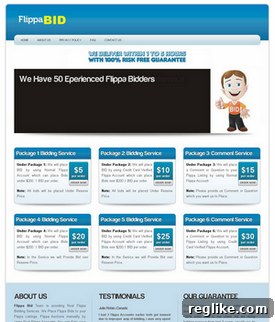
The year 2014 brought to light a particularly egregious example of auction manipulation. A website explicitly dedicated to offering shill services for Flippa auctions, FlippaBid.com, operated openly, making it possible to purchase fake bids and endorsements. This brazenness surprised even seasoned observers familiar with “buddy bidding” or suspicions of hidden shill networks. The sheer audacity and longevity of this operation were truly remarkable.
Peterson first learned of FlippaBid.com on December 16, and by December 19, the site had vanished, presumably shut down due to complaints. However, evidence preserved by DomainTools.com, including a screenshot from March 17, 2014, revealed that FlippaBid.com had been active for at least nine months prior to its disappearance. You can view a glimpse of FlippaBid.com in action here.
The website itself displayed a professional design, indicating a commercially viable operation. It even claimed to have been providing “bidding services” for three years, dating its inception back to approximately March 2011. This suggests that the practice of placing fake bids and comments likely preceded the formal establishment of their website, highlighting a long-standing issue.
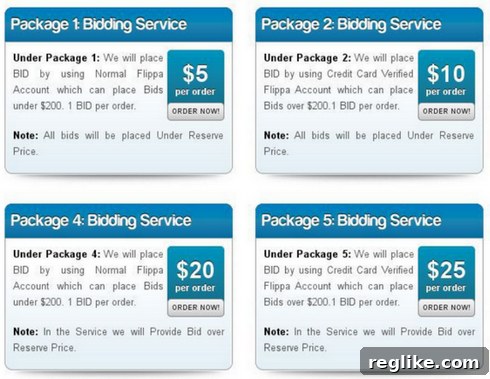
FlippaBid.com’s service menu was alarmingly straightforward. For a mere $5, one could buy a fake bid below the reserve price. A $10 payment secured bogus bids above $200, placed using a credit card-verified Flippa account. To ignite a bidding war *above* the reserve, bids cost between $20 and $25, depending on the desired bidder credentials. The site offered a total of six service packages, including endorsements in the comments section of Flippa listings, further demonstrating the comprehensive nature of their deceptive offerings.
FlippaBid.com openly boasted about the scale of its operations:
We Have 50 Eperienced Flippa Bidders [sic]
Their blog post titles underscored a focus on client security and privacy, albeit for illicit activities:
Your Safety and Secrecy is our first Preference
They even presented a veneer of professionalism with guarantees:
We deliver within 1-5 hours with 100% risk free guarantee
Beyond offering refunds if a shill bidder was caught, FlippaBid.com adorned its site with testimonials and facilitated multiple payment options, creating a seemingly legitimate façade for their fraudulent services. While FlippaBid.com stood out for its dedicated platform, similar “bidding services” were also openly offered on other gig economy sites like Fiverr, underscoring a wider industry problem.
The Pervasive Challenge of Shill Bidding on Flippa
Flippa.com, a prominent auction platform for digital assets, has faced consistent criticism regarding its vulnerability to shill bidding. This manipulative practice takes various forms, each designed to deceive potential buyers and inflate perceived value:
- Phantom Bids Near Reserve: High bids that strategically stop just short of the reserve price, incurring no obligation to pay but creating an illusion of demand.
- Early and Frequent Bidding: A pattern of rapid bids, often from new or less active accounts, which dramatically increases an auction’s visibility and “activity” ranking on the platform.
- Fervent Endorsement Comments: A “parade” of enthusiastic comments from various individuals, many of whom are later banned or suspended, endorsing the listed item.
While Flippa explicitly states that shill bidding “is strictly forbidden on Flippa,” the persistence of these issues raises questions about enforcement and detection. Kevin Fink, Flippa’s Director of Domains, has commendably stated that Flippa has suspended and severed ties with some of its most successful and profitable sellers due to such practices. However, when accounts are quietly closed, past fraudulent bids that inflated prices and overshadowed legitimate listings often remain unaddressed. This discreet approach means the larger, systemic issue of ongoing shill bidding continues to cast a shadow over the marketplace.
Understanding Flippa’s Vulnerability to Artificial Bidding
A key question arises: why does Flippa seem to attract shill bidders, “buddy bidding,” and potentially fake comments more readily than some other platforms? The answer may lie in its economic model and seller incentives.
Unlike many domain auction platforms, Flippa charges a base listing fee and heavily promotes expensive upgrades, some costing as much as $349 per auction. Standard listings have become less prominent, pushing sellers towards these costly enhancements for visibility. While some top sellers receive these $349 upgrades for free and enjoy promotional email inclusion, the majority face considerable pressure to compete for exposure.
This situation leaves sellers with a difficult choice for boosting visibility: pay for expensive official upgrades or generate artificial bids. Since legitimate buyers often prefer to wait until the last moment to “snipe” auctions or negotiate post-auction, even attractive listings might not receive bids until their window for extra exposure has closed. This creates a strong temptation for sellers to solicit bids from friends or even purchase them through illicit services, perceiving it as a more cost-effective way to gain attention and drive interest.
Consider the stark contrast: a legitimate “Home Page Listing” upgrade on Flippa costs $49 for a few hours of exposure. In contrast, a mere $5 spent on FlippaBid.com could secure a $200 bid, visible for a full 30 days and permanently archived as a sign of “buyer” interest. This same $50 could buy 10 bids from 10 unique bidders, all reaching up to $200, or 5 bids from 5 distinct bidders for any desired amount, even astronomical figures like $266,000!
At the time of this article’s original writing, only 8 auctions on Flippa had 20 or more bids. This meant that $100 spent on FlippaBid.com could theoretically keep a listing in the top 8 “Most Active” auctions for an entire month. Why pay $349 for official Flippa upgrades (such as a logo or a single tweet promotion) when the same amount could buy enough artificial bids to maintain a listing’s top position for 30 days? This economic disparity highlights a significant structural incentive for fraudulent activity.
Flippa’s Transparency and Verification Challenges
To Flippa’s credit, some steps have been taken to improve marketplace transparency. Users can now view a bidder’s transaction history on the platform, and commenters who are removed from the system are clearly marked as “banned.” However, these measures have limitations.
Without bidder aliases, it remains challenging to connect patterns of suspicious activity across different auctions. Furthermore, verification processes still appear weak. Only phone verification is required for comments, which can be easily circumvented using services like Google Voice. While a credit card pre-authorization is needed for bids above $200, this alone isn’t a sufficient deterrent for determined shills. GoDaddy Auctions, recognizing this, recently implemented additional verification requirements for significant bids, implicitly acknowledging the inadequacy of basic credit card checks.
Pathways to a More Secure and Trustworthy Marketplace
One crucial step Flippa could take to combat shill bidding is to assign unique bidder aliases to each participant, similar to the system used by NameJet. This would significantly enhance transparency, allowing the community and Flippa’s integrity team to more easily identify patterns and suspicious behavior, thereby restoring trust among legitimate buyers.
The unfortunate reality is that, in the short term, online marketplaces can sometimes benefit from shill bidding. Fake bids inflate final sale prices, creating a false impression of a vibrant, high-demand market. This perceived activity, in turn, can lead to increased revenue from seller listing fees, particularly if sellers are steered towards lucrative upgrades. Thus, fake bids can directly boost profits. Until public pressure and the regulatory landscape evolve to a point where the cost of neglecting shill bidding far outweighs the perceived benefits, the motivation for auction platforms to invest heavily in eradicating internal manipulation remains limited. However, the industry appears to be approaching a critical “tipping point,” suggesting that greater accountability may be on the horizon, not just for Flippa but for online marketplaces across the board.
Flippa’s Official Response: A Commitment to Change
Prior to the publication of this article, Domain Name Wire posed several critical questions to Flippa. Kevin Fink, Director of Domains at Flippa, provided insightful responses, outlining the company’s perspective and ongoing efforts. You can reach him at domains (at) flippa.com.
DNW: When did Flippa become aware of FlippaBid.com and what actions did it take to shut it down?
Fink: “Due to the legal component involved in the shutdown of FlippaBid, I’m unable to comment further than to simply say — Our team cracks down on these individuals and sites, on the daily, including sellers on gig-related sites that push this kind of service. It hurts everyone involved, and we’re keen on hammering out ways we can eradicate this sort of behavior entirely. Is it possible? I’m not sure; otherwise an auction space would have figured it out by now, but I will address what we are going to do about this — and other verification / security measures — in this space, and in future posts to come.”
DNW: Do you believe that the way Flippa highlights “popular” domains or sites incents people to request friends/others to place below reserve bids or post comments?
Fink: “No more or less than any other outlet. All auctions are subject to this kind of behavior, and everywhere you look. What matters most to me and my day-to-day, is how we’re handling it on our end and what more we can do. How can Flippa become the most secure and trusted auction-based marketplace? We’ve made great strides; I do appreciate Joseph acknowledging that things have improved, and rightfully so. While this doesn’t dissuade our detractors and skeptics, the focus is now on upcoming changes we are aiming to implement en route to further fighting and hopefully eradicating this kind of behavior entirely.”
DNW: What concrete steps has Flippa taken to cut down on shill bidding and fake comments?
Fink: “As for fake comments, we’ve implemented a system that not only mutes these (so only sellers’ comments are broadcast out via email), but we are fairly active in warning, suspending and – yes – banning those that blanket self promotional comments across listings. I have personally witnessed this activity, in particular, drop tremendously. We’ve also seen erroneous bids and deadbeat buyers dwindle considerably, and have been able to spot more duplicate accounts (and potential or actual shill bidders) than ever before throughout Flippa’s history. This is a joint-effort between our Marketplace Integrity and Customer Success departments, as well as automated checks in place to find and root-out fake accounts, fake bidders and fake buyers. We spot the vast majority of erroneous activity through this coordinated effort, and rely on eyeballs of the rest of our staff and active members of our community to report suspicious behavior, which we investigate and act upon individually.”
DNW: Has Flippa considered showing bidder aliases rather than “bidder 1” and “bidder 2” as a way to cut down on shill bidding?
Fink: “First, yes — bidder aliases are something I feel would make tremendous sense to implement. We’re also crafting some major improvements to bidder / buyer verification; more information to follow, but I would like to see these shifts rollout altogether. I do want to state one thing about our current bidding structure, in that there’s a massive misconception that — let’s use “Bidder 1” as an example — subsequent bids from this bidder are considered shill bidding. Rather, this could be a couple of things that often are not spoken of: first, it could be a legitimate buyer testing the reserve range. Second, it could be an automatically “upped” bid due to the high bidder’s proxy, and the way by which our system displays the order of bids. I appreciate Andrew including me in this dialogue, and the opportunity we have — with our members and the audience reading this — to continually improve our marketplace. Please be in contact with us at any time to offer feedback, suggestions or product requests.”
The Road Ahead for Fair Online Auctions
Joseph Peterson’s in-depth exploration, coupled with Flippa’s candid responses, paints a comprehensive picture of the challenges and ongoing efforts to combat shill bidding. While Flippa has made strides in enhancing marketplace integrity through improved detection systems and enforcement actions, the pursuit of a truly transparent and fair auction environment is an continuous journey. The implementation of clearer bidder identities, robust verification processes, and a sustained commitment to addressing the underlying economic incentives for fraud will be crucial. Ultimately, fostering a marketplace where legitimate buyers and sellers can transact with full confidence benefits everyone involved, strengthening the entire ecosystem of online digital asset trading.